The Schwarzschild radius is the critical radius of a sphere around a mass such that, if all that mass were compressed within it, the escape velocity at the surface would equal the speed of light. For any object, this defines the size of the event horizon of a non-rotating black hole: nothing, not even light, can escape from within this radius. It is a purely geometric quantity, proportional to the mass, and for the Sun it is about 3 kilometers, while for Earth it is about 9 millimeters.
History
Karl Schwarzschild derived the solution in 1916, just months after Einstein published general relativity, while serving on the Russian front in World War I. The concept of an object so dense that light cannot escape had been speculated earlier by John Michell (1783) and Pierre-Simon Laplace (1796), but Schwarzschild's work placed it on a rigorous relativistic footing.
How it works
The Schwarzschild radius arises from the exact solution to Einstein's field equations for a spherically symmetric, non-rotating mass, derived by Karl Schwarzschild in 1916. In general relativity, mass curves spacetime, and at the Schwarzschild radius the curvature becomes so extreme that all future-directed light cones point inward. For a non-rotating black hole, the event horizon is precisely this radius; for rotating black holes, the horizon is smaller and the geometry is more complex, but the Schwarzschild radius still sets the characteristic scale.
In practice
The Schwarzschild radius is used to estimate the size of black holes from their mass, to interpret observations of black hole shadows (as in the Event Horizon Telescope images), and to calibrate dynamical mass measurements of black holes in galaxies.
Fun fact
If you compressed the entire Earth to the size of a marble, it would become a black hole with a Schwarzschild radius of about 9 millimeters.
A dance floor where couples whirl. At the center, an invisible master of ceremonies sets the rhythm. This is the supermassive black hole at the heart of the Milky Way, and the couples are stars whose orbits astronomers have tracked for years. But what if the master himself is wrapped in a fluffy fur coat of tenuous matter?
A black hole isn't just a cosmic vacuum cleaner. If it rotates, it can amplify waves around it, much like a mountain echo repeats sound. For ultralight dark matter (particles billions of times lighter than an electron), this effect, called superradiance, can create a huge cloud.
You could send a short radio pulse toward a black hole and wait for the reflected echo. Intuitively, the shorter the signal, the better it would probe the finest details of spacetime right at the horizon: that region from which even light cannot return.
A black hole is like a perfectly smooth sphere. It has no features — only mass, charge, and spin. This rule is called "no-hair." But nature loves to complicate things: sometimes a cloud of a scalar field (a special field described by a single number at each point) spontaneously appears around a black hole.
A whirlpool gulps down water, but splashes most of it back out. That's roughly how a black hole behaves when too much matter falls onto it. In a new study, astrophysicists ran 32 computer simulations to understand how a black hole's parameters — mass, spin, and "appetite"—control these cosmic fountains.
A black hole is not an absolutely black bag. In 1974, Stephen Hawking showed that it glows — faintly, but continuously. This radiation is born not inside, but outside, right at the boundary from which even light cannot escape.
A new study sharpens the picture.
Light from afar bends around a black hole like a cyclist taking a sharp turn. Get closer, and it starts looping around an invisible sphere of photons. Every black hole has such a sphere, but usually it's wobbly: the slightest nudge sends light flying away or falling in.
A black hole is not a perfect vacuum cleaner. It is surrounded by a swarm of particles and fields, and this swarm alters its fate. In a new study, astrophysicists examined how a massive vector field, a hypothetical form of dark matter, behaves near a rotating black hole.
At the center of a galaxy sits a supermassive black hole, surrounded by a vast, tenuous cloud of dark matter. It doesn't shine or heat, but its gravity warps space and changes the rules of the game for everything orbiting nearby.
Two neutron stars whirl in a close dance, each feeling the tidal field of its partner. It's like the Moon raising oceans on Earth, but here it's spacetime itself and the star's matter that deform. Astrophysicists call this tidal deformation — a measure of how much an object 'bends' under the gravitational pull of its companion.
Two balls dropped from different heights fall to the ground with different accelerations. In space, things are more complicated: even emptiness makes bodies move differently.
A black hole is not eternal. Even in a perfect vacuum, it slowly loses energy — a process known as Hawking radiation. Quantum effects near the event horizon create pairs of particles, one of which escapes, carrying away some of the black hole's mass.
A black hole is not just an abyss where everything falls. Right at its horizon, in the so-called quantum atmosphere, a faint glow is born — Hawking radiation. This is not calm light but a churning stream of particles that can influence the most delicate quantum connections.
It is commonly believed that a black hole is a merciless cosmic vacuum cleaner, sucking in everything indiscriminately. But new research flips the picture: right at the horizon, curvature transforms from a trap into a trampoline.
At the center of attention is a black hole of unusual shape. Its geometry resembles a spindle: a slight elongation is added to the usual rotation. The parameter B measures this deformation.
The spindle deformation is not just a mathematical toy.
A black hole is not just a dark silhouette against the stars. Its shadow is surrounded by a thin glowing ring of photons that loop around the event horizon before escaping to an observer.
At the center of a classical black hole lurks a singularity — a point where the density and curvature of spacetime become infinite. Physics goes silent there.
A black hole is like a perfectly dark room: from outside, you can't see what's inside, and anyone crossing the threshold seems to vanish from the outside world. But what does the falling observer feel? In classical physics, nothing special: the event horizon isn't marked by any signpost.
At the center of galaxy M87, 55 million light-years away, lurks a black hole with a mass of 6.5 billion Suns. In 2019, the Event Horizon Telescope (EHT) gave us its first portrait: an orange donut with a dark core. But the donut is not the abyss itself.
A cosmic ray approaches a black hole almost tangentially. Instead of falling straight in, it lingers on an unstable orbit, like an acrobat balancing on a tightrope over an abyss. After a few loops, the light finally escapes toward a distant observer. Such rays produce multiple images of the same source, known as higher-order images.
A black hole horizon is like a soap film stretched over an abyss. From a distance it looks perfectly smooth, but up close it trembles. This ripple arises from quantum fluctuations — the continuous birth and death of particles in the vacuum.
A black hole is a place where gravity is so strong that even light cannot escape. But around it there is a glowing ring of gas, and in the center a dark void known as the shadow. The size of this shadow depends on how spacetime is curved.
A black hole is not just a dark spot in the sky. Its shadow falls on the glowing backdrop of infalling matter and carries the imprint of spacetime geometry itself. If gravity works even slightly differently than we think, the shadow will give it away.
In a new study, physicists traced light rays around a rotating black hole in so-called Rastall gravity.
Atomic nuclei are rarely perfect spheres. More often, they resemble a slightly squashed ball — the electric charge inside is unevenly distributed, and protons may shift a bit, creating a tiny 'pear-shaped' bulge.
Drop a pebble into a pond, and ripples spread across the water. A black hole 'sounds' much the same when matter falls into it or when its spacetime gets a gentle jolt. These fading oscillations are called quasinormal modes, like the tolling of a bell that gradually fades away.
Emptiness can surprise you. In general relativity, there is a solution where space itself gives birth to a black hole — literally from a point. It all starts at the moment when the event horizon (the surface from which not even light can escape) appears with zero radius and immediately begins to grow.
Two heavy spheres of dark emptiness hurtle toward each other and collide dead-on. This is not billiards: it's the collision of two equal black holes. The impact sends a tremor through space itself — gravitational waves.
Most of this tremor is a low hum that physicists call bremsstrahlung.
A black hole is like a pot that slowly boils away. Its surface emits particles, a process known as Hawking radiation. The hotter the pot, the faster it empties. But what if the pot is not ordinary, but has a double bottom — capable of turning into a passage to another place?
In 1963, Maarten Schmidt unraveled the nature of quasars — distant active nuclei outshining entire galaxies. Since then, we've learned that at their hearts lurk supermassive black holes, converting infalling matter into blinding light.
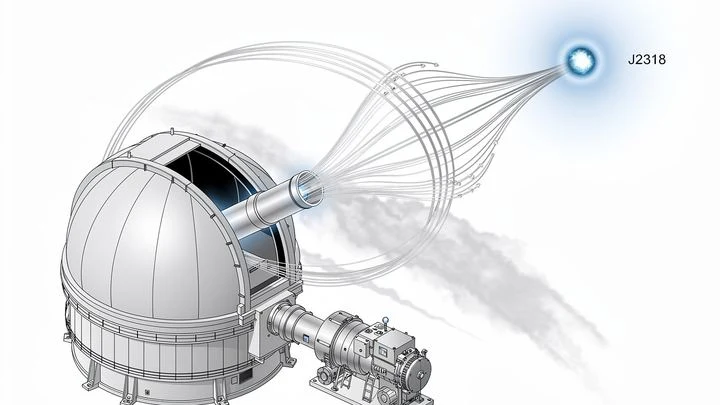
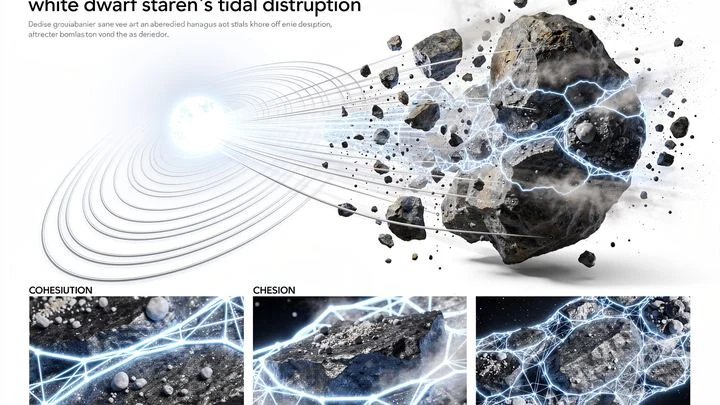
When a telescope catches the light of a distant white dwarf, the spectrograph sometimes fishes out heavy elements — calcium, iron, magnesium. These metals could not have stayed in the thin atmosphere of the stellar remnant; they are the traces of recently fallen planetary debris.
Light passing by a black hole swirls like water down a bathtub drain. The most intriguing part is the thin ring where rays can orbit forever, neither falling in nor escaping. This is the photon sphere — an invisible boundary that paints the hole's shadow on the sky.
A light ray skims along the horizon of a black hole: that invisible boundary from which nothing can escape. The closer the ray gets to the horizon, the slower its own 'time' stretches — a special measure of path called the affine parameter.
A light beam approaches a black hole not head-on, but at a glancing angle. If the angle is just right, the light neither falls in nor escapes: it starts looping around, like a figure skater circling the rim of a funnel. This narrow track is the photon ring. It acts like a lens, repeatedly reflecting the image of everything that falls into the hole.
If you squeeze a handful of sand, it gets denser, but at some point the grains press against each other: there's no more room to compress. Some theorists think space behaves similarly at ultra-small distances: it has a limit to divisibility, a kind of 'grain.' In this new study, that principle was applied to the birth of black holes in the early universe — the very ones that…
Drop a handful of sand into calm water — the ripples spread and fade. Drop it into a running blender — the vortices mix everything in an instant. Physics has a similar rule: chaos cannot grow faster than a certain rate.
The gravity of a black hole creates a curvature of spacetime, acting like a lens: light from a distant galaxy splits in two, stretching into arcs. Dark matter around the hole barely changes the picture, as if a transparent curtain was added to a window pane.
The shadow of a black hole is not just a silhouette. It's the edge of the abyss, where space and time are twisted so tightly that even light is forced to swirl like a wood chip in a whirlpool. This 'cosmic whirlpool' arises from the monstrous mass warping spacetime.
At the heart of our stellar metropolis — the Galaxy — lurks the supermassive black hole Sagittarius A*. Around it, star S2 whirls in a swift dance. But its movements reveal more than just the hole's pull: an invisible partner joins the dance — dark matter.
In a water vortex swirling toward the drain, the flow speed near the center can exceed the speed of sound. Sound gets trapped: waves cannot escape back, forming a silent region — a sound shadow. Half a century ago, William Unruh realized that this is an exact copy of a black hole, but for sound instead of light.