A microarcsecond is a unit of angular measurement equal to one millionth of an arcsecond, which itself is 1/3600 of a degree. This is an extraordinarily tiny angle — roughly the size of a coin on the Moon as seen from Earth. It is used in extremely precise positional astronomy, where measuring the apparent shifts of stars and other celestial objects at this level can reveal subtle effects like the gravitational deflection of light or the wobble of a star due to an orbiting planet.
History
The concept of microarcsecond astrometry was developed in the late 20th century, with the Hipparcos mission (1989-1993) achieving milliarcsecond precision. The idea of reaching microarcsecond levels was proposed for future missions like Gaia and SIM.
How it works
To achieve microarcsecond precision, astronomers use interferometry, combining signals from multiple telescopes separated by large distances to create a virtual telescope with enormous resolving power. Space-based observatories like Gaia also achieve this by repeatedly measuring star positions with extreme care, accounting for all known systematic errors. The tiny angles are then used to infer distances via parallax or to detect tiny accelerations of stars.
In practice
Microarcsecond astrometry is used to measure distances to stars across the galaxy, detect exoplanets through astrometric wobble, and test general relativity by measuring light deflection by the Sun.
Fun fact
A microarcsecond is so small that it would take about 100 years for a clock hand to move that angle on a standard clock face.
Systems:SIOne microarcsecond is 10^-6 arcseconds, where an arcsecond is 1/3600 of a degree.
It's like a sprint record: to break it, you need a perfect run-up. But for sub-millisecond pulsars, the run-up is too short. The fastest known pulsar, PSR J1748-2446ad, spins 716 times per second — faster than a kitchen blender. If it were the size of Earth, a point on its equator would move at about 0.24 times the speed of light. But why doesn't any pulsar spin even faster?
A passing particle leaves a flash of light in a long transparent bar — a scintillator. Inside the bar, like threads in a rope, thin fibers are stretched to collect this light and channel it to a sensor. Particle detectors have worked this way for decades.
Six runners sprint down the track, and officials time their speed without noticing a tailwind. The wind blows at their backs, and the stopwatches show a better result than the truth. Roughly this is how six megamasers — natural cosmic lasers in distant galaxies — misled astronomers measuring the expansion rate of the universe.
Cosmic rays aren't rays in the usual sense: they're fast particles bombarding Earth from all directions. Mostly they're protons and atomic nuclei. Their energies vary widely, from modest to fantastically huge. When such a particle heads our way and the Moon or Sun gets in its path, it gets absorbed.
Light waves are never perfectly smooth — they are constantly jittered by quantum ripples. These almost invisible nudges were studied by Nobel laureate Roy Glauber, who laid the foundations of quantum optics. Now physicists have learned to freeze these ripples.
The Moon is a natural archive that has been collecting cosmic dust for billions of years. Among the microscopic grains that arrived from distant stars, there could be techno-specks — particles created by alien civilizations.
A charged particle streaks through a silicon sensor, leaving behind a trail of free electrons. The time it takes for this charge to be collected at the electrode depends on how deep in the crystal it was born. A particle entering head-on carves identical paths through neighboring pixels: their signals arrive almost simultaneously.
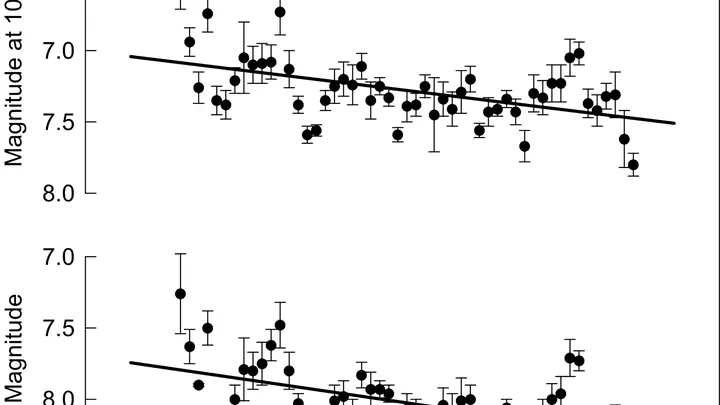
For five consecutive years, the automated MMT9 observatory measured the brightness of Starlink and OneWeb satellites using photometry (precise light measurement). The results were surprising: VisorSats, equipped with visors to reduce glare, became brighter by 0.6 magnitudes, while OneWeb, on the contrary, dimmed by 0.4.
In a particle accelerator, nuclei shatter into fragments like a porcelain cup dropped on the floor. Each fragment flies through silicon wafers, which register the impact and its strength. But to distinguish a real signal from random noise, you need a threshold: below it, readings are considered interference.
A standard laser rangefinder works like a stopwatch on a 100-meter dash: it times how long light takes to run to the target and back. But such a stopwatch has a limit: it ticks in steps of tens of picoseconds (trillionths of a second). In that step, light travels about a centimeter, so finer details are invisible.
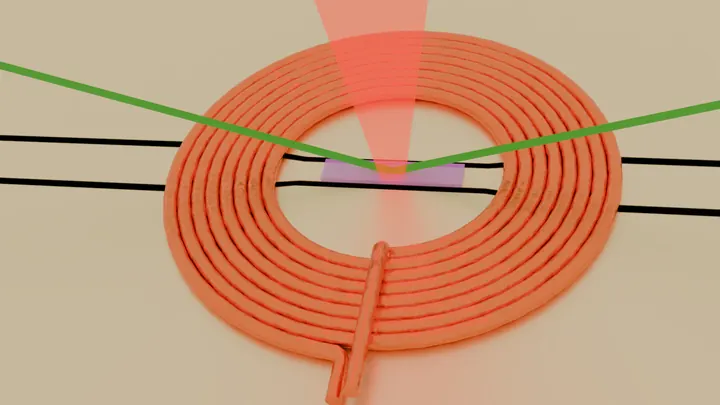
A tiny defect in a diamond crystal works like a sensitive antenna. When a magnetic field oscillates nearby, this defect, a nitrogen vacancy, responds by glowing. Previously, to hear the signal, you had to accumulate many repeated measurements, like listening to a whisper with your ear pressed against a door. Now a single short "look" suffices.
In distant galaxies, old stars swell and redden. Among them are two groups that act like lighthouses: some have just ignited helium burning, while others are already burning carbon and oxygen.
Diamonds sometimes have a defect: instead of two adjacent carbon atoms, there is one nitrogen atom and an empty spot. This defect acts like a tiny antenna that responds to magnetic fields. Scientists aimed a laser and microwaves at such a diamond, and the defect started spitting out electrons.
The crystal CeRh₂As₂ behaves like a switch: cool it down and it becomes a superconductor, then bring a magnet close and it abruptly jumps to another superconducting state. Such behavior is rare: most superconductors have only one state, but here there are two, separated by a sharp boundary.
In Chile's Atacama Desert, at an altitude of nearly five kilometers, stands a radio telescope that catches millimeter waves from the depths of space. These waves carry the heat of distant galaxies, but first they must pass through a window — a thin plate of silicon that separates the cold receiver from the warm outside world.
Short gamma-ray bursts — instantaneous, but most powerful explosions — are born from the mergers of neutron stars (the superdense remnants of dead stars).
Astronomers have found an invisible object in the Universe weighing just a million Suns — for cosmic scales, that’s a mere trifle, a hundred times lighter than anything they’ve been able to “weigh” at such distances. The object itself doesn’t shine, but it gave itself away by bending the light from an even more distant galaxy.