A Chance Encounter of Two Stars ✛
Original: "An Eccentric Massive Protobinary Assembled via a Core-merger Parabolic Encounter"
arXiv:2609.07390v1 · 2026-09-07 · CC BY 4.0 · 1 min
Two young stars in a gas cloud passed very close to each other and are now flying apart, like two people who collided while running.

In a dark cloud where new stars are born, two of them recently flew very close to each other. They resemble two strangers who accidentally bumped into each other on the street and are now going their separate ways. Astronomers tracked them for eight years and were able to measure their motion.

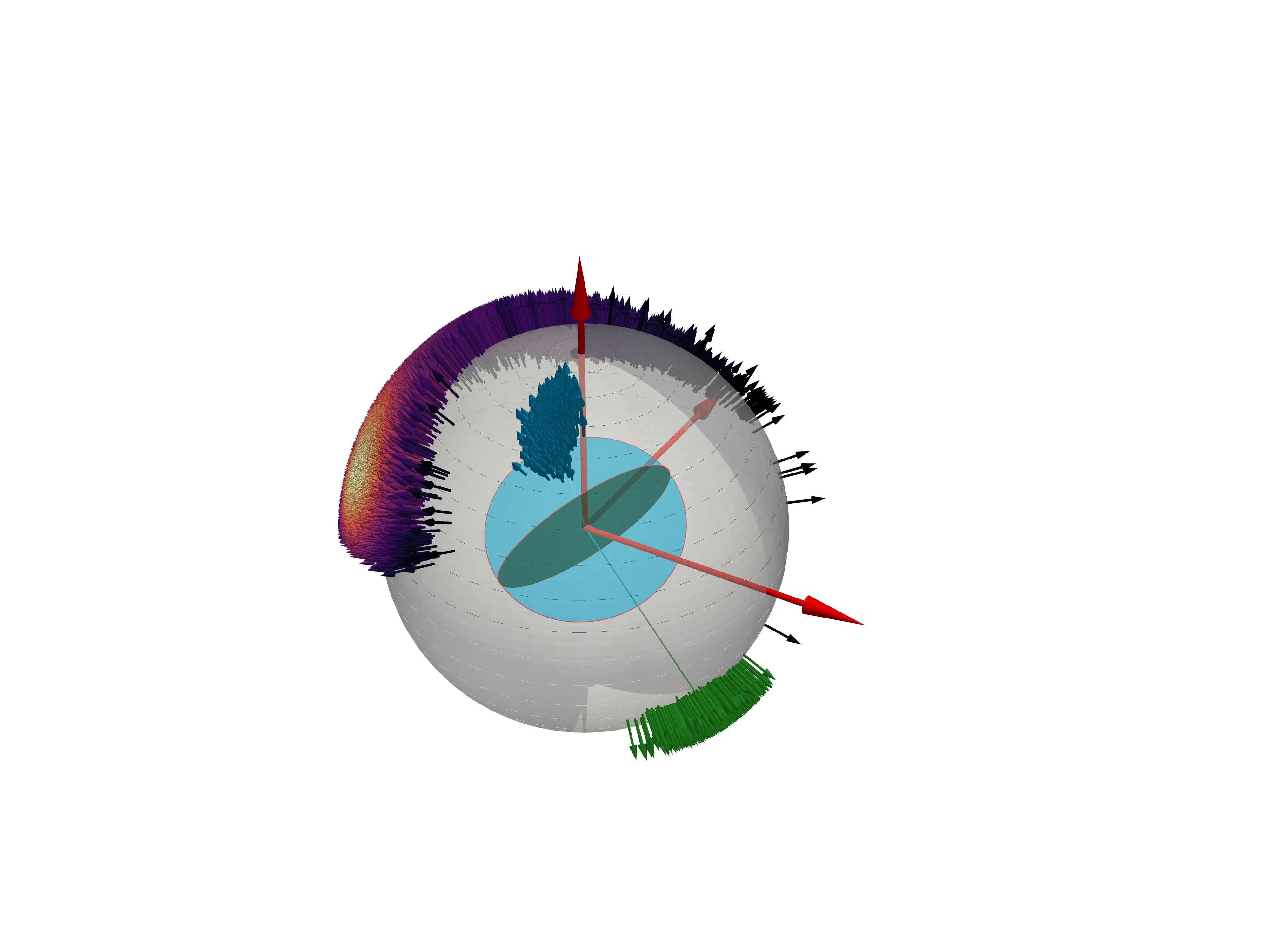
It turned out that the path of these stars is almost like that of a thrown stone: they approached each other and are now moving apart, but they are still held together by gravity. Around each star there is a flat disk of gas and dust, like the rings of Saturn. These disks are tilted in different directions, and one of them rotates in the opposite direction. This happens when stars are born separately and only later meet.

If the stars had been born from a single common cloud, their disks would lie in the same plane, like pancakes on the same griddle. Here, however, they are tilted at large angles, revealing their independent past.

Now astronomers will continue observations to understand whether these stars will remain a pair or fly apart forever. This will help us learn how often massive stars form pairs not from birth, but after a chance encounter.

Periastron was passed only about 60 years ago, meaning that at the time of observation the stars were still moving apart after their closest approach. Had astronomers looked at the system a century ago, they would have seen it in a completely different configuration.

\ddot{\mathbf{r}} + \frac{G M_{\mathrm{tot}}}{r^3} \mathbf{r} = 0
The acceleration of the relative position of two stars is inversely proportional to the square of the distance and directed toward the center of mass, which determines the shape of the orbit.
\tau_{\nu,\mathrm{ff}} = 3.366 \times 10^{-7} \left( \frac{T}{10^4 \, \mathrm{K}} \right)^{-1.323} \left( \frac{\nu}{10^9 \, \mathrm{Hz}} \right)^{-2.118} \left( \frac{\mathrm{EM}}{\mathrm{pc}\,\mathrm{cm}^{-6}} \right)
Shows how opaque the ionized plasma is to radio emission at a given frequency; depends on temperature, frequency, and emission measure.
\cos \psi_{\alpha\beta} = \sin i_\alpha \sin i_\beta \cos(\phi_\alpha - \phi_\beta) + \cos i_\alpha \cos i_\beta
Computes the angle between the planes of two disks or between a disk and the orbit from their inclinations and position angles.
Concepts
binary stellar evolution binary star young star stellar planetary misalignment protoplanetary disk population iii stars eccentric orbit starburst asteroid belt pair instability supernova supermassive black hole formation white dwarf extreme mass ratio inspiral protoplanetary disk dynamics core collapse planetary embryo cataclysmic variable trappist 1 superdense matter ultraluminous x ray source