The Dance of Two Protostars: How Eccentric Pairs Are Born ✛
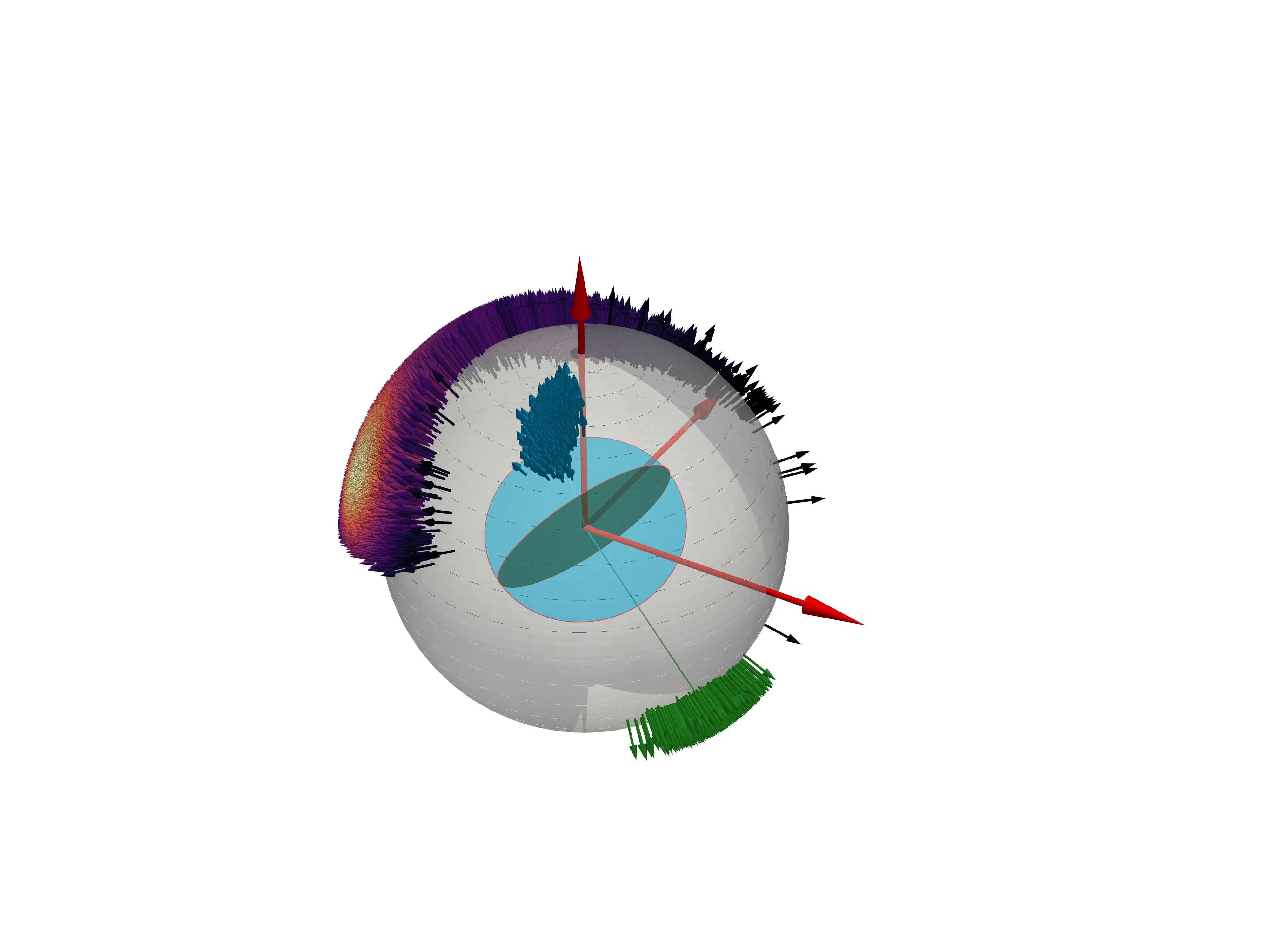
In a dense cloud of gas and dust where massive stars are born, two young stars recently passed very close to each other. Their dance has lasted only about sixty years, and astronomers have now seen it in detail for the first time. The IRAS 07299−1651 system lies 1.4 kiloparsecs away, and over eight years of observations its components shifted on the sky by an amount the eye cannot discern, yet instruments recorded it with precision down to one ten-thousandth of an arcsecond.
The pair's orbit turns out to be nearly parabolic, meaning the stars are flying apart after their close encounter but are still bound by mutual gravity. The point of closest approach, periastron, was passed around 1965, when the separation between the stars was about 139 astronomical units. For comparison, Pluto sits on average 39.5 astronomical units from the Sun, so the stars came within about three and a half times that distance.
Why does this matter? Most massive stars live in pairs, but exactly how such unions form has been a matter of debate. One scenario holds that a single star splits in two during collapse; another says two independent cores approach and capture each other. Observations of IRAS 07299−1651 now show, for the first time, that the second path is possible even for close pairs that may eventually merge or become sources of gravitational waves.
Further monitoring of the system will clarify whether the stars will stay together or fly apart forever. If the orbit turns out to be hyperbolic, that would be direct evidence of capture. If the pair is bound, friction with gas will gradually make the orbit rounder and tighter. Searching for similar systems in other star-forming regions will help us understand how often massive binaries are born through chance encounters rather than a shared childhood.
Periastron was passed only about 60 years ago, meaning that at the time of observation the stars were still moving apart after their closest approach. Had astronomers looked at the system a century ago, they would have seen it in a completely different configuration.