Population III stars are the hypothetical first generation of stars, formed from the primordial gas of hydrogen and helium left over from the Big Bang. Because this gas contained no heavier elements (which act as coolants), these stars are predicted to have been extremely massive — often hundreds of times the Sun's mass — and to have burned hot and fast, ending in spectacular supernovae that seeded the universe with the first heavy elements.
History
The concept was proposed in the 1960s by astrophysicists like Yakov Zel'dovich and others, who realized that the first stars must have differed from modern ones. Direct observation remained elusive until the James Webb Space Telescope began searching for them in the early 2020s.
How it works
Without metals, the primordial gas could not radiate heat efficiently, so it stayed hot and resisted fragmentation into small clumps. This allowed large clouds to collapse into single, enormous stars. Their intense ultraviolet radiation and short lifetimes (a few million years) meant they exploded quickly, dispersing elements like carbon, oxygen, and iron into space, which then enabled the formation of later, smaller stars like our Sun.
In practice
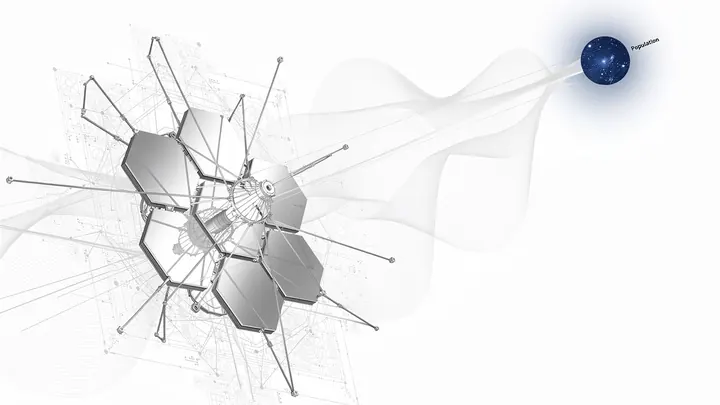
They are a key target for the James Webb Space Telescope, which aims to observe them to understand the early universe's chemical evolution and the seeds of supermassive black holes.
Fun fact
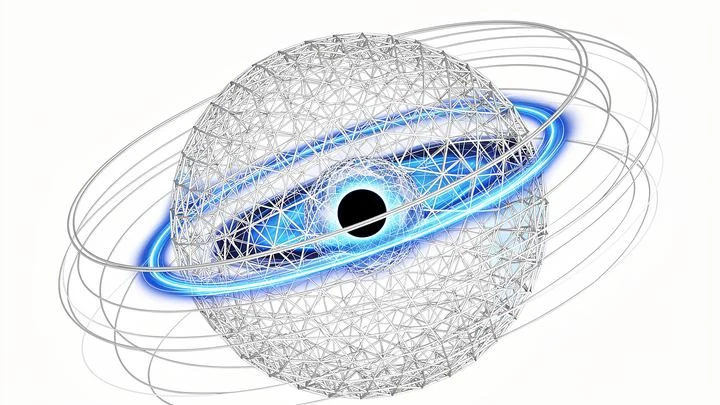
Population III stars may have been so massive that some collapsed directly into black holes without a supernova, potentially explaining the origin of the supermassive black holes at the centers of galaxies.
In a dense cloud of gas and dust where massive stars are born, two young stars recently passed very close to each other. Their dance has lasted only about sixty years, and astronomers have now seen it in detail for the first time.
A filament of the cosmic web stretches through the young universe, and strung along it like beads on a necklace are galaxies. In the core of the SSA22 protocluster, which in a few billion years will become the center of a massive cluster, these beads are still hot and dusty: stars are being born inside them, and cold gas serves as fuel.
A particle with an energy of $$10^{18}$$ eV hitting Earth's atmosphere is like a tennis ball traveling at 200 km/h slamming into a wall. Astrophysicists have debated for decades where such projectiles come from. Gamma-ray bursts, brief and powerful explosions of gamma radiation, have long been suspected as accelerators.
An old city gains new suburbs. In the center, narrow streets where life has nearly stopped, while on the outskirts construction is booming. That is what a spiral galaxy looks like when its core stars have long aged and new stars are still being born in the outer disk.
The night sky in neutrino light resembles a canvas worked on by two hands. One holds a broad, soft brush: these are supernova remnants, the shells left behind after stellar explosions. The other grips a fine, hard pen — microquasars, binary systems where a black hole twists matter into narrow jets.
Faint galaxies scattered across the Perseus cluster are like ghosts among their bright neighbors. They are so diffuse that distant objects shine through them, and they contain hundreds of times fewer stars than our Milky Way.
Cosmic rays are particles that race across our Galaxy at enormous speeds. Their energies can be millions of times higher than those of particles in the most powerful accelerator on Earth. But the higher the energy, the fewer such particles there are: the plot of their numbers shows a noticeable kink, which is called the knee.
Two spinning tops whirl so close they nearly touch. One is scorching blue, the other dim white. Together they complete a full orbit in twenty hours. This is the pair Feige 64: a blue star with a mass of just a third of the Sun's, and a white dwarf, the cooled core of a former star, one and a half times heavier than our Sun.
The blue star seems too hot for its mass.
In the first half-billion years after the Big Bang, galaxies grew like crazy. Gas fell in rapidly and collapsed into stars without any resistance. This period is called 'unimpeded star formation.' It's like frying pancakes on a scorching skillet without a lid: splatters fly, but nothing holds them back.
In the first moments after the Big Bang, matter and antimatter should have been created in equal amounts. But today, everything around us is ordinary matter, and antimatter is almost nowhere to be found. Where did it all go? The standard answer: a tiny imbalance in favor of matter wiped out almost all antimatter.
The most massive stars are like overinflated balloons: their envelope stops stretching and instead begins to furiously vent material. At a certain stage, the mass loss becomes so intense that the star stops growing in size. Astronomers see this moment as a kink in the diagram where stars are sorted by luminosity and temperature.
A young star cluster resembles an orchestra before a concert: each instrument tunes up in its own way, and the overall hum seems like chaos. But if you listen closely, you can pick out individual notes.
The cosmos resembles silk fabric with threads of the dark web showing through. We only glimpse tiny swatches of the real tapestry — through telescopes, in actual galaxy catalogs. To separate the fundamental signal from astrophysical noise in the cosmic pattern, statistical analysis demands thousands of plausible sketches — synthetic sky maps.
In the early universe, just a few hundred million years after the Big Bang, astronomers see strange objects — little red dots. They are compact, red, and in their spectra, broad Balmer lines scream the presence of supermassive black holes. But how did the hole manage to accumulate millions of solar masses in such a short time?
Two cities endure a series of fires. In one, the wind carries ash far beyond the outskirts, leaving the sky clear. In the other, ash settles as a dense veil, painting sunsets crimson. Roughly the same thing, just on a galactic scale, happens with supernova explosions, the final flares of massive stars.
Imagine a green beam that, passing through an ingenious optical setup, twists into a three-dimensional funnel of light — an optical vortex. At its heart, like in the eye of a hurricane, the intensity drops to zero. It is there that photons disappear.
The James Webb Space Telescope peered into an era when the universe was less than a billion years old and spotted strange objects—'little red dots.' These are black holes with masses of millions of suns, but in very compact, chemically pristine galaxies. Standard scenarios can't grow such heavyweights that early.
For a long time, astronomers searched for the 'factories' of the most energetic cosmic rays — particles that carry the macrocosm compressed to the size of an atomic nucleus. Colossal star-forming regions like Cygnus OB2, where winds from young giants collide, were prime suspects.
A low rumble coming from underground could be the noise of a distant construction site, or it could be the echo of an ancient earthquake. Astronomers faced a similar puzzle in 2023 when they detected ultra-low-frequency gravitational waves — the trembling of spacetime itself, rippling across the universe.
In a giant cosmic cradle, the Tarantula Nebula, astronomers took a close look at 122 massive stars, each at least 30 times heavier than the Sun. They measured the nitrogen abundance in their atmospheres, and the picture turned out to be unexpected.
Imagine an ancient manuscript, where a new story is written over an old text. Over time, the upper layer wears thin, and lines of the past show through. That’s exactly how globular clusters, the oldest stellar systems in the Universe, are structured, like a palimpsest.
Massive stars are cosmic titans, living under the sign of indomitable energy. When such a star enters the B[e] supergiant phase, its radiation is so powerful that it would seemingly pulverize any molecule into atoms. The spectral lines, once systematized by Johann Balmer, blaze here with particular fury.
The standard cosmological model ΛCDM, where dark matter and dark energy act as the chief architects of the cosmos, has predicted astronomical data with Swiss-watch precision for decades. Its foundation was laid by three geniuses.
A detective story unfolded in the GWTC-5 catalog. Hundreds of signals from merging black holes, captured by the detectors of Rainer Weiss and his colleagues, held the secret to the origin of the most massive and rapidly spinning stellar-scale objects.
In the first moments after the Big Bang, the universe inflated at an unimaginable rate. This inflation left behind ripples — tiny overdensities in the hot radiation and plasma.
Right after the Big Bang, the Universe was a chemical desert — only hydrogen and helium, not a hint of metals. But moments passed (by cosmic standards), and the birth of the first stars — Population III — began.
Imagine a forest planted in a single day. At first glance, all trees look alike, but their cross sections tell different stories: some grew on clean soil, others on the ashes of ancient fires.
In 2019, an unusual visitor, comet 3I/ATLAS, zoomed into the Solar System. It came from another star, and for the first time, astronomers were able to see what its dusty tail is made of.
Lenticular galaxies are the cosmic quiet types: they have a disk but no bright spiral arms. For a long time, their origin remained a mystery. A team of scientists ran the Hydrangea computer simulation and traced the fate of each galaxy from its youth to the present day.
On the mass–size diagram, these galaxies line up in a V shape.
Stars are born in cold clouds of cosmic dust and hydrogen. Inside these cocoons, protostars — the cores of future suns — were long thought to be just hot clumps. But it turns out many of them are powerful accelerators: they shoot out narrow jets of gas that, slamming into surrounding matter, produce invisible gamma-ray light.
The galaxy NGC 1277 is like an old book that no one has opened for billions of years. It formed quickly at the dawn of the Universe and has barely changed since — no collisions with neighbors, no new layers added.
A giant baby planet is still pulling in leftover building material from its surrounding cloud. That's the scene the Hubble Space Telescope captured when it aimed its cameras at an object catalogued as SR 12 c. This companion planet orbits a young star at a wide distance — farther out than Neptune is from the Sun.
A vast city lights new streetlamps every night. But then a hurricane sweeps in, rips all the fuel from the warehouses, and the lamps go out one by one. Something similar has been spotted by astronomers in a galaxy whose light has traveled 12.5 billion years to reach us.
Blacksmith's bellows fan the fire by forcefully pushing out air. In space, the shock wave from a supernova, a concept introduced by Fritz Zwicky, acts like such bellows: it catches up with a giant bubble of charged particles and magnetic fields formed around a spinning neutron star…
The Universe is singing. Not in the usual sense: its symphony is recorded in tiny density variations from which galaxies and ourselves grew. After the Big Bang, space was almost uniform, but quantum fluctuations during inflation left a faint pattern — slightly more matter here, slightly less there.
The universe is full of the invisible. We know about dark matter from galaxy rotation and gravitational lensing, but its nature has eluded us for a century.
Elliptical galaxies are quiet stellar metropolises in retirement. By all rights, their light should be calm, reddish, like a sunset. But their spectra scream otherwise: in the far ultraviolet, these old-timers blaze like holiday lights. For three decades, astronomers have puzzled over this 'ultraviolet upturn' (UV upturn).
Using the James Webb telescope, astronomers peered into an ancient quasar — the dazzling heart of a galaxy where a giant black hole sucks in matter. It turns out it doesn't just destroy, but also creates: its powerful outflows and shock waves act like a true cosmic mill.