A pair-instability supernova is a colossal stellar explosion that occurs in extremely massive stars, typically between 140 and 260 times the mass of the Sun. In these stars, the core becomes so hot that gamma rays spontaneously convert into electron-positron pairs. This process saps the radiation pressure that supports the star against gravity, causing a sudden collapse and a thermonuclear runaway that obliterates the star completely, leaving no remnant behind.
History
The theoretical prediction was made in the 1960s by Z. Barkat, G. Rakavy, and N. Sack, who calculated the instability in massive stellar cores.
How it works
In the core of a very massive star, the high-energy photons can transform into pairs of electrons and positrons. This reduces the outward pressure, so the core contracts and heats up even more. The increased temperature triggers rapid nuclear fusion of oxygen and silicon, releasing enormous energy that blows the entire star apart. Unlike core-collapse supernovae, no neutron star or black hole is left behind.
In practice
Pair-instability supernovae are key to understanding the first generation of stars in the universe and the origin of heavy elements, and they help explain the mass gap observed in black hole populations.
Fun fact
The first pair-instability supernova candidate was identified in 2016, and its explosion was so bright that it briefly outshone its entire host galaxy.
In a dense cloud of gas and dust where massive stars are born, two young stars recently passed very close to each other. Their dance has lasted only about sixty years, and astronomers have now seen it in detail for the first time.
In the cosmic forge, stars do not melt iron but atomic nuclei. An ordinary furnace can do that, but sometimes the heat becomes so intense that the furnace blows itself apart. That seems to be exactly what happened with supernova SN 2024afyu. Its spectrum shows sulfur and silicon lines that leave no doubt: several solar masses of these elements were forged inside.
A neutron star is the remnant of an exploded star, compressed so tightly that a teaspoon of its material would weigh as much as a mountain. Inside such an object, protons and neutrons are packed tightly together, and under enormous pressure, hyperons, particles containing a strange quark, can appear.
A lighthouse doesn't flash steadily but in short, bright pulses. The neutron star in the system 4U 1323-62 is such a lighthouse in the X-ray range. It pulls gas from a companion star, and when enough material accumulates on its surface, a thermonuclear explosion occurs — an X-ray burst.
In nuclear physics, a puzzle has long been nagging: why among elements lighter than bismuth, only technetium (No. 43) and promethium (No. 61) have no stable isotope at all? All their neighbors in the periodic table can boast at least one long-lived variant, but these two seem to fall out of the general pattern.
A young star cluster resembles an orchestra before a concert: each instrument tunes up in its own way, and the overall hum seems like chaos. But if you listen closely, you can pick out individual notes.
At the centers of many galaxies, not only supermassive black holes lurk, but also vast clouds of invisible matter. If this matter consists of ultralight particles, it can gather into dense clumps — a kind of 'star' made of dark matter.
Two ultradense spheres, each the size of a city, whirl in a dance. Their masses are less than the Sun's, but inside them is matter compressed to unimaginable limits. One sphere is a neutron star; the other is a strange star, made entirely of quarks — the elementary particles that build up protons and neutrons.
Boson stars are gravitational atoms. Only instead of electric charge, gravity itself serves as the nucleus, holding a cloud of scalar field in quantized clumps.
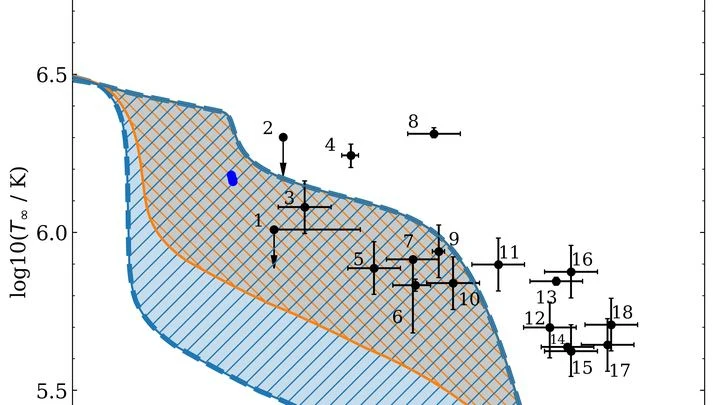
A hot infant and a cold adult — the same neutron star looks different. Just born in a supernova explosion, it is scorching hot at tens of billions of degrees. But as time passes, it cools, contracting like cooling metal. For the star PSR J1012+5307, this transition means an almost twofold reduction in radius.
A collision of two neutron stars is a cosmic forge where the heaviest elements of the periodic table are hammered out in seconds. In 2017, detectors picked up gravitational waves from such a merger, and telescopes saw a flash — a kilonova.
LIGO and Virgo detectors catch ripples in spacetime, but some signals force us to rewrite the scripts of stellar death. GW190814 — the merger of a black hole of 23 solar masses with a compact object of 2.6 solar masses — is a discordant chord in the symphony of standard models.
A string sounds perfectly pure until a draft touches it. That's roughly how a superradiant laser works: a beam of atoms, pre-charged with energy, flies through a room made of two mirrors — an optical resonator (a trap where light bounces back and forth).
In the depths of a neutron star, the remnant of an exploded star, matter is compressed so tightly that a teaspoon would weigh billions of tons. Within this superdense material, a special kind of force might be at work, one that affects only muon and tau neutrinos.
Two stones fall into a pond. Ripples spread from each, but when they collide, there's a splash and a short, sharp clap. That's roughly what the merger of two neutron stars sounds like: those ultra-dense remnants of exploded stars.
Picture a tightrope walker balancing over an abyss. Every step changes the rope's tension, and the slightest shift in center of gravity can prove fatal. That's roughly what the dance of an ordinary sun-like star around a black hole of ten solar masses looks like when the orbit is highly elongated.
In an orchestra, each musician plays their own part, but at a certain moment all instruments pause on a single note. Cosmic rays behave somewhat like this — particles flying toward us from distant stars.
A figure skater pulls their arms in, and their spin suddenly accelerates. When a massive star exhausts its fuel and its core collapses, something similar happens, but on a cosmic scale. The core shrinks to a city-sized sphere, and if it is spinning rapidly, a peculiar instability can arise.
Inside a neutron star, matter is compressed so intensely that atomic nuclei fuse into long strands and flat sheets. Astrophysicists call these structures nuclear pasta. At their surface, the density of matter plummets to nearly zero, like diving out of thick jelly into thin air.
It's this sharp transition that creates the unusual effect.
For a long time, a void yawned in the family of ultra-dense remnants of dead stars. Neutron stars, swift city-sized tops, rarely weigh more than two Suns. Black holes start at about five solar masses. Between them lies a 'gap' where for decades no object could be found.
A light bulb that doesn't burn out but flares brighter and brighter until it blows the whole fixture apart. That's roughly how the most massive stars in the universe die. When a star's core heats up to billions of degrees, pairs of particles (electrons and their antimatter counterparts, positrons) begin to form.
When hot soup cools, clumps form on the surface — similarly, as the early universe cooled, it gave birth to threadlike clumps of energy: cosmic strings. Some of them are like a stretched rubber band: as long as it's intact, it's stable. But if you nick the band, it snaps.
In a packed hall where couples are spinning, a wave sometimes ripples through: some pairs break apart, others form, and the motion sweeps everyone along. A dense neutrino cloud behaves similarly: these are the tiniest particles that barely interact with matter.
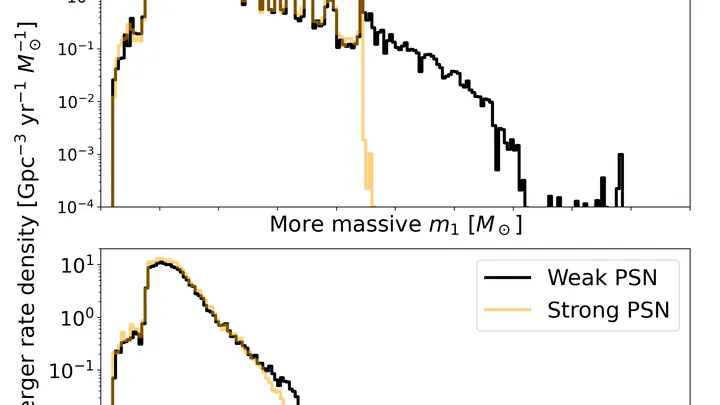
The latest crop of gravitational waves brought a puzzle. The LIGO, Virgo, and KAGRA detectors caught dozens of signals from merging black holes, and the mass plot shows a glaring gap: objects heavier than 45 Suns are almost absent, and the few that exist spin suspiciously fast. Some say giant stars explode too 'cleanly,' leaving nothing behind.
In the Norma cluster, the nearest rich galaxy cluster to us, astronomers have spotted a shock wave. It arose when one cluster plowed into another, like the bow wave of a ship cutting through water. This wave compressed and heated the gas between the galaxies.
Two galaxies sit right behind the wave front.
A neutron star is the remnant of an exploded star, compressed to the size of a city. In its core, matter is packed so densely that a teaspoon of such material would weigh as much as a mountain. At such densities, as predicted by the theory of strong interactions, particles acquire 'twins'—parity partners.
In 2019, gravitational-wave detectors caught a signal from the merger of distant objects. One was a black hole of 23 solar masses. The other weighed just 2.5 solar masses — and that's weird.
Usually, neutron stars don't get heavier than two solar masses: beyond that, they collapse into a black hole.
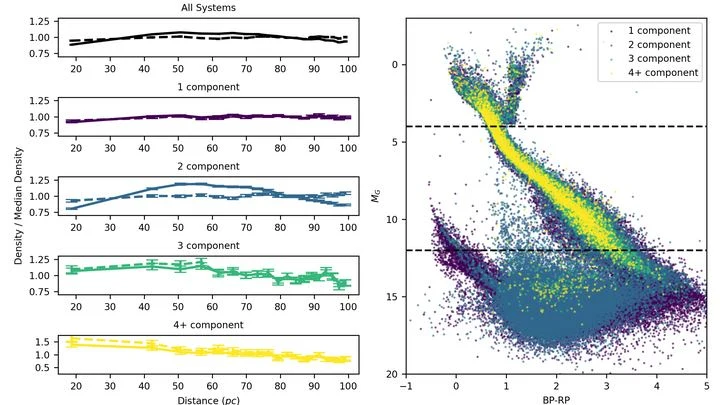
Two spotlights placed side by side: from a distance, their light blends into one patch, and it seems there's a single source. The same happens in space: about 10–20% of faint stars are actually close pairs of identical stars. Individually, they can't be resolved, but together they shine noticeably brighter than a single star with the same parameters.
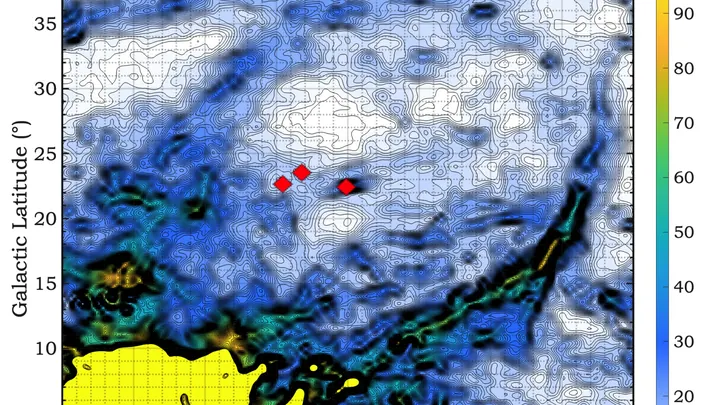
In radio sky data, like on old photographic film, two bright gas streaks have emerged. They move at different speeds but hang near the same dim star. The star and the streaks turned out to be inside a huge empty bubble in the interstellar gas. This bubble is like a blown soap bubble left over from an ancient supernova explosion.
At the heart of a neutron star, matter is squeezed so tightly that protons and neutrons transform into heavier particles — hyperons. These particles resemble neutrons but contain a strange quark. For a long time, physicists couldn't understand how a star with hyperons inside could be as heavy as observations show.
In a dark corner of the Milky Way, a natural metronome is at work. Every 8196 seconds, about 2 hours and 16 minutes, X-ray light flares on the surface of a neutron star. The star EP J171159.4-333253 pulls gas from a neighboring star, and this gas, falling inward, accumulates on its surface.
In a star cluster, like on a crowded dance floor, massive stars rarely stay single. More often they whirl in pairs or triples, and the distance between them can be less than from Earth to the Sun. But how do they manage to get so close to each other?
Simulations showed: it's all about the disk of gas and dust that envelops the pair. This disk, like a drain funnel, swirls the stars and slowly pulls them inward.
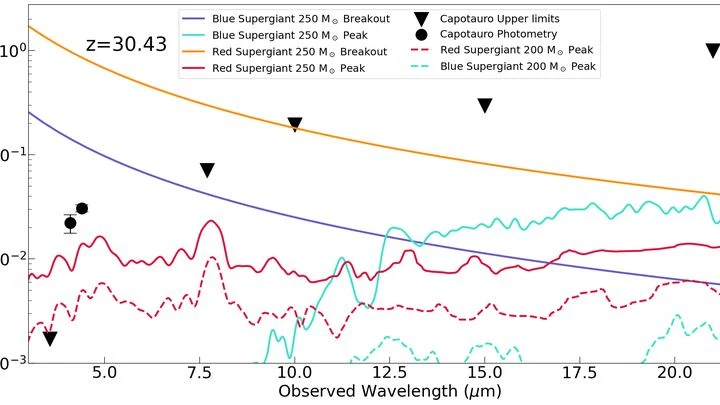
The James Webb Space Telescope spotted bright points of light from an era just 100–300 million years after the Big Bang. At first they were taken for distant galaxies, but now a hypothesis suggests they might be lone fireworks — explosions of the very first stars.
Imagine a bridge with its middle ripped out: cars on the other side would be a surprise. That's how astronomers long viewed black holes with masses from 50 to 130 solar masses: the stars that could produce them explode as pair-instability supernovae.
In 1181, Chinese and Japanese astronomers recorded the appearance of a 'guest star', a bright object that shone for six months in the constellation Cassiopeia and then vanished. Today, that spot hosts Pa 30: a nebula with a hot central source ejecting material at 16,000 km/s.
In the quiet harbor of the Local Bubble, a rarefied cavity of hot gas around the Sun, an explosion recently thundered. A supernova went off tens of parsecs away, and its echo still lingers in the neighborhood, reshaping the cosmic-ray landscape.