Corecollapse is the catastrophic gravitational collapse of the iron core of a massive star (typically >8 solar masses) at the end of its life. When nuclear fusion in the core produces iron, fusion can no longer release energy, and the core's pressure support fails. The core collapses from roughly Earth-sized to a neutron star or black hole in less than a second, releasing a colossal amount of gravitational energy that powers a supernova explosion.
History
The concept of corecollapse as the mechanism for Type II supernovae was developed in the 1960s–1980s, with key theoretical work by Stirling Colgate, Hans Bethe, and others, and confirmed by the detection of neutrinos from Supernova 1987A.
How it works
The collapse is halted when nuclear densities are reached, creating a stiff 'bounce' that sends a shock wave outward. However, the shock stalls due to energy losses; it is revived by neutrinos streaming from the newly formed proto-neutron star, which deposit energy and drive the explosion. The details of this neutrino reheating are still an active area of research, involving turbulence and instabilities.
In practice
Core-collapsesupernovae are the primary source of heavy elements in the universe, and their remnants (neutron stars and black holes) are studied to understand extreme matter and gravitational waves.
Fun fact
The neutrinos from a core-collapsesupernova carry away about 99% of the gravitational energy released, and they can escape the star hours before the light from the explosion reaches the surface.
Stated relations:part of →supernova · follows from →pulsar · follows from →jet
In a dense cloud of gas and dust where massive stars are born, two young stars recently passed very close to each other. Their dance has lasted only about sixty years, and astronomers have now seen it in detail for the first time.
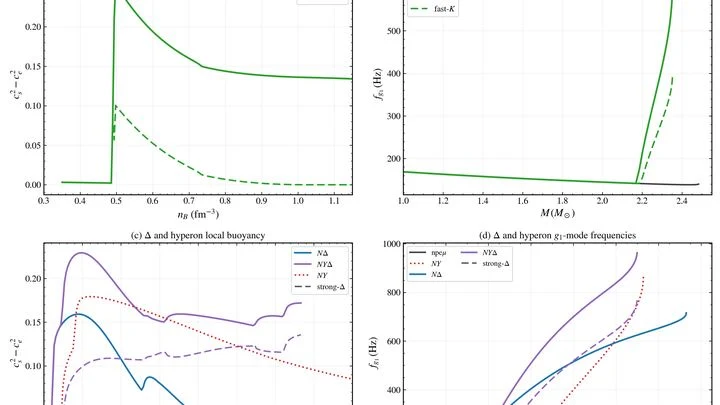
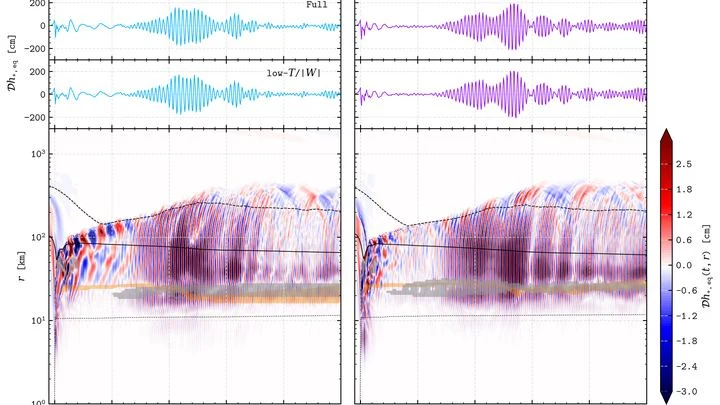
After a supernova explosion, a dense ball the size of a city remains at the center — a newborn neutron star. It is hot, compressed, and rings like a bell after being struck. These tremors, the star's oscillations, emit gravitational ripples that sensitive detectors on Earth can catch.
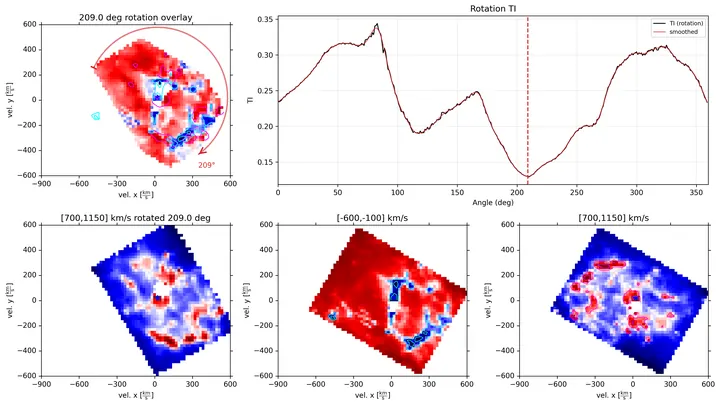
The explosion of a massive star is not just a flash: it's a blow to the surrounding gas. But until now, no one had looked at how the gas itself moves at the sites of such explosions. Now astronomers have gathered data on 33 nearby supernovae and for the first time measured the turbulence of the cold molecular gas around them.
The calm surface of a lake suddenly ripples — somewhere in the depths, an underwater cliff has collapsed. The water trembles almost imperceptibly, and the circles spread wider and wider until they reach a bobber near the shore.
At the end of a massive star's life, its core collapses in a fraction of a second, giving birth to a supernova flash. This cataclysm shakes spacetime itself, emitting gravitational waves — ripples that race across the Universe.
A supernova explosion blasts off the outer layers of a dying star. What remains is the core — a neutron star, packed into a sphere the size of a city. The existence of such stars was predicted back in 1934 by Fritz Zwicky.
The collapse of a star's core is like compressing a spring: matter falls inward, and a neutron star is born at the center. But the fall is never perfectly smooth. In the boiling outer layers, random eddies transfer angular momentum to the infalling gas, and a disk swirls around the central object.
This disk is no calm river. It pulses, strengthening and fading.
A neutron star is a boiling cauldron the size of a city but with the mass of one and a half Suns. Deep inside, matter is squeezed so hard that atomic nuclei lose their meaning. Strange forms of matter are born there: a kaon condensate (similar to a superfluid) and neutron stars with hyperons (heavy particles).
Three invisible strings oscillate in the intergalactic void. This is not poetry, but a hypothesis about the nature of dark matter — an ultralight quantum field with spin 1, carrying three polarizations.
At the centers of many galaxies, not only supermassive black holes lurk, but also vast clouds of invisible matter. If this matter consists of ultralight particles, it can gather into dense clumps — a kind of 'star' made of dark matter.
An old factory where instead of machines there are atomic nuclei, and neutrino radiation seethes all around. When a massive star exhausts its fuel, its core compresses a hundredfold, and the temperature skyrockets to billions of degrees.
The James Webb Space Telescope JWST has peered into the heart of supernova remnant SNR 0540-69.3 — what remains after a massive star died in a neighboring galaxy. Inside, amid the flying debris, astronomers saw a clear pattern: glowing clumps and voids arranged in a symmetric design.
A hot infant and a cold adult — the same neutron star looks different. Just born in a supernova explosion, it is scorching hot at tens of billions of degrees. But as time passes, it cools, contracting like cooling metal. For the star PSR J1012+5307, this transition means an almost twofold reduction in radius.
LIGO and Virgo detectors catch ripples in spacetime, but some signals force us to rewrite the scripts of stellar death. GW190814 — the merger of a black hole of 23 solar masses with a compact object of 2.6 solar masses — is a discordant chord in the symphony of standard models.
A neutron star is a gravitational lens that focuses our attempts to glimpse dark matter. Through its ultra-dense matter, like exotic glass, we search for the axion — an elusive particle that could explain the hidden mass of the universe.
In April 2021, in a galaxy 35 megaparsecs away, supernova SN 2021foa erupted. It immediately puzzled astronomers: its spectrum feverishly switched between hydrogen and helium lines — as if the star, in agony, was frantically shedding its outer layers.
Somewhere in the galactic bulge, a massive star lies dormant, ready to trade quiet burning for collapse. Its core will exhaust its fuel, and in a fraction of a second, a neutron star or black hole will be born, releasing 10⁵⁸ neutrinos — almost all the energy of the explosion.
A figure skater pulls their arms in, and their spin suddenly accelerates. When a massive star exhausts its fuel and its core collapses, something similar happens, but on a cosmic scale. The core shrinks to a city-sized sphere, and if it is spinning rapidly, a peculiar instability can arise.
A pot of boiling porridge, where instead of grains there are layers of oxygen and silicon, and the fire beneath is about to go out, and the star will collapse in on itself. Until now, astrophysicist cooks have used a simplified recipe: they assumed that bubbles and eddies in the porridge obey one and the same average temperature throughout the depth.
In the minutes before a massive star becomes a supernova, a hidden drama unfolds in its depths. A giant cauldron boils: matter churns, rotates, and invisible magnetic threads snap and rejoin. This moment, which has eluded direct observation, has now been recreated for the first time in three-dimensional computer models.
Imagine a packed dance floor where dancers glide without any friction — passing through each other without a touch. That's a superfluid. In a neutron star's crust, neutrons could behave this way, but a rigid lattice of ions gets in the way, like suddenly sticking the dance floor full of pillars.
A light bulb that doesn't burn out but flares brighter and brighter until it blows the whole fixture apart. That's roughly how the most massive stars in the universe die. When a star's core heats up to billions of degrees, pairs of particles (electrons and their antimatter counterparts, positrons) begin to form.
Imagine an interpreter at a crucial negotiation suddenly switching to another language, and the meaning of everything changes. That's roughly what neutrinos do in the depths of a dying star. These invisible particles are born in enormous numbers when a star's core compresses into a city-sized lump. But on their way out, neutrinos can change their type — physicists call this flavor transformation.
Gravitational waves — ripples in spacetime predicted by Einstein — have exposed an abyss: black holes with masses between 60 and 120 solar masses are almost never born.
Stars tens of times heavier than our Sun don't die as thought before. Computer models show that their core often doesn't ignite a supernova, but quickly collapses into a black hole. Imagine a soufflé: the center suddenly sinks, and almost all the batter falls into the funnel, with just a few drops splashing out.
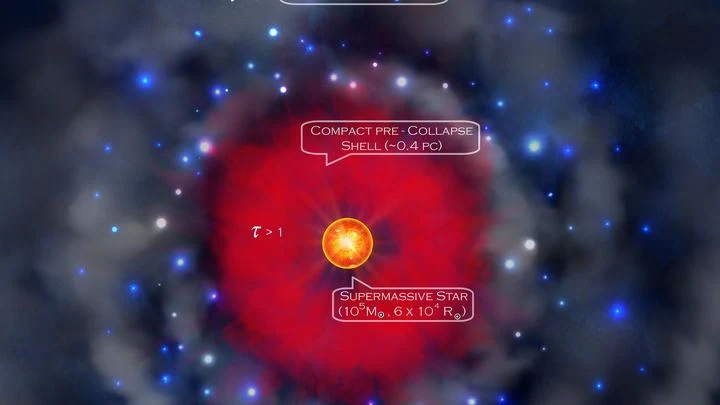
A star weighing a hundred thousand Suns lives bright and brief. Its finale is a rapid collapse into a black hole. But just before the end, it manages to wrap itself in a dense gas cocoon.
Previously it was thought that hydrogen barely mixes with liquid iron at low pressure, so it wasn't expected in the Moon's core. New experiments have flipped that view.
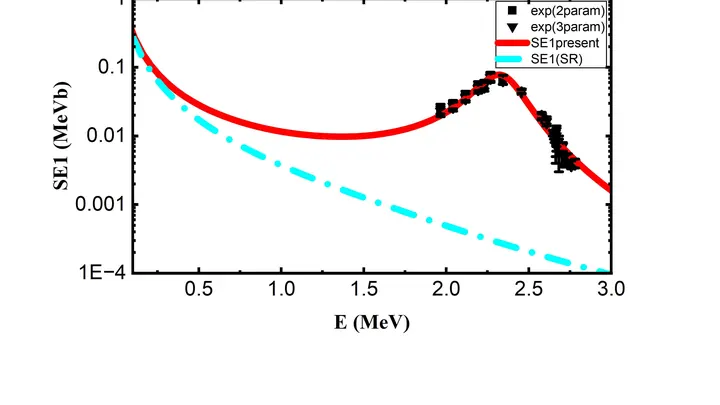
When a heavy atomic nucleus splits, it doesn't break into even halves. First, two fragments form that look like pears pressed together at their narrow ends. Then the junction begins to smooth out, like two droplets merging and the surface quickly leveling.
In that brief moment, the surface moves inward, and particles inside the nucleus can bounce off it, like a ball off an oncoming wall.
A massive star's explosion is bright but brief. The flash itself lasts weeks, but the dust it heats around it glows in infrared for years. It's like a camera flash illuminating a room, then hot dust particles lingering in the air — only on a cosmic scale.
When a massive star dies and collapses into a supernova, a neutron star is born — a city-sized sphere with the Sun's mass. Its matter is so compressed that a teaspoon weighs more than Mount Everest. Physicists are trying to learn the "recipe" of this matter — the equation of state that explains how matter behaves under extreme pressure.
A massive star, 40 times heavier than the Sun, dies in a fraction of a second. Its core compresses like a spring squeezed too hard, then snaps back: that's a supernova explosion. But what if the star is also spinning, like a figure skater pulling in their arms, and threaded with a magnetic field, like invisible strings?
Deep inside a massive star, before it explodes, layers sit on top of each other like the layers of an onion. Sometimes two adjacent layers, the carbon and oxygen layers, mix together. It's like how layers of broth and vegetables in a pot of soup blend when you stir them with a spoon.
A neutron star is the dead core of a star that once exploded, compressed to the size of a city. If a normal star is nearby, the neutron star siphons matter from it like a vacuum cleaner. This matter falls onto the surface and forms a crust — a solid layer of neutron-rich atomic nuclei.
In a gas cloud left after a star exploded (called a supernova remnant), astronomers noticed a giant glowing letter S. It was drawn by two jets of superheated material ejected during the cataclysm. These jets didn't just shoot straight out — they slowly spun like a top, which bent their path into curves.
In its youth, Earth resembled a beehive: it grew by sticking together from countless rocky chunks. When the main construction was over, a late swarm of meteorites rained down on the young planet — the so-called late veneer. These impacts, scientists thought, brought platinum, gold, and other rare metals to Earth's upper layers.
In the Norma cluster, the nearest rich galaxy cluster to us, astronomers have spotted a shock wave. It arose when one cluster plowed into another, like the bow wave of a ship cutting through water. This wave compressed and heated the gas between the galaxies.
Two galaxies sit right behind the wave front.
Neutrinos are tiny particles that barely interact with matter. They pass straight through a star like bullets through fog. When a massive star is gearing up to explode, its core contracts, temperatures soar, and neutrinos start streaming out.
In 2019, gravitational-wave detectors caught a signal from the merger of distant objects. One was a black hole of 23 solar masses. The other weighed just 2.5 solar masses — and that's weird.
Usually, neutron stars don't get heavier than two solar masses: beyond that, they collapse into a black hole.
In April 2023, Japanese satellites detected a super-intense X-ray burst on the neutron star MAXI J1752–457. The star cooled down in 4 days — five times faster than usual. Like someone cracked open a cosmic window.
Long before that, Fritz Zwicky predicted that a supernova explosion gives birth to a tiny neutron star. Years later, Jocelyn Bell Burnell caught its pulses, discovering pulsars.