An eccentric orbit is an elliptical path around a central body, where the orbital eccentricity (a value between 0 and 1) measures how much it deviates from a perfect circle. Eccentricity determines how a body's distance from its host varies over time, affecting its speed, tidal forces, and the amount of radiation it receives. This concept is crucial for understanding planetary dynamics, binary star systems, and the behavior of objects around black holes.
History
The elliptical nature of orbits was discovered by Johannes Kepler in 1609, who formulated his first law stating that planets move in ellipses with the Sun at one focus. This was later explained by Newton's law of universal gravitation in 1687.
How it works
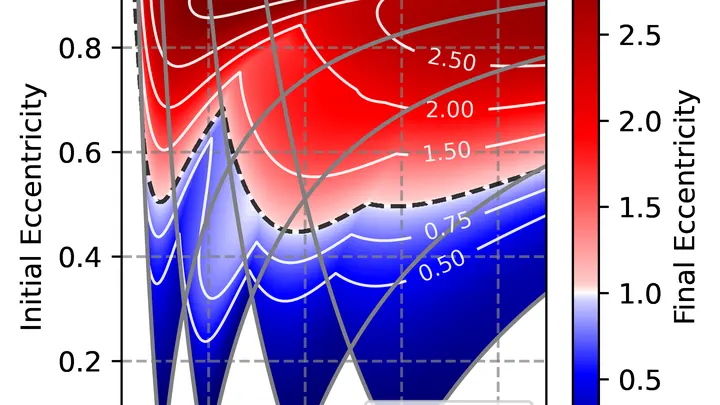
In a two-body system, the orbit is described by Kepler's laws: a body moves faster at perihelion (closest approach) and slower at aphelion (farthest point). The eccentricity is determined by the orbital energy and angular momentum. In multi-body systems, gravitational perturbations from other objects can gradually change eccentricity over time, a process known as secular evolution. For extreme cases like stars orbiting a supermassive black hole, relativistic effects cause the orbit's orientation to precess, and the eccentricity can be used to test general relativity.
The recently discovered exoplanet HD 20782b has one of the most eccentric orbits known, with an eccentricity of 0.96 — it swings from a scorching 0.06 AU to a frigid 2.6 AU from its star, experiencing a 1000-fold change in stellar radiation.
In a dense cloud of gas and dust where massive stars are born, two young stars recently passed very close to each other. Their dance has lasted only about sixty years, and astronomers have now seen it in detail for the first time.
The night sky looks serene, but it is actually pierced by an invisible rain of charged particles: cosmic rays. Scientists have long tried to figure out where the most energetic ones are born. Until recently, it was thought that our Galaxy supplies particles up to about 4 EeV, the so-called "ankle" in the spectrum.
Every 165 days, the giant planet dives toward its star, nearly grazing its fiery corona, then flies off into the icy void. This is TIC 241249530 b — an exoplanet with a record eccentricity of 0,94.
At the center of a galaxy, a huge black hole is shrouded in an invisible cloud — a swarm of ultralight particles that it itself spawned. Into this cloud dives another black hole, about the size of a star, and begins a long spiral dance. The approach takes millions of years, but the most dramatic events unfold right at the horizon.
The Kepler telescope spent years watching thousands of stars, spotting planets by the tiny dips in starlight when a planet passes in front of its star. Such a passage, or transit, lets us measure the planet's size but not the shape of its path.
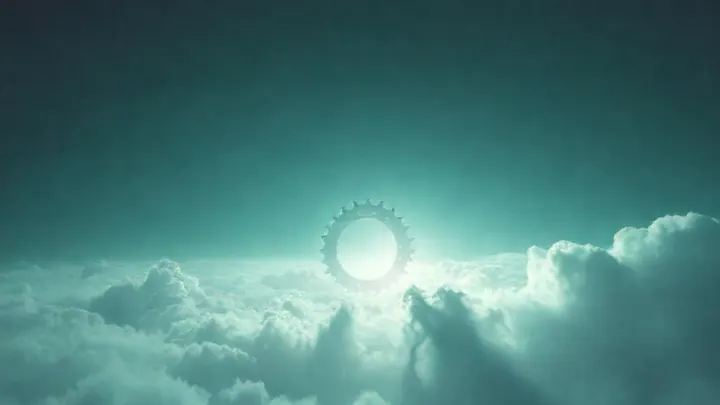
A wormhole is a tunnel through space, connecting distant regions of the Universe. Its shadow against a bright gas background was long thought to be as round as that of a black hole. But for a rotating wormhole (one you could actually traverse), the shape of the shadow might be surprising: the edge becomes jagged, like a gear.
Interstellar wanderers are rocks and icy chunks that have broken free from their home planetary systems and now drift through the Galaxy. The first such visitor, 'Oumuamua, zipped past the Sun in 2017, followed by Comet Borisov and the ATLAS object. Where do they come from?
For 39 years, astronomers have been recording how the star BE Lyn brightens and dims. Its light pulsates with a rhythm of several hours, like a lighthouse that never stops blinking. But there is a glitch in this rhythm: sometimes the flashes came a little early, sometimes a little late. The star was moving closer to Earth and then farther away, as if something were dragging it in a circle.
The trace of a short-lived particle is like a signature left in the detector. The particle is born and decays in an instant, but from its trace you can reconstruct its character — whether it's compact like a stone or fluffy like a snowball. That's exactly what this work is about: the authors propose a new way to read such signatures.
They noticed that each particle has an angle that links its mass and lifetime.