The Dance of Two Protostars: How Eccentric Pairs Are Born ✛
Context
Most massive stars are born in binary systems, but how such pairs form remains debated. The main scenarios include disk fragmentation, core fragmentation, and capture. This work stands alongside studies of close massive star pairs, double white dwarfs, and pulsars, but stands out because it directly measures orbital motion at the earliest, dust-enshrouded stage. Previous observations only hinted at proper motions in massive systems, whereas here a full three-dimensional picture was obtained.
Methods
From 2016 to 2024, the IRAS 07299−1651 system was observed with ALMA at wavelengths from 0.3 to 3 mm and with the VLA at 7 and 13 mm. The positions of the two components were determined by fitting two-dimensional Gaussians to the images with an accuracy of about 0.1 milliarcseconds. Radial velocities were measured from the hydrogen lines H26α and H30α. The orbit was then fitted jointly using a two-body model that allowed elliptical, parabolic, and hyperbolic solutions. Additionally, a model of ionized disks was constructed to explain the spectral energy distributions and recombination line fluxes.
Results
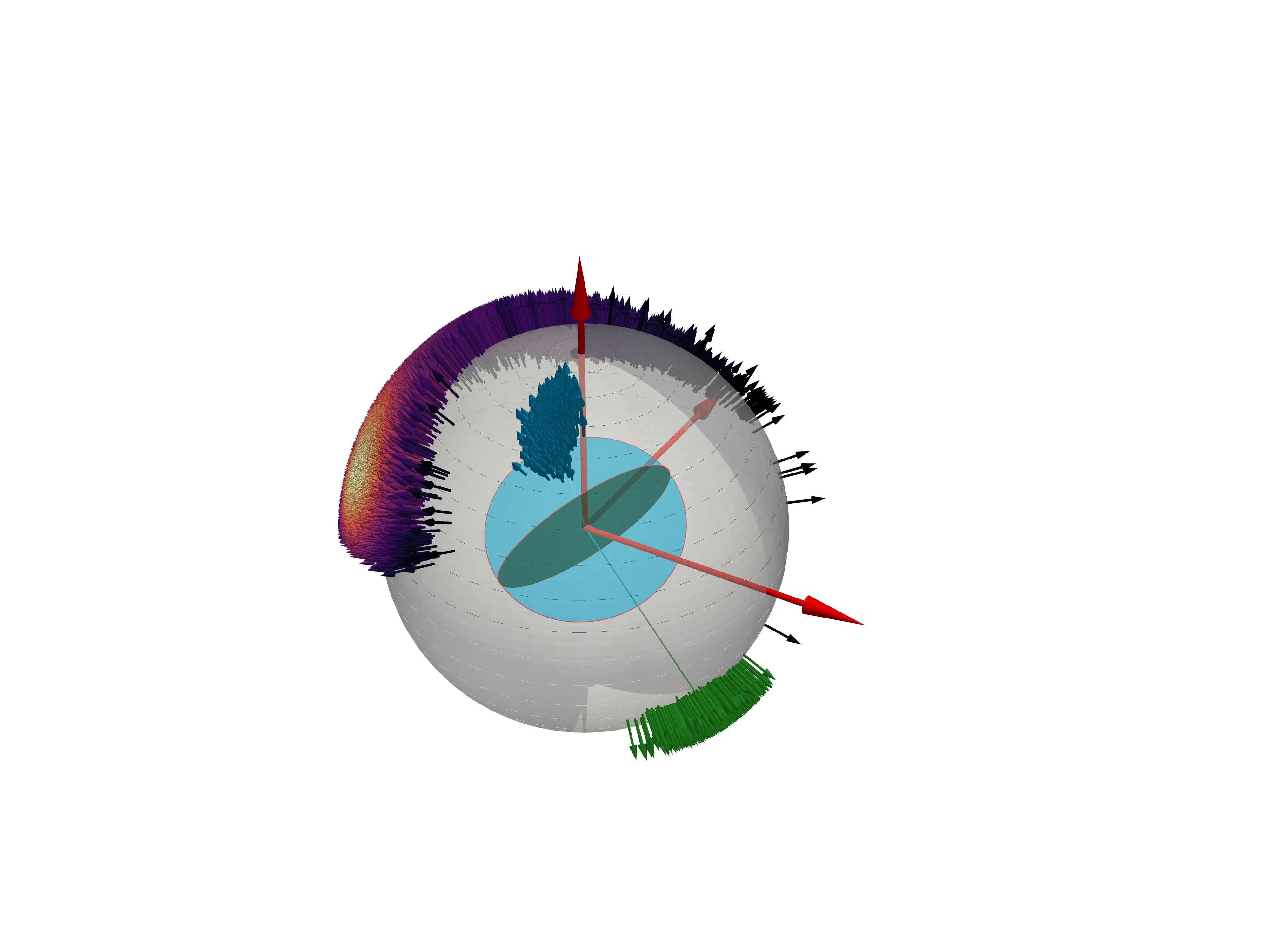
The relative velocity of the components on the sky is 10.4±1.6 km/s, comparable to the radial velocity difference of about 10 km/s. The joint orbital fit shows that the eccentricity is close to unity, meaning the orbit is nearly parabolic. Periastron was passed about 60 years ago at a distance of about 139 AU, and the current three-dimensional separation of the stars is about 220 AU. The disks of both protostars are strongly tilted relative to the orbital plane: the angle for source A is 59°, and for source B it is 133°, indicating retrograde rotation. The stellar masses, depending on the estimate, lie in the range of 8–16 solar masses.
Implications
This work shows for the first time that the core merger scenario can lead to the formation of close massive binaries with eccentric orbits. Unlike neighboring studies that focused on wider or more evolved systems, here the orbit is directly measured during the active accretion stage. The strong misalignment of the disks and the absence of a common circumbinary disk are difficult to reconcile with disk fragmentation but arise naturally from the capture of independently formed protostars. This shifts the balance toward dynamical mechanisms for forming massive binaries.
Future development
Further monitoring of the system will refine the eccentricity and distinguish a bound orbit from an unbound one. If the orbit turns out to be hyperbolic, it would be direct evidence of capture. If the system is bound, interaction with the surrounding gas may gradually reduce the eccentricity and lead to a tighter pair. Searching for similar systems in other star-forming regions will help assess how often massive binaries are born via core mergers.
Impact
The results will affect models of massive star and binary formation, as well as the interpretation of young cluster observations. They are important for understanding the origin of close pairs that may later become gravitational wave sources or X-ray binaries.
Next steps
Continue astrometric monitoring of IRAS 07299−1651 with ALMA and the VLA to accumulate a larger orbital arc. Conduct a search for analogous systems in other massive protostellar clusters.
Key open problems
For the field of star formation, a key unresolved question is the relative role of fragmentation and dynamical interactions in binary formation. This work shows that even close pairs can arise from independent cores, requiring a revision of statistical population models. It remains unclear how often such events occur in typical clusters and how they affect subsequent stellar evolution.
The knowledge machine's view
This section is addressed to the author of the paper and their colleagues. Neighbouring works were found by meaning-based search across our archive, not by word overlap. We do not review: we show the field around the work.
What the work does
The authors traced the proper motion of the components of the massive protobinary IRAS 07299−1651 using ALMA and VLA data spanning 8 years. A joint fit of the orbit, radiative transfer modeling, and the kinematics of hydrogen lines showed that the orbit is close to parabolic, and the disks around both stars are strongly inclined to the orbital plane. Such an architecture is naturally explained by the core merger scenario: the two protostars formed independently and recently experienced a close encounter.
Where its strength is
This is the first time the three-dimensional orbit of a massive protobinary has been recovered with this level of detail. Direct measurement of orbital motion at the earliest, dust-embedded stage provides unique constraints on the formation mechanisms of massive binaries.
Where it could go next
- It might be interesting to look at a paper on the birth of close massive star pairs: it discusses formation and evolution scenarios for such systems, which could provide context for interpreting the observed architecture of IRAS 07299−1651.based on: How tight pairs of massive stars are born arXiv:2601.06251
- Nearby lies a study of the acceleration of invisible pairs, which uses orbital motion analysis to reveal hidden companions. Perhaps similar methods could help search for additional components in the system or test dynamical evolution models.based on: The Acceleration of Invisible Pairs: What the Dance of Black Holes Reveals arXiv:2606.28156
- The archive contains an analysis of a neutron gravitational waltz, where precise orbit measurement in extreme systems is discussed. One might borrow approaches for accounting for relativistic effects or for jointly analyzing data from different epochs to refine orbital parameters.based on: Neutron Gravita-Waltz and Dance with a Defect arXiv:2606.23926
Worth trying
- Try applying a Bayesian joint fit of the orbit and radiation, as done in some neighboring works, to more fully account for uncertainties.
- Check whether the kinematics of hydrogen lines can constrain the presence of a third body in the system.
- Compare the observed disk inclinations with predictions from numerical core merger models for different initial conditions.
Why this may matter
Such observations are rare and provide direct evidence of dynamical processes in the early evolution of massive binaries. Understanding how close pairs of massive stars form is important for interpreting binary populations, gravitational-wave sources, and the evolution of star clusters.
Nearby works in our archive
- Where Giant Stars Explodesimilarity 0.52
- The Acceleration of Invisible Pairs: What the Dance of Black Holes Revealssimilarity 0.51
- How tight pairs of massive stars are bornsimilarity 0.51
- A Dance of Two Stars 57 Light-Years Awaysimilarity 0.51
- Dust and Time: How Distant Galaxies Growsimilarity 0.51
- X-ray Clock in a Binary Starsimilarity 0.51
- Neutron Gravita-Waltz and Dance with a Defectsimilarity 0.50
The archive is sparse around this work: the closest review is only 0.52, against a usual 0.64. It looks like few have drilled nearby.
Periastron was passed only about 60 years ago, meaning that at the time of observation the stars were still moving apart after their closest approach. Had astronomers looked at the system a century ago, they would have seen it in a completely different configuration.
Key numbers
- relative motion velocity: 10.4±1.6 km/s
- current separation of stars: about 220 AU
- periastron distance: 139+88−62 AU
- time since periastron: about 60 years
- mass of each star: 8–16 solar masses