An extreme mass ratio inspiral (EMRI) is a cosmic dance in which a small, compact object — typically a stellar-mass black hole or a neutron star — slowly spirals into a supermassive black hole that can be millions or billions of times more massive. This process emits gravitational waves, ripples in spacetime that carry away orbital energy and cause the two objects to draw closer over thousands of orbits. EMRIs are among the most promising sources for future space-based gravitational wave detectors, as they encode detailed information about the geometry of spacetime around the supermassive black hole.
History
The concept of EMRIs emerged in the 1990s as part of the planning for the Laser Interferometer Space Antenna (LISA), a proposed space-based gravitational wave observatory. The theoretical framework was developed by researchers such as Ryan, Finn, and Thorne, who recognized that these systems would be ideal probes of strong-field gravity.
How it works
The smaller object orbits the supermassive black hole at a distance of only a few times the black hole's event horizon. As it moves, it generates gravitational waves that are weak but highly periodic. These waves slowly drain energy from the orbit, causing the small object to spiral inward over many cycles. The waveform is extremely complex because the small object's orbit precesses and the strong curvature of spacetime near the supermassive black hole distorts the signal in a characteristic way. By analyzing this waveform, scientists can map the spacetime geometry and test general relativity in a regime not accessible in laboratories.
An EMRI can complete tens of thousands of orbits before the final plunge, making its gravitational wave signal a long-lasting 'chirp' that lasts for months or even years.
In a dense cloud of gas and dust where massive stars are born, two young stars recently passed very close to each other. Their dance has lasted only about sixty years, and astronomers have now seen it in detail for the first time.
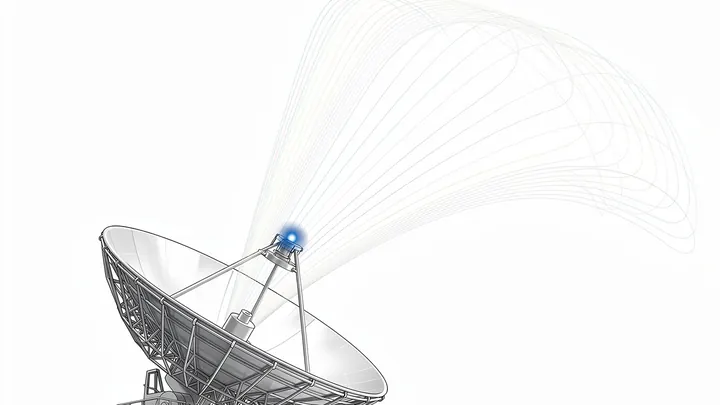
A network of radio telescopes scattered across the planet catches the whisper of a distant black hole. Each antenna records a signal, but how do you combine these recordings if the clocks at the stations tick at different rates and the atmosphere distorts incoming waves?
Somewhere in the depths of space, two supermassive black holes are circling each other. Their dance is not smooth — the orbit is stretched, like a rubber band that alternately tightens and relaxes. Each revolution sends ripples through the fabric of spacetime — gravitational waves.
Imagine a quiet room where you need to pick out a single melody among many barely audible rustles. That's roughly what it's like to search for signals from extreme systems of two black holes — one huge, the other millions of times smaller.
Two black holes circle in a cosmic dance, spiraling closer together. In the end, they merge into one, and that moment unleashes a powerful burst of gravitational waves, ripples in spacetime itself. But what remains after the merger?
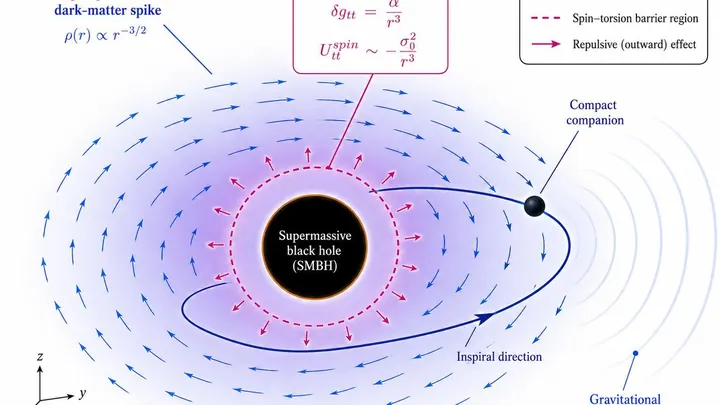
At the center of a galaxy sits a supermassive black hole, surrounded by a vast, tenuous cloud of dark matter. It doesn't shine or heat, but its gravity warps space and changes the rules of the game for everything orbiting nearby.
Space is full of invisible waves — ripples in the fabric of spacetime left behind by cataclysms like black hole mergers. An ordinary black hole swallows everything without a trace. But there are hypothetical exotic objects — ultradense clumps of matter without an event horizon (a surface from which not even light can escape).
At the centers of many galaxies, not only supermassive black holes lurk, but also vast clouds of invisible matter. If this matter consists of ultralight particles, it can gather into dense clumps — a kind of 'star' made of dark matter.
In May 2020, the LIGO and Virgo detectors picked up a gravitational-wave burst known as GW200105. Among the many similar gravitational waves recorded, this one stood out for an oddity: the orbit of the colliding neutron star and black hole was not a perfect circle, but a stretched ellipse.
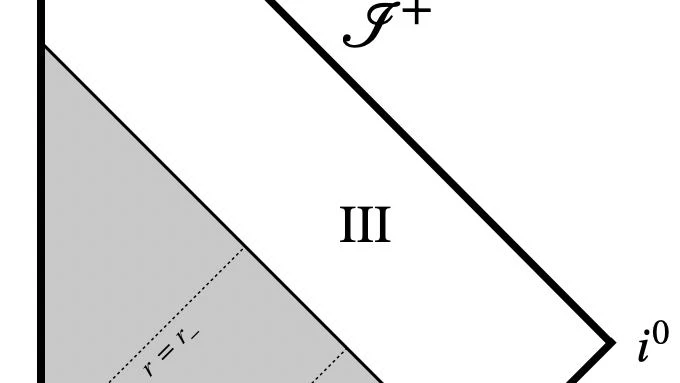
When a giant star runs out of fuel, it collapses into a black hole. Such a hole has an outer boundary — the event horizon, beyond which even light cannot escape. But many black holes also have an inner boundary — a second horizon that separates the outer layers from the singularity core.
In a recent study, astrophysicists showed how pre-recombination physics, particularly early dark energy, affects the spectral running $$α_s$$ and, consequently, the viability of scenarios forming primordial black holes from an ultra-slow-roll (USR) phase during inflation.
In the centers of distant galaxies, X-ray 'beacons' sometimes light up. They don't flash randomly but on a strict schedule: every few hours or days. These bursts are called quasi-periodic eruptions (repeating at nearly regular intervals).
Gravitational-wave detectors picked up a strange burst — the signal GW241011. Two black holes merged, but the pair looked unusual: one hole was about three times lighter than the other, and the system as a whole was spinning rapidly. Such a combination is a rare guest in the catalogs.
A tiny star spirals around a giant rotating black hole. Slowly, it moves closer in a spiral, and this dance lasts thousands of years. All the while, waves ripple through space, like ripples on water, but these are gravitational waves. They can be "heard" with special detectors.
At the center of a galaxy, a huge black hole is shrouded in an invisible cloud — a swarm of ultralight particles that it itself spawned. Into this cloud dives another black hole, about the size of a star, and begins a long spiral dance. The approach takes millions of years, but the most dramatic events unfold right at the horizon.
A rapidly spinning black hole, where spacetime is curved to the limit, resembles a bell that can hum for centuries. Its special oscillations barely decay, losing energy incredibly slowly.
A tightrope walker spirals over an abyss, each loop drawing closer to the center. Their path is not a smooth glide but a series of sharp jerks and pauses. That is roughly how a tiny black hole behaves when it is pulled toward a supermassive neighbor.
A supermassive black hole drifts through a cloud of dark matter. In the usual picture, this invisible substance just adds mass and barely interacts with ordinary matter. But dark matter particles could have intrinsic rotation — spin.
Waves sort pebbles on a sandy beach. Small stones lie close together, nearly identical in size. Farther from shore, there's a scatter of larger and more varied ones. And right at the waterline, where the surf is strongest, the biggest and most rounded fragments pile up. Nature sorts black holes by mass in much the same way when they merge in pairs.
When a piano falls into an abyss, we think about the abyss. We don't think about the piano's cover. In much the same way, astrophysicists have for decades studied extreme close encounters between small bodies and massive black holes. They focused on the black hole itself and what orbits it. But what the 'bullet'—the small object heading toward doom — is wearing, almost no one asked.
At the heart of nearly every large galaxy lives a supermassive black hole — a silent giant around which stars, gas, and other, smaller black holes orbit. From time to time, one of these objects breaks free from its orbit and begins to fall toward the central monster in a tightening spiral.
Gravitational waves from a tiny body falling into a black hole work like an X-ray image. Only instead of a bone, they illuminate the curved spacetime itself.
A tiny coin circles a heavy bowling ball. The coin is a small black hole or a neutron star, and the ball is a supermassive black hole at the center of a galaxy.
A giant black hole tore apart a star, leaving behind a lopsided disk of scorching gas — like a vinyl record warped by the heat. Now a tiny black hole (or a star) zips around and repeatedly pierces that disk. Each puncture is a bright X-ray flare.
Usually, black holes inch closer gradually, circling in a tightening spiral. This dance births a long ripple of gravitational waves — a tremor in the very fabric of spacetime. Detectors LIGO and Virgo routinely catch such mergers.
But GW190521 is the exception.
The universe is full of invisible substance that governs the movement of galaxies. In the 1970s, astronomer Vera Rubin showed: without dark matter, stars on the outskirts would have long since flown apart. But what it's made of remains unknown.
A stone falls into a well, and a second later, a splash. A star falls into a black hole, and disappears beyond the horizon, leaving only a ripple in space. But what if the bottom of the well is not a dead end but a passage? In the usual picture, matter compresses into a point of infinite density — a singularity.
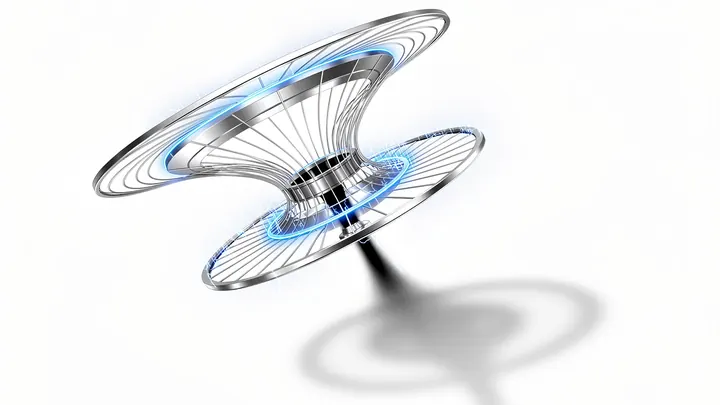
The shadows of supermassive objects at the centers of galaxies, M87 and the Milky Way, have become icons of modern astrophysics. But what if these shadows are not from absorption, but passage? The equations of Einstein allow for traversable wormholes — tunnels in the fabric of spacetime.
A swing swings higher and higher if you push it in rhythm. A similar mechanism kicks in when a dead star orbits a massive black hole shrouded in a cloud of ultralight particles. These particles are candidates for dark matter — the invisible substance that keeps galaxies from flying apart.
A figure skater glides across the ice, gradually moving toward the center. Their trajectory isn't a perfect spiral: sometimes they catch the rhythm of the music and add an extra turn, slightly changing their speed. That's roughly how a small black hole behaves when it falls into a supermassive one.
At the center of a vast funnel sucking everything in, a small ball spirals inward. As it orbits, a low hum arises: it's spacetime itself trembling, and we call that trembling gravitational waves. The frequency rises, the pitch climbs, just like the sound of a siren from a passing ambulance.
Two black holes spiral around each other not in a smooth dance, but like two stones thrown from opposite banks into a deep whirlpool. Their orbit resembles a highly flattened oval — the eccentricity is nearly one. When they finally collide, a powerful burst of gravitational waves is born — a shudder of space itself.
A spinning top on a table wobbles: its axis is tilted, and the motion becomes unsteady. Black holes surrounded by a disk of gas and dust behave similarly. If the rotation axes of the black hole and the disk do not align, the whole system begins to vibrate, producing ripples in spacetime — gravitational waves.
When two black holes merge, space shudders with gravitational waves, and the newborn hole receives a powerful kick, like a cannon recoiling. In the centers of galaxies, it often slams into a gas disk — a swirling cloud of matter, like a cosmic bullseye.
Two black holes spiral faster and faster until they merge into one. This dance shakes space itself: waves ripple outward from the collision site, like ripples from a stone thrown into a pond. Sometimes the merger also produces a flash of light.
Two non-spinning black holes at the moment of merger give birth to gravitational waves — ripples in the very fabric of spacetime, captured by instruments developed with the help of Kip Thorne.
A star made of dark matter is an invisible ocean of ultra-light particles, whose existence was first suspected by Fritz Zwicky back in the 1930s. Into this ocean plunges a neutron star — a tiny, yet unimaginably dense sphere.
Black holes are cosmic spinning tops. Their spin warps spacetime (as predicted by Einstein) and is described by a spin parameter from 0 to 1. The limit 1 is unattainable: infalling matter acts like a brake.
A stick thrown into a pond sinks straight down. But if the pond's water is slowly rising, the stick will be delayed and sink somewhere unexpected. So it is with black holes: we usually assume they sit in a void, but the entire universe is gently stretching. This stretch, like the rising water, slightly alters the path of anything orbiting nearby.
About 25,000 light-years from Earth, in the constellation Sagittarius, a dense veil wraps around the neutron star GX 13+1. It scatters X-ray photons the way fog scatters streetlight, and for a long time it hid the source's true power from astronomers.