Why a Single Recoil in a Detector Could Explain Dark Matter and Neutrino Mass ✛
In an underground laboratory in South Dakota, a tank holding ten tons of liquid xenon waits for a dark matter particle to fly through it. Over 60 days of observations, the detector registered a single nuclear recoil with an energy of 248 keV. This hit was too strong for ordinary background, and scientists are seeking an explanation.
A new model suggests viewing the event as a dark matter particle jumping to a higher rung on a ladder. The ladder consists of two nearly identical particles with a tiny mass difference. When the lighter particle strikes a xenon nucleus, it transitions to the heavier state, depositing energy into the nucleus. Such a transition explains the observed recoil. Elastic scattering is forbidden because the particle is its own antiparticle, leaving only the inelastic channel.
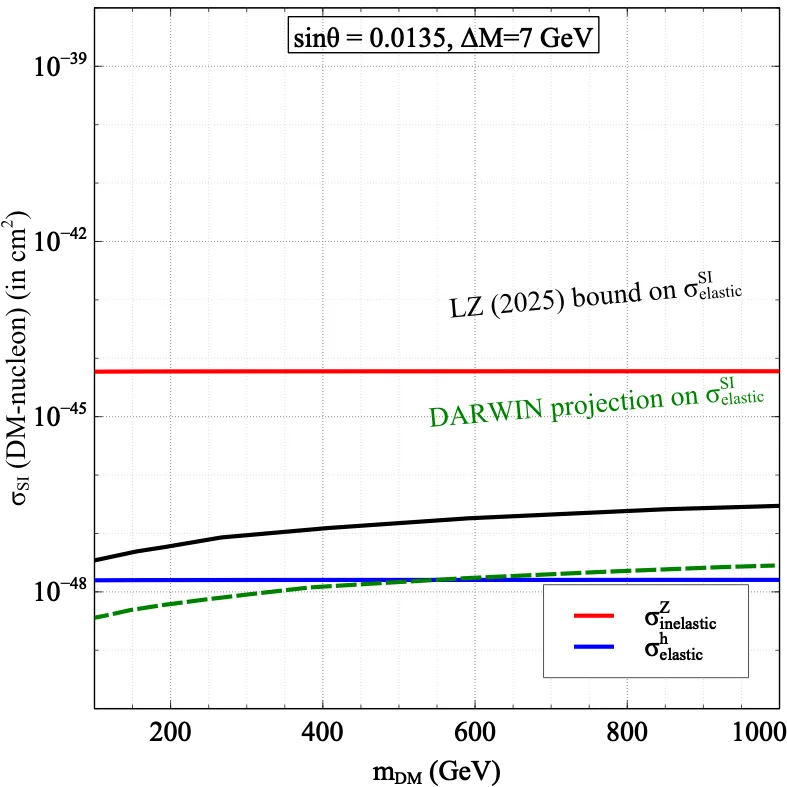
The most intriguing part is that the ladder is built by the same mechanism that gives mass to neutrinos. The model introduces a scalar triplet: three fields united by an internal symmetry. This triplet splits the pseudo-Dirac states and simultaneously generates small neutrino masses. Thus, the same mechanism accounts for both dark matter behavior and neutrino masses. Future experiments, such as DARWIN, could test this idea.
The recoil energy of 248 keV is roughly 50 times larger than typical thermal energies at room temperature, but for a xenon nucleus it is still a very weak kick: the nucleus would move at only about 0.1% of the speed of light after the collision.
The idea of dark matter split into two nearly degenerate states evokes the concept of 'dark twins' from Greg Egan's novels, where invisible matter has its own complex structure influencing visible matter through rare interactions.