A single bounce in an underground detector links dark matter to neutrino mass ✛
In an underground laboratory beneath Sanford Mountain in South Dakota, a tank holding ten tons of liquid xenon waits for a dark matter particle to fly through it. Over 60 days of observation, the LZ detector registered a single nuclear recoil with an energy of 248 keV. That hit was too strong for ordinary background, and various explanations have already been proposed, but they either require extreme parameters or fail to connect the recoil to the origin of neutrino masses.
A new model suggests viewing the event as a dark matter particle jumping to the next rung of a ladder. The ladder itself consists of two nearly identical particles with a tiny mass difference: pseudo-Dirac fermions. When the lighter particle strikes a xenon nucleus, it does not simply bounce off; it transitions to a heavier state, transferring energy to the nucleus. It is precisely this transition that explains the recorded recoil. Elastic scattering via the Z boson is forbidden by the particle's Majorana nature, meaning the particle is its own antiparticle, so only the inelastic channel remains.
The most intriguing part is that the ladder is built by the same mechanism that gives neutrinos their mass. The model introduces a scalar triplet: three fields united by an internal symmetry. This triplet splits the pseudo-Dirac states and simultaneously generates small neutrino masses via the type-II seesaw mechanism. Thus, one and the same mechanism accounts for both the behavior of dark matter and neutrino masses, reducing the number of free parameters.
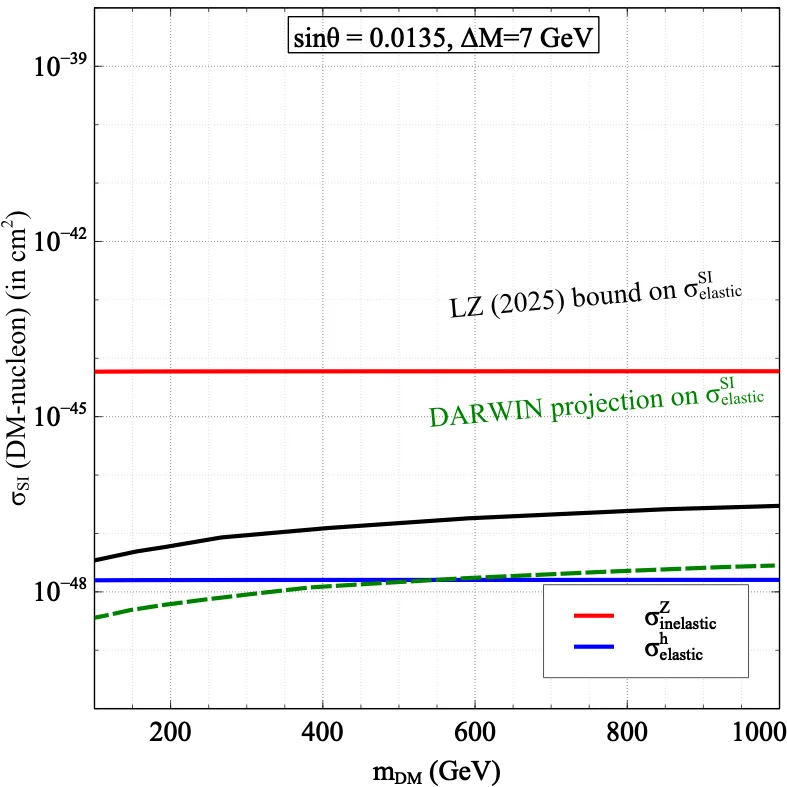
The model reproduces the LZ event over a wide parameter range: with a small mixing angle sinθ = 0.0135, the dark matter mass lies between 300 and 6000 GeV, and the splitting δ = 30–180 keV. Constraints on elastic scattering narrow the allowed mixing angle to sinθ ≲ 0.04, leaving only the lower values viable. For benchmark points with sinθ = 0.03 and 0.0135, the elastic scattering cross sections are 1.6×10⁻⁴⁸ and 6.6×10⁻⁵⁰ cm², respectively, both below the current LZ limit. The relic density of dark matter is achieved for all benchmark points through annihilation and coannihilation.
Future LZ data and planned detectors such as DARWIN will test the model's predictions in the small mixing angle region. If the event is confirmed, a detailed study of the scalar triplet's phenomenology will be needed: its decays, its contribution to electroweak precision observables, and possible collider signals. Of particular interest is the connection to indirect dark matter searches via annihilation into gamma rays, where the model could produce a characteristic spectrum. Dark matter may not just be jumping up a ladder; the ladder itself might lead to the solution of the neutrino mass puzzle.
The recoil energy of 248 keV is roughly 50 times larger than typical thermal energies at room temperature, but for a xenon nucleus it is still a very weak kick: the nucleus would move at only about 0.1% of the speed of light after the collision.
The idea of dark matter split into two nearly degenerate states evokes the concept of 'dark twins' from Greg Egan's novels, where invisible matter has its own complex structure influencing visible matter through rare interactions.