An underground laboratory is a research facility built deep beneath the Earth's surface, often in mines or caverns, to shield sensitive experiments from cosmic rays and other background radiation. Cosmic rays — high-energy particles from space — constantly bombard the surface, creating a noisy background that can swamp the faint signals physicists seek to detect. By placing detectors hundreds or even thousands of meters underground, the surrounding rock absorbs most of this radiation, providing a quiet environment for studying extremely rare events.
History
The concept emerged in the 1960s, when physicists began placing detectors deep underground to study neutrinos and search for proton decay. Early examples include the Homestake experiment in South Dakota, which began operating in 1967.
How it works
The overlying rock acts as a natural shield. When cosmic rays hit the atmosphere, they produce showers of secondary particles; the deeper the lab, the fewer of these particles penetrate. The rock also blocks gamma rays and neutrons from natural radioactivity in the environment. Labs are typically built in stable geological formations, with additional layers of shielding — such as lead or copper — inside the cavern to further reduce background noise.
In practice
Underground laboratories host experiments in neutrino physics, dark matter detection, and rare nuclear decays, such as the search for neutrinoless double beta decay.
Fun fact
The deepest underground laboratory, the China Jinping Underground Laboratory, sits under 2,400 meters of rock, reducing cosmic ray flux by a factor of about 100 million.
Deep inside a mountain, where cosmic-ray muons are muffled by a thick layer of rock, stands a detector that catches not light but its absence. Positronium is a tiny atom in which an electron and its antiparticle, the positron, circle each other like a pair of dancers. Usually they come together and vanish in a flash of two or three gamma quanta.
The universe is constantly sending us signals, but many are too faint to notice. Relic neutrinos, particles left over from the Big Bang, pass through Earth by the billions every second, yet catching even one is a feat on the edge of possibility. We need a detector that can sense energy a thousand times smaller than what it takes to move a speck of dust.
The Universe is structured like a sponge: there are dense regions packed with galaxies and gas, and giant pores — cosmic voids. These voids occupy most of space, but their contents have remained a mystery because matter there barely reveals itself.
Now astronomers have 'felt' the voids using fast radio bursts — super-powerful pulses from distant galaxies.
A dark matter detector is like a room where you're trying to hear a whisper while static electricity crackles nearby. This crackle is produced by radon atoms — a radioactive gas that seeps out from materials and air.
At the bottom of lunar craters, where sunlight never reaches, an eternal cold reigns — about minus 240 degrees Celsius. In these icy pockets, known as permanently shadowed regions, plans are underway to install a mirror resonator made of monolithic silicon.
Since Vera Rubin first convincingly showed that galaxies are surrounded by invisible matter, the quest to understand the nature of dark matter has remained one of physics' greatest challenges.
Deep inside an underground laboratory, a room-sized detector waits for an event that might happen once in a hundred million billion years. That event is neutrinoless double beta decay — a process that would break one of physics' fundamental laws. To catch it, you need perfect silence: not a single stray radioactive atom in the detector's materials.
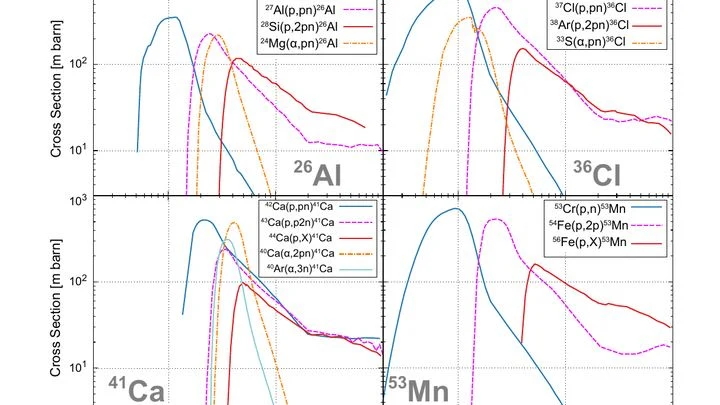
Just as yeast turns flour into fluffy dough, radioactive 'seasoning' from a supernova — the explosion of a massive star at the end of its life helps mold a rocky planet. The key ingredient here is aluminum-26, a radioactive isotope that releases heat as it decays.