Elastic scattering is a collision process in which the total kinetic energy of the interacting particles is conserved — the particles may change direction, but they do not lose energy to internal excitation or radiation. This is in contrast to inelastic scattering, where some kinetic energy is converted into other forms. Elastic scattering is fundamental to understanding how particles interact, from billiard-ball-like collisions of atoms to the deflection of electrons by nuclei.
History
The concept was formalized in the early 20th century with the development of scattering theory in quantum mechanics, notably by Ernest Rutherford's experiments on alpha particles scattering off gold nuclei, which were elastic and revealed the atomic nucleus.
How it works
During elastic scattering, the particles exchange momentum and energy, but the sum of their kinetic energies before and after the collision remains the same. The interaction is governed by the forces between the particles, described by a cross-section that quantifies the probability of scattering at a given angle. In quantum mechanics, elastic scattering is described by a scattering amplitude, which can reveal details about the potential energy between the particles.
In practice
It is used in neutron scattering to probe the structure of materials, in electron microscopy, and in medical imaging techniques like X-ray scattering.
Fun fact
In a perfectly elastic collision between two identical particles, they simply exchange velocities — a fact used to explain the behavior of ideal gases and the cooling of ultracold atomicclouds.
A hydrogen bubble on a platinum electrode behaves like a swimmer trying to surface, but every time it almost breaks free, something below grabs its legs. In the lab, high-speed cameras captured this behavior: a millimeter-sized bubble hangs near the surface, even though buoyancy pulls it upward with a force thousands of times stronger than surface tension can hold.
An octopus waits with tentacles spread wide. No central controller directs its arms, but the moment prey touches one, all eight wrap around it. Physicists have recreated a similar trick in the lab with a body that has neither neurons nor muscles: a star polymer with self-propelled arms.
The polymer was assembled from small cylindrical vibrobots on a vibrating plate.
A raindrop falls on glass and flattens into a pancake. Add a bit of polymer to the water, and it becomes elastic, like jelly. You'd think such a jelly would spread differently.
At a concert, moving through a dense crowd is tough — the tighter the pack, the less you want to move. That's how active matter usually behaves: swarms of bacteria or robot flocks freeze in tight quarters. But one research group found the opposite effect.
Imagine a multilayered shell where metal and insulator layers alternate like pages in a book. Such a structure can make an object hidden inside invisible to an observer. Light bends around it as water smoothly flows around a smooth stone: no ripple, no splash — no reflection, no shadow.
Two guitar strings are stretched on the same neck. They are almost identical, but one is slightly shorter — and they sound different. That's roughly how the two isomers of ethanimine work: molecules with the same set of atoms but rotated differently in space. Astronomers spotted this molecule in the dense clouds near the center of our Galaxy.
A thin layer of oil on the surface of water breaks into separate droplets at the slightest disturbance. Something similar happens in the pulsar wind — a stream of particles ejected by a rapidly rotating neutron star. This stream also contains plasma layers, which can break apart into clumps — magnetic islands.
When a raindrop hits a leaf, it flattens for a moment, then gathers itself and bounces off. But what if the drop isn't quite liquid, but jelly-like, like a gummy candy? Scientists took exactly such drops — made of hydrogel, a material that is 90% water but holds its shape thanks to a polymer network.
A cold cloud of atoms is like a swarm of fireflies drawn to one another. The attraction between atoms tries to pack them into a single dense ball. But quantum jitter, the unavoidable motion of particles, keeps the ball from collapsing. When the attraction is strong, the cloud breaks into separate clumps.
An electron flying through a gas is like a swimmer trying to cross a crowded pool. Each collision with an atom changes its course and speed. In dense argon gas, there are so many collisions that a simple description no longer works.
Physicists measured electron mobility — how easily electrons drift under an electric field.
When two atomic nuclei collide, the outcome depends on their energy and the angle at which the fragments fly apart. Typically, such calculations demand enormous computing power, and accuracy hits a wall due to approximations.
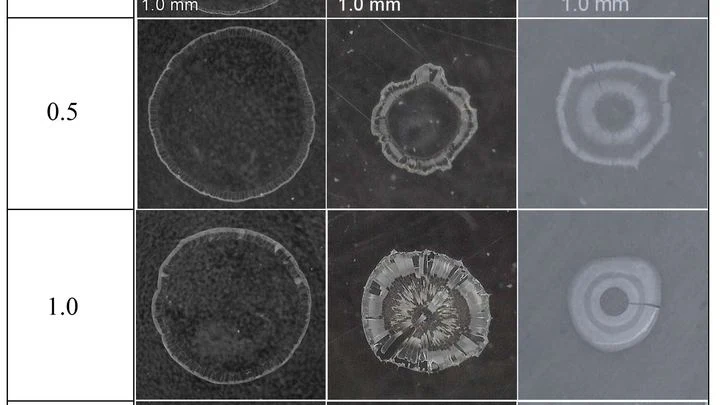
A drop of water with tiny particles dries on a table. The water evaporates, leaving the particles behind, and they arrange into a pattern, like sand after the tide. But if the particles are soft, the pattern turns out quite different. Researchers studied this process under a microscope, varying only one property of the particles: their elasticity.
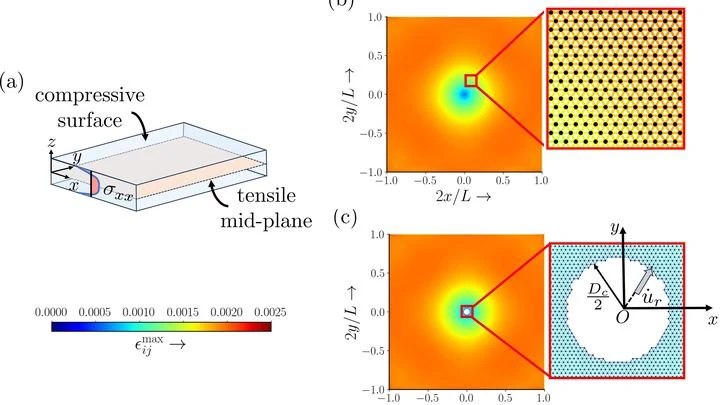
Glass is a material with attitude. It seems fragile, but powerful invisible forces can live inside it. In chemically strengthened glass, the surface is compressed like a stretched rubber band, while the interior is stretched. When a fast object hits such glass, that rubber band snaps in many places at once.
Scientists fired projectiles at glass and watched how it shattered.
When you press your finger on a piece of soft putty, it obediently dents and then slowly returns to its original shape. But if you press on a window pane, it either holds or cracks — no smooth deformation. Both materials are amorphous: their atoms are not arranged in a strict crystal lattice like in metal. Yet they behave completely differently.
Molten metal is like an overcrowded hall where everyone is waiting for a signal to start dancing. Crystallization is that very moment when chaos turns into order. But to start the dance, you need a first step: the appearance of tiny crystal nuclei. Usually, this requires the metal to be cooled a lot. It turns out that a simple shake can replace some of that cooling.
A water droplet races across a taro leaf like a bead on a freshly waxed floor. But it doesn't just glide: it picks up electricity. Thirty years ago, scientists explained why lotus leaves stay dry: their surface is covered with microscopic bumps that trap air. Now it turns out that water on leaves has another, hidden power.
A coffee drop on a table dries and leaves a ring — coffee particles gather at the edge. But if charged nanoparticles float in the drop, the picture becomes richer: the deposit cracks like mud in a dried-up puddle. Physicists studied how the particle charge and the surface on which the drop dries change these cracks.
A kitchen sponge squeezed in your fist springs back. But if you squeeze it slowly while letting it dry, it stays flattened. That's roughly what scientists did with tiny gel beads: they let them dry while compressing them, and watched what happened inside.
A gel is made of tiny particles that stick together into an open, lacy network, like cereal flakes in a bowl of milk.
A water droplet falls onto a lotus leaf and bounces off without leaving a trace. Nature has perfected this self-cleaning marvel over millions of years, and engineers have long tried to replicate it. But if the droplet hits too fast, it shatters into splashes, losing mass and leaving wet marks on the surface.