Inelastic Collision: How a Single Recoil in a Detector Linked Dark Matter to Neutrino Mass ✛
Context
The LZ event stands out: it is the only recorded candidate in the high-energy recoil region where the background is almost absent. Several interpretations have already been proposed, involving Higgsino, exothermic dark matter, and other candidates, but all either require extreme parameters or do not connect the recoil to the origin of neutrino masses. This work places the singlet-doublet dark matter model in this series, adding a mechanism for generating Majorana mass via a scalar triplet. Such an approach not only explains the kinematics of the event but also embeds it in a broader picture of particle physics.
Methods
The authors construct a model with a vector-like fermion doublet and a singlet, odd under a stabilizing Z2 symmetry. After electroweak symmetry breaking, the neutral states mix, and the lightest splits into two pseudo-Dirac fermions with a small mass difference δ. Inelastic scattering on xenon nuclei proceeds via Z-boson exchange, while elastic scattering through the Higgs channel is suppressed. To test the hypothesis, an extended maximum likelihood method is used: the differential event rate is computed, integrated over the LZ energy window (5.4–269.9 keV) for an exposure of 2.84 tonne-years, and a likelihood function is constructed for one observed event at 248 keV. The model parameters—dark matter mass, splitting δ, and mixing angle sinθ—are varied to find the best agreement.
Results
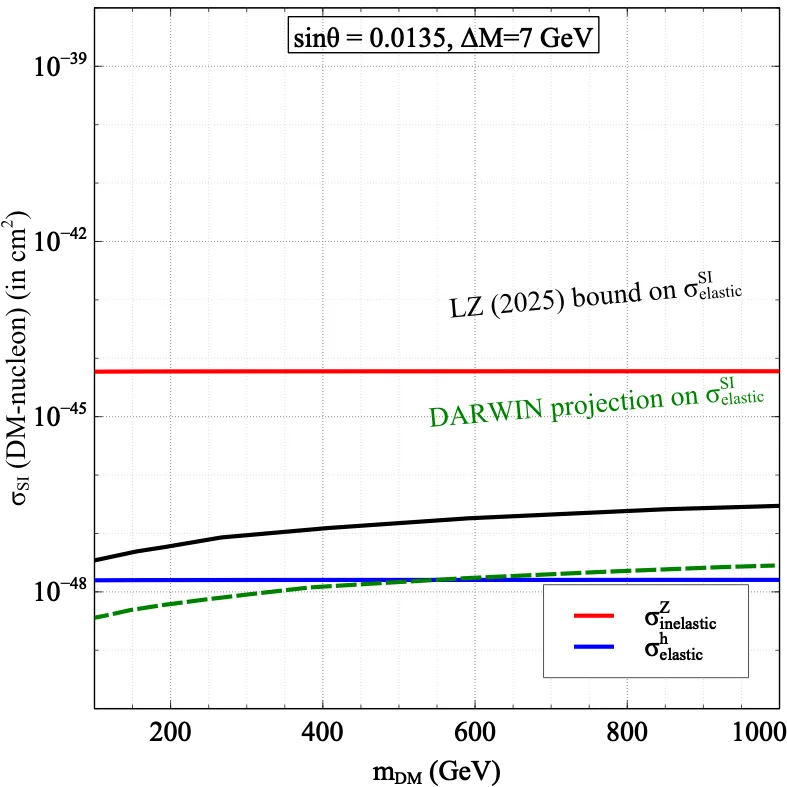
The model reproduces the LZ event over a wide parameter region: dark matter mass from about 300 GeV to 6 TeV, and splitting δ from 30 to 370 keV depending on the mixing angle. For sinθ = 0.0135, the preferred region lies at masses 300–6000 GeV and δ = 30–180 keV; for sinθ = 0.7, the mass increases to 10–600 TeV and δ to 310–370 keV. Constraints on elastic scattering narrow the allowed mixing angle to sinθ ≲ 0.04, leaving only the lower values viable. For benchmark points with sinθ = 0.03 and 0.0135, the elastic scattering cross sections are 1.6×10⁻⁴⁸ and 6.6×10⁻⁵⁰ cm², respectively, below the current LZ limit. The relic density of dark matter is achieved for all benchmark points through annihilation and coannihilation.
Implications
This work differs from neighboring interpretations of the LZ event by linking the inelastic recoil to the generation of Majorana mass through the same scalar triplet. It is not just a fit to kinematics but a unified mechanism that explains both the splitting of pseudo-Dirac states and neutrino masses via the type-II seesaw mechanism. This approach reduces the number of free parameters and provides testable predictions for future experiments searching for rare processes involving the triplet.
Future development
Future LZ data and planned detectors such as DARWIN will allow testing the model's predictions in the small mixing angle region. If the event is confirmed, a detailed study of the scalar triplet's phenomenology will be needed: its decays, contribution to electroweak precision observables, and possible signals at colliders. Of particular interest is the connection with indirect dark matter searches via annihilation into gamma rays, where the model could produce a characteristic spectrum.
Impact
The results will influence the interpretation of direct dark matter detection data, especially in the high-energy recoil region. The model also motivates searches for charged and neutral components of the triplet at the Large Hadron Collider and in high-luminosity experiments.
Next steps
A global fit of the model parameters is needed, including relic density, direct detection, and collider constraints. It is also important to consider scenarios with CP violation and the triplet's effect on the electroweak phase transition.
Key open problems
This work directly addresses the unresolved problem of the nature of dark matter and the origin of neutrino masses. It proposes a common mechanism for both puzzles, but leaves open the question of why the splitting scale of the pseudo-Dirac states is so small compared to the electroweak scale. This is part of the broader hierarchy problem in extensions of the Standard Model.
The knowledge machine's view
This section is addressed to the author of the paper and their colleagues. Neighbouring works were found by meaning-based search across our archive, not by word overlap. We do not review: we show the field around the work.
What the work does
The paper considers a singlet-doublet fermionic dark matter model where inelastic scattering off xenon nuclei via the Z boson explains the LZ event at 248 keV. The mass splitting of the pseudo-Dirac states is generated by a scalar triplet, which also accounts for neutrino masses through the type-II seesaw mechanism. The authors perform a maximum likelihood fit of the parameters (dark matter mass, splitting δ, mixing angle) and find consistent regions.
Where its strength is
A strong point is the unification of inelastic scattering and neutrino mass generation through a single scalar triplet, which reduces the number of free parameters and yields testable predictions.
Where it could go next
- Nearby is an analysis of the LZ event interpretation as a Higgsino, where dark matter scatters via Higgs exchange. It might be interesting to compare predictions for differential spectra and constraints on elastic scattering, and to explore how the allowed parameter regions differ in these two approaches.based on: Higgsino: An Invisible Guest in Liquid Xenon arXiv:2609.01583v1
- Our archive contains a paper on the influence of dark matter on neutrino properties, including possible modifications to oscillations. Since your model connects the dark sector to the neutrino sector via a scalar triplet, it might be interesting to consider how the new interactions affect neutrino experiments and cosmological constraints.based on: Dark Matter Changes the Face of Neutrinos arXiv:2605.06777
- There is a rapid review on dark matter searches in liquid xenon detectors, discussing various scattering channels. It might be useful to compare the sensitivity of your model to future experiments such as XENONnT or DARWIN, taking into account the inelastic channel and constraints on elastic scattering.based on: Dark Matter Knocks on the Detector arXiv:2605.20162
Worth trying
- Check whether your model can be distinguished from the Higgsino interpretation by the shape of the recoil spectrum at higher energies.
- Calculate the contribution of the scalar triplet to neutrino oscillations and compare with data from experiments such as T2K or NOvA.
- Assess the prospects for detecting inelastic scattering in future detectors with larger exposure, for example the XLZD project.
Why this may matter
Connecting the LZ event to neutrino mass via a common mechanism could point to new physics at the TeV scale, accessible to upcoming dark matter and neutrino experiments.
Nearby works in our archive
- Higgsino: An Invisible Guest in Liquid Xenonsimilarity 0.61
- Why Technetium and Promethium Are Outcasts of the Periodic Tablesimilarity 0.53
- Dark Matter Knocks on the Detectorsimilarity 0.52
- Dark Matter Changes the Face of Neutrinossimilarity 0.52
- A Neutrino Whisper from the Dark Sectorsimilarity 0.52
- Solar Neutrinos in a Dark Matter Trap: An Unexpected Tool for Helioseismologysimilarity 0.52
The archive is sparse around this work: the closest review is only 0.61, against a usual 0.64. It looks like few have drilled nearby.
The recoil energy of 248 keV is roughly 50 times larger than typical thermal energies at room temperature, but for a xenon nucleus it is still a very weak kick: the nucleus would move at only about 0.1% of the speed of light after the collision.
The idea of dark matter split into two nearly degenerate states evokes the concept of 'dark twins' from Greg Egan's novels, where invisible matter has its own complex structure influencing visible matter through rare interactions.
Key numbers
- LZ event energy: 248 ± 23 (stat.) ± 23 (syst.) keV
- LZ exposure: 2.84 tonne-years
- mass splitting δ: 30–370 keV (depending on mixing angle)
- dark matter mass: from ~300 GeV to ~600 TeV (in the studied region)
- mixing angle constraint: sinθ ≲ 0.04