Scientist

Roberto D. Peccei

1942–2022 · elementary particle physics, theoretical physics
Italian theoretical physicist, together with Helen Quinn proposed the mechanism for solving the strong CP problem in quantum chromodynamics, known as the Peccei–Quinn symmetry. This predicted the existence of axions, hypothetical particles that are prime candidates for dark matter.

Biography

Roberto Peccei was born in Italy in 1942. He graduated from the Massachusetts Institute of Technology (MIT), then worked at Stanford University, the University of California, Los Angeles (UCLA), where he became dean of the physics department and vice-chancellor for research. He made significant contributions to the phenomenology of elementary particle physics. He was a scientific administrator for major projects.

Key discoveries

💡 The term 'axion' was coined by Frank Wilczek, inspired by a detergent brand, because the new particle was supposed to 'clean up' the theory of the CP problem.
"He believed that if nature elegantly solves a problem, we should follow that hint."
Concepts
axiondark matterStandard Model
Scientists
Fritz ZwickyVera RubinEmilio Gino SegrèPaul DiracPeter HiggsRichard FeynmanJ. J. ThomsonMarie Curie

Related articles

Optics2024-11-293 minarXiv:2412.00271
A String That Never Goes Out of Tune: Higher Modes Hold Light in the Resonator
Tuning a string: higher harmonics help hold the pitch without drowning out the fundamental note. In an optical microcavity, a tiny resonator made of two mirrors, light bounces between the reflective surfaces, and any jitter in the spacing knocks it off resonance.
How a Sheet of Paper Decides to Wrinkle or Fold
A thin rubber film lies on a table. Someone grabs it by the middle and slowly pulls upward. The film doesn't just rise: it arches into a dome, then wrinkles run along the dome's edge, like pleats on a skirt. Pull higher — the wrinkles gather into large folds that cross the entire film. And if you start lowering it, the folds don't disappear but collapse into new shapes.
Exoplanets2026-01-061 minarXiv:2601.02665express
The Stumbling Dance of Two Planets Around TOI-4495
Two planets around the star TOI-4495 perform a stumbling dance: while the inner one completes two laps, the outer manages just one. But the rhythm is off — the inner planet speeds up and slows down, like a partner stumbling in her steps. Using the transit method, watching as the planets briefly dim the star's light, astronomers weighed these worlds.
Plasma Physics2026-01-222 minarXiv:2601.15567express
The Dense Dead End of Fusion
A fusion reactor is an attempt to hold a miniature sun in a magnetic cage. To get more energy out of it, you need to squeeze the plasma denser. But tokamaks have an invisible fence: once the density crosses a certain line, the plasma shudders and falls apart. This disruption is one of the main mysteries on the road to clean energy.
How a Drop with Nanoparticles Cracks on Glass
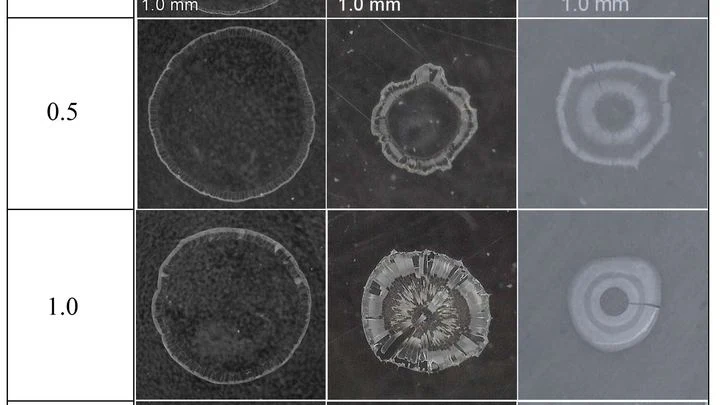
A coffee drop on a table dries and leaves a ring — coffee particles gather at the edge. But if charged nanoparticles float in the drop, the picture becomes richer: the deposit cracks like mud in a dried-up puddle. Physicists studied how the particle charge and the surface on which the drop dries change these cracks.
Geophysics2026-01-301 minarXiv:2601.22606express
Mars's Brain-Like Terrain Tells a Tale of Climate Shifts
In the northern part of Arabia Terra, there are fields that look like a giant brain: ridges and troughs wind like convolutions. On Earth, similar patterns form in cold regions when water in the soil freezes and thaws, causing stones to sort themselves into stripes. But the Martian ridges are taller — averaging 3.29 meters — while Earth's mechanisms produce less than half a meter.
Plasma Physics2026-02-072 minarXiv:2602.07329express
Why Stellarators Don't Blow Up
In a tokamak, plasma is like a crowd on a narrow street: once someone starts running, everyone takes off at once. In a stellarator with a non-circular cross-section, the street is winding, with dead ends and pockets. The crowd can't gather into a single wave — people get stuck in different corners.
q-bio.OT2026-03-013 minarXiv:2603.06657
The Two Leaks of Aging: Why Some Breakdowns Fix Themselves and Others Need a Specialist
In a house where people live, something is always breaking: a faucet drips, a door creaks, a light bulb burns out. The residents tighten the valve themselves, grease the hinges, screw in a new bulb. This is routine repair, it is visible, and you can do it with your own hands. But there are breakdowns of another kind: a crack in the foundation, corrosion inside a wall, a leak behind the drywall.
Quantum Gases2026-03-101 minarXiv:2603.09357express
Solitons on a Magnetic Rope
Magnetic waves in an ultracold gas behave like elastic cords. Two or three such cords can twist into a single knot that breathes: it contracts and expands, but never unravels. For the first time, scientists assembled such knots in the lab and confirmed that their breathing matches calculations exactly. The gas consisted of two atomic species that do not mix, like oil and water.
Materials2026-03-201 minarXiv:2603.20113express
Crack in the Battery: Why Dendrites Grow
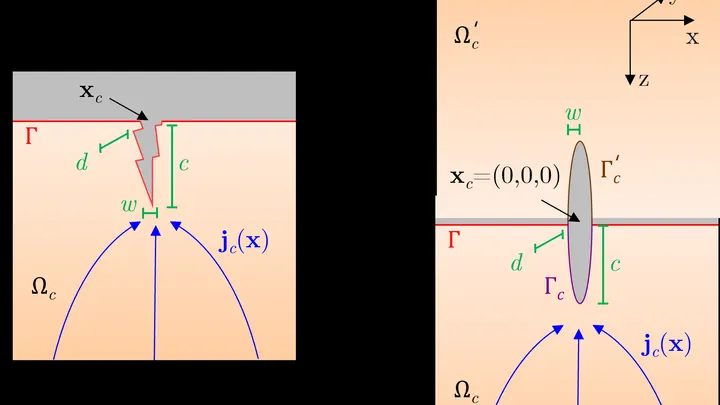
A metal filament as thin as a hair grows through the ceramic like a root through asphalt. In solid-state batteries, such filaments are called dendrites, and they appear when the charging current exceeds a critical threshold. The ceramic electrolyte is solid but brittle, like glass.
Materials2026-04-261 minarXiv:2604.23491express
Plutonium That Heals Itself
Plutonium is a metal with attitude. One form shrinks when cooled, another swells. But at room temperature, the alloy behaves strangely: the ruler says one thing, X-rays say another. The ruler shows the sample barely grows, while X-rays see atoms in the crystal lattice moving further apart.
Strongly Correlated2026-05-172 minarXiv:2605.17469express
A Magnetic Pattern from Three Rivals
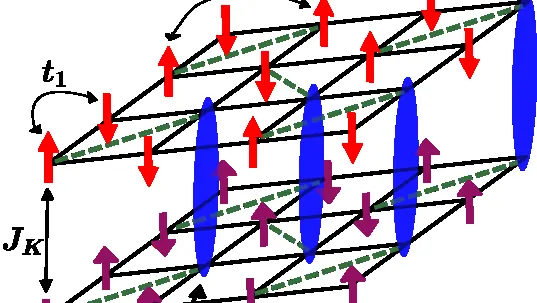
The magnetic field increases, but the magnetization stays put. It's like a scale where you add weight, yet the needle doesn't move until enough has accumulated to jump to the next mark. That's exactly how rare-earth tetraboride crystals behave, and physicists have been puzzled for decades.
HEP Theory2026-05-212 minarXiv:2605.22974express
Walls That Collapse Faster Than Light
A balloon doesn't deflate all at once: first, dents appear on its surface, which run, merge, and finally the balloon shrivels into a point. Domain walls behave in much the same way — thin partitions that divided space in the first moments after the Big Bang.
A Sleeping Layer of Cells Remembers Which Way to Crawl
A tightly stretched sheet lies on a table for days. Outwardly it's still, but the fabric fibers retain tension — loosen one edge slightly, and wrinkles will run across it, rearranging the whole pattern. That's roughly how a layer of epithelial cells behaves at rest. It doesn't just freeze; it accumulates mechanical stress — a kind of cellular memory of past movements.
Materials2026-05-281 minarXiv:2605.29925express
Trap Defects: Why a Solar Material Won't Deliver Current
Sunlight hits a crystal, and inside, a pair is born — a swift electron and a hole. Ideally, they immediately race off to the contacts and produce current. But in the material the authors studied, things go differently. The moment a charge stumbles upon a void, a missing atom in the lattice, a cloud of vibrations tightens around it.
Cosmology2026-06-233 minarXiv:2606.24886
The Logarithmic Revolt of Monopoles
When the cooling cosmos, in the aftermath of the Big Bang, lost its primordial symmetry, tensions arose in the fields, like microcracks forming in solidifying glass. Global monopoles, predicted by Gerard 't Hooft and Polyakov, became such “scars” on the fabric of the universe. Each monopole is a tiny but incredibly massive knot of field.
HEP Phenomenology2026-07-111 minarXiv:2607.10272express
The Strong CP Problem: Much Ado About Nothing?
Quantum chromodynamics is the theory that describes how quarks and gluons assemble into protons and neutrons. In its equations, there is a strange angle, the parameter θ (theta).
Defects in the Cellular Dance: How Obstacle Size Dictates Symmetry
A cell monolayer resembles a crowd of people lined up one behind the other. If there are obstacles in the crowd, say two pillars, people must go around them, and vortices appear in the flow. In living tissue, such vortices are called topological defects, and they are not just a random occurrence but a way for the tissue to adapt to the shape of its surroundings.
The Secret of Eight Blocks: How Molecular Building Blocks Create Order in Cuprates
At first glance, a city of blocks looks orderly, but its rhythm is set not by the streets themselves but by the houses that line them. In cuprates, layered copper oxides, a mysterious periodicity of eight unit cells (8a0) has long been observed, as if the streets were laid out with a spacing of 8.
Materials2026-09-093 minarXiv:2609.09761
Building blocks on a substrate: how roughness controls self-assembly
On a smooth silicon wafer, gold nanocubes behave like a crowd on an ice rink: at first, individual figures glide randomly across the ice, but within a minute they gather into an even carpet covering two-thirds of the area. A gap of two nanometers remains between the cubes, roughly like the space between neighbors in a queue.
Cracks Learn from Their Mistakes
A drying puddle of mud becomes covered with cracks, like an old painting with craquelure. At first the cracks meet at nearly right angles, forming a rough grid. But if the mud is wetted again and allowed to dry, the pattern changes: cracks begin to meet in threes, at an angle of 120 degrees, like a honeycomb. Why this happens remained a mystery for a long time.
Water Breaks on Graphene Defects
Picture a tiny hole in a sheet of graphene: a single missing carbon atom. It used to be thought that a water molecule splits apart at this defect only on its own, in dry gas. But if liquid water is sloshing all around, everything changes.