Nucleation is the initial step in a phase transition where a new phase (like a crystal, bubble, or droplet) forms from a metastable parent phase. It involves the formation of a small nucleus that must overcome an energy barrier to grow. Nucleation is crucial in many natural and technological processes, from cloud formation to the boiling of water, and even in the early universe's phase transitions that might produce gravitational waves.
History
The theory of nucleation was developed in the 1920s-1930s by Volmer and Weber, and later refined by Becker and Döring. The classical nucleation theory remains a cornerstone, though modern extensions account for non-classical pathways.
How it works
In a metastable phase (e.g., supercooled liquid), thermal fluctuations create tiny clusters of the new phase. If a cluster is smaller than a critical size, it dissolves; if larger, it grows. The critical size is determined by the balance between the energy gained from forming the new phase (volume term) and the energy cost of creating an interface (surface term). Nucleation can be homogeneous (spontaneous) or heterogeneous (assisted by impurities or defects, which lower the energy barrier).
In practice
Nucleation is used in controlled crystallization for pharmaceuticals, in cloud seeding for weather modification, and in understanding bubble formation in boiling water. It also plays a role in the formation of neutron stars from supernovae.
Fun fact
Vibrations can trigger nucleation in a melt, as shown in experiments where shaking a supercooled liquid induces crystallization, a phenomenon used in some industrial processes.
Two mica plates, smooth as mirrors, slowly approach each other in a calcium solution. At a distance of fifty nanometers, an invisible barrier suddenly appears between them: as if someone had stretched a web of molecules between the walls. This web prevents the plates from touching, even though by all calculations they should glide freely toward each other.
Deep inside a neutron star, where matter is compressed to the density of an atomic nucleus, neutrons form a superfluid and protons form a superconductor. A neutron vortex is a quantized vortex in the superfluid, akin to a miniature whirlpool that cannot stop spinning.
Plasma is a gas in which electrons are stripped from atoms and roam freely. Sometimes, regions where electrons are almost absent spontaneously appear in such a gas; they are called holes. It is like a whirlpool forming in a stream, pulling everything around it in. But exactly how such a whirlpool is born has long remained a mystery.
A uranium-235 nucleus that captures a slow neutron doesn't immediately fly apart into fragments. Instead, it seems to get stuck in two 'pits'—states with different shapes. The first, the ground state, is a slightly elongated drop. The second, the isomeric state, is a drop stretched further but not yet torn.
In water cooled to –40°C, a paradoxical pause sets in: perfect hexagonal ice is in no hurry to form. Instead, a disordered structure with interspersed cubic layers emerges — a real cradle for future symmetry, brimming with disorder yet already charged with hidden architecture.
The quantum vacuum is not a dead void but a boiling cauldron of probabilities. In some theories, our Universe is frozen in a metastable state: like superheated water, it's ready to explode into steam at the slightest nudge.
Dark matter remains one of the greatest mysteries of modern physics. Back when Vera Rubin observed galaxy rotation, she proved that visible matter is insufficient to keep stars from flying apart.
In the first moments after the Big Bang, the Universe was not a silent void but a seething cauldron of plasma, threaded with sound waves. As the temperature dropped, the cosmos underwent phase transitions — spontaneous reorganizations that gave birth to bubbles of a new phase.
Diamond is a symbol of perfection, but its true magic is revealed through flaws. Perfect lattice purity gives transparency and hardness, while defects, such as color centers, open a portal to the quantum world, becoming the foundation for quantum computers and quantum sensors.
Hot tea in a freezer doesn't freeze all at once. First, tiny ice needles dart around — forming and melting until the temperature drops enough for the ice to set solid. The early universe behaved similarly as it cooled and changed its internal structure.
In a pot of boiling water, steam bubbles rise and pop. In the quantum world of a superfluid, bubbles behave differently: they can collide and give birth to vortices — tiny swirling flows, like whirlpools in a river.
Scientists modeled such a liquid using a holographic approach.
Nitrogen, the very gas we breathe, behaves like a finicky metal under a million atmospheres of pressure. In a diamond anvil cell, it is squeezed to 78–98 gigapascals and heated with a laser to 1800–2500 kelvin. Under these conditions, N₂ molecules rearrange into crystals that can store energy more densely than explosives.
The assembly of a virus shell is like fastening a button: protein blocks must interlock in the correct order, and thermal fluctuations act like trembling fingers. With weak binding, the trembling helps find the right position — the shell closes faster.
A tumor doesn't stay put. Individual cells or whole groups break off and set off on a journey through the body. Some crawl solo, like scouts; others stick together, like a flock. Scientists built a computer model to understand how these cells pick a direction.
In the model, cells respond to two signals.
Molten metal is like an overcrowded hall where everyone is waiting for a signal to start dancing. Crystallization is that very moment when chaos turns into order. But to start the dance, you need a first step: the appearance of tiny crystal nuclei. Usually, this requires the metal to be cooled a lot. It turns out that a simple shake can replace some of that cooling.
Ten microseconds after the Big Bang, the Universe resembled a pot of boiling broth. Floating in it were quarks and gluons — the particles that would later assemble into protons and neutrons. As the broth cooled, at some point the quarks clumped together into lumps — the very protons and neutrons that make up all visible matter.
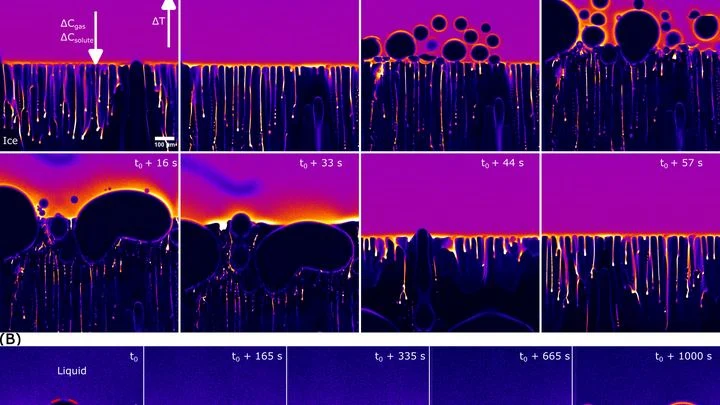
In a glass of soda, bubbles merrily rise to the top. But if you freeze the water, some bubbles end up trapped in the ice. How do they get there? After all, ice grows, pushing gas aside, but it doesn't always manage to.
Ultrasound in a liquid is like shaking a bottle of soda vigorously: shake it, and bubbles appear. In science, this is called cavitation, and the bubbles don't just float around: they are born, grow, and collapse with tremendous force.
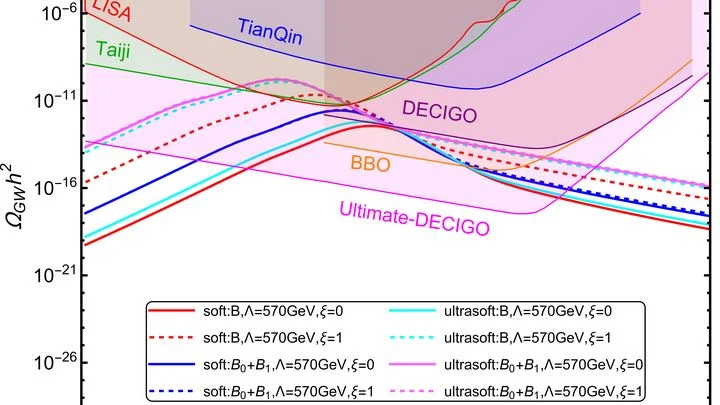
In the infant universe, right after the Big Bang, space was expanding rapidly, and the vacuum resembled a superheated liquid. When 'boiling' began, bubbles of true vacuum emerged. Expanding at the speed of light, they triggered gravitational waves — tremors of space itself that have reached us.
The early universe was an extremely hot and dense medium. In this medium, like bubbles of steam in boiling water, bubbles of a new state of space spontaneously emerged — regions where physical properties changed abruptly.
The universe exists in a state of false vacuum, like water behind a dam. Behind it lies the true vacuum — an abyss with different laws. Normally, water can only seep through the pores in a thin trickle (a quantum effect), barely changing the level.