Unequal jets gave the neutron star of Cassiopeia A its kick
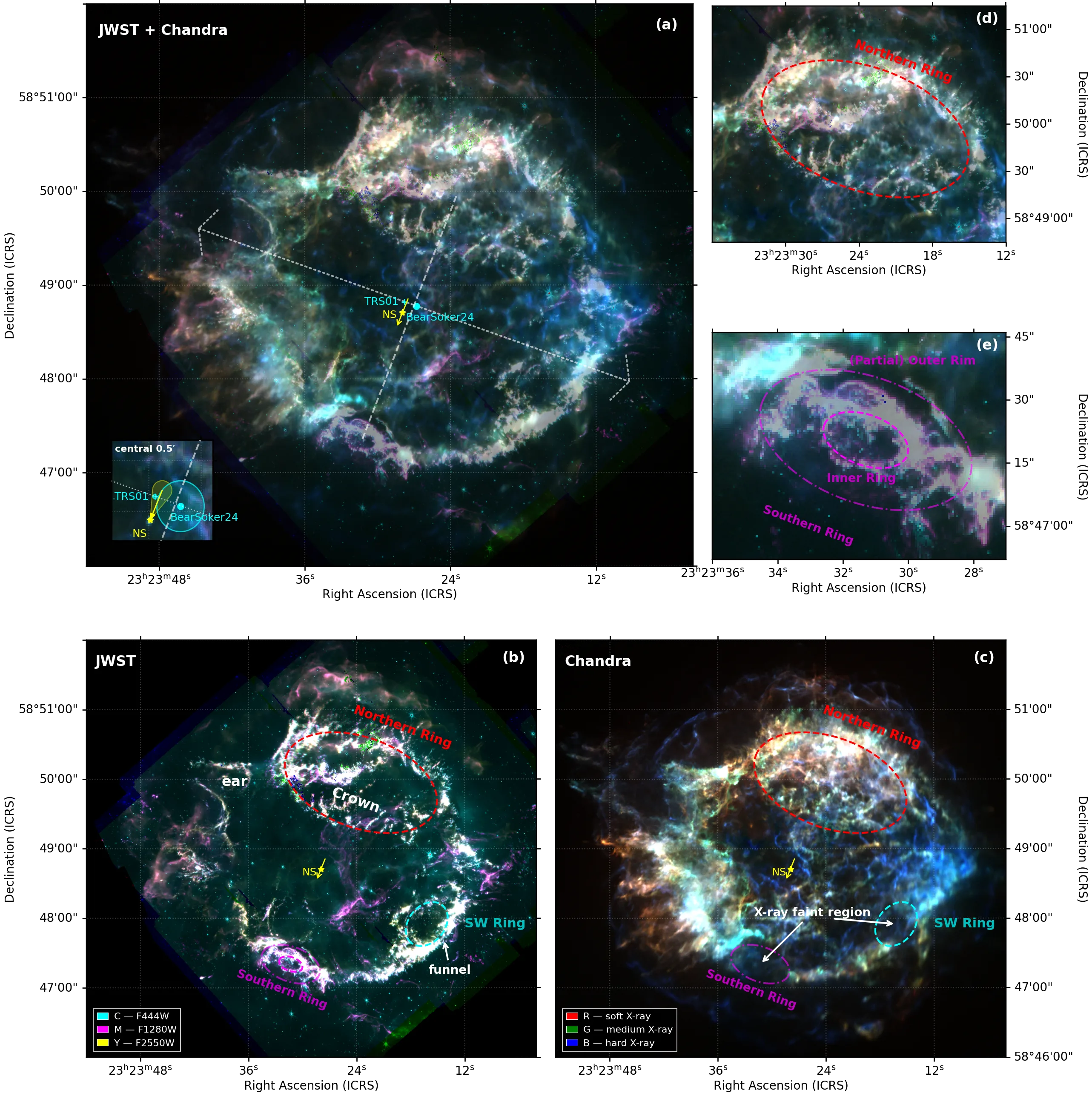
At the center of the supernova remnant Cassiopeia A, a neutron star races along at 400 kilometers per second. In a single second it covers the distance from Moscow to St. Petersburg. Where does that acceleration come from? A new study shows that the star was pushed by two shots from a cosmic cannon, and one of them was forty times more powerful than the other.
The star's explosion left behind an expanding cloud of gas. Images of Cassiopeia A reveal two rings: a large northern one named the "Crown" and a small southern one. They lie on the same axis but differ greatly in size. The researchers combined images from the JWST and Chandra telescopes, measured the rings, and built a three-dimensional model of the explosion. In the model, the star first exploded spherically, and four seconds later two jets, narrow streams of matter, struck out in opposite directions. The northern jet carried an energy of 3.6×10^50 erg, while the southern one carried only 9×10^48 erg.
The model reproduced both rings with the correct size ratio. The axis connecting their centers passes through the remnant's point of symmetry. At the boundary of the rings, a Rayleigh-Taylor instability developed in the model: finger-like outflows resembling the "Crown" seen in the observations. This means that an asymmetric pair of jets really could have formed both the rings and the star's kick.
Previously, the "Crown" was explained by rising bubbles of nickel. The new work is the first to link a specific pair of rings to the motion of the neutron star through the kick-BEAP mechanism. It strengthens the case for "wobbly jets," the idea that a supernova explosion produces several pairs of jets that change direction.
This method can now be applied to other supernova remnants. If rings and kicks turn up often, then jet asymmetry is a common source of neutron star velocities. Cassiopeia A has once again proved to be the key: its proximity and youth allow astronomers to see details that have long since been erased in other remnants.
The neutron star in Cassiopeia A moves at about 400 km/s. In one second it covers the distance from Moscow to St. Petersburg.