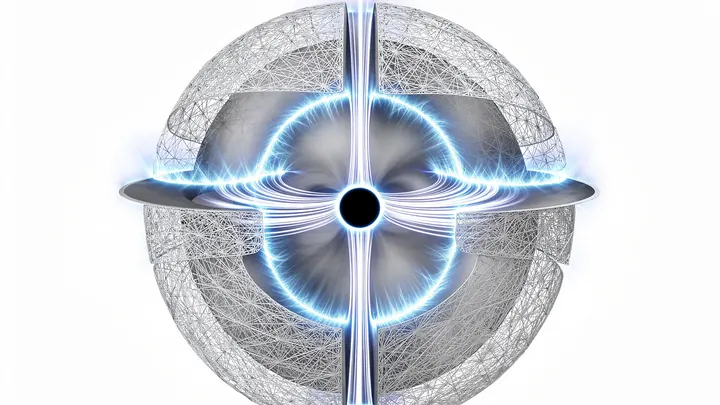
A supernova remnant is the expanding shell of gas and dust left after a star explodes, often accelerating cosmic rays.A supernova remnant is an expanding shell of ejected material and swept-up interstellar matter. Inside lies a hot, tenuous bubble bounded by a shock wave that heats gas to X-ray emitting temperatures. Several morphological types exist: shell-type (like Cassiopeia A), plerionic (powered by a pulsar wind, like the Crab), and mixed. Supernova remnants enrich the interstellar medium with heavy elements and launch cosmic rays.
Fritz Zwicky in 1934 predicted neutron stars as supernova remnants. The discovery of pulsars by Jocelyn Bell Burnell in 1967 confirmed this connection. Subrahmanyan Chandrasekhar earlier calculated the white dwarf mass limit, indicating the inevitability of collapse for more massive stars. Advances in X-ray astronomy (Chandra, XMM-Newton) have allowed detailed study of remnant dynamics and chemical composition.
The shock wave propagates through the interstellar medium according to momentum and energy conservation. The Sedov-Taylor solution for a point explosion in a uniform medium is applied: radius depends on time as R ~ t^{2/5}. High-energy electrons in magnetic fields produce synchrotron emission, explaining radio glow. Heavy elements (oxygen, silicon, iron) synthesized in the star are ejected and mixed with interstellar gas, influencing subsequent star formation.
Supernova remnants are natural accelerators of cosmic rays and factories of heavy elements; their emission helps study the interstellar medium and explosion dynamics.
The Crab Nebula expands at about 1,500 km/s — while you read this sentence, its diameter increases by a distance comparable to Earth's size.