Unequal jets gave the neutron star in Cassiopeia A its kick
Context
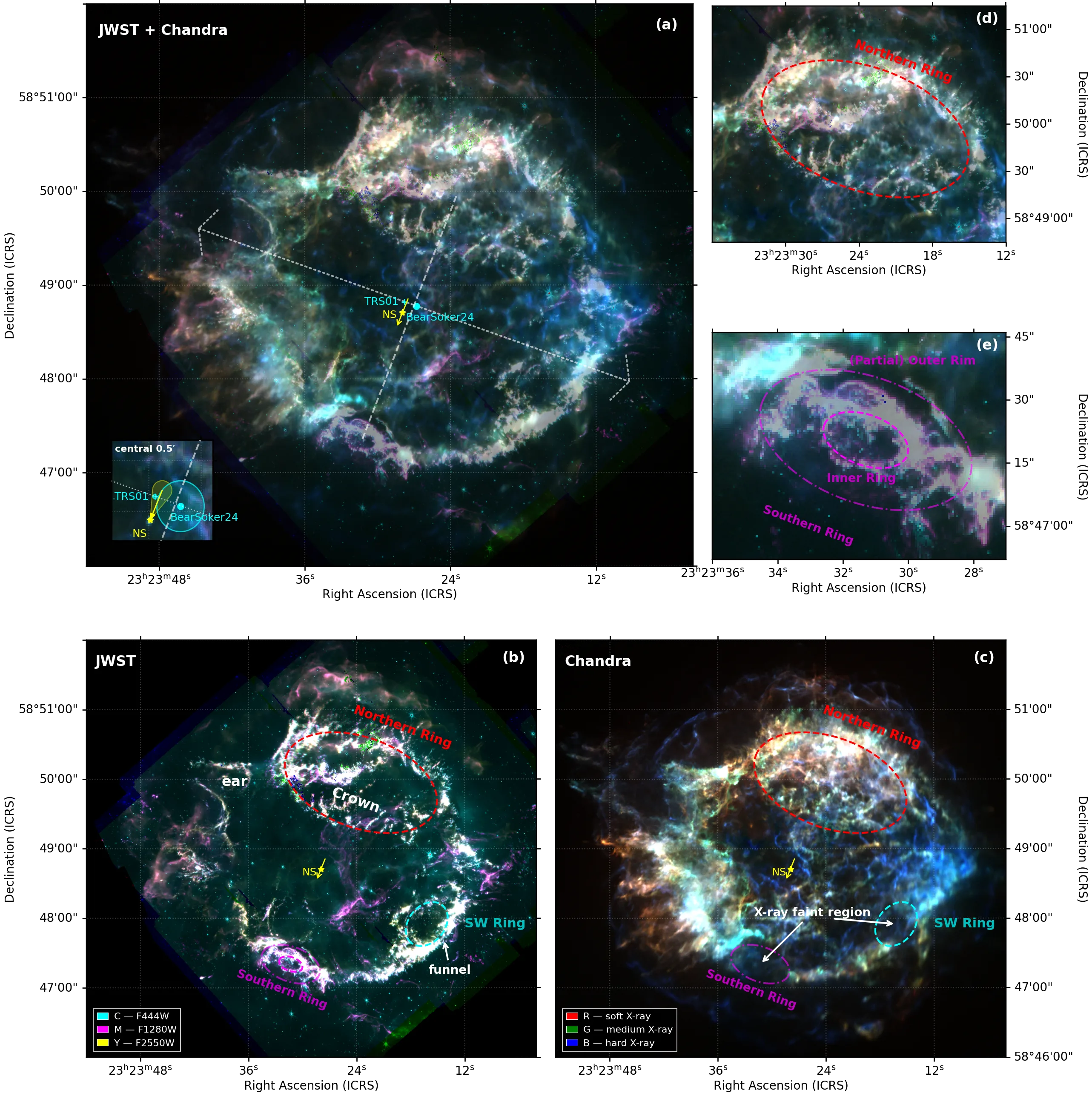
Cassiopeia A is one of the closest and brightest supernova remnants, and it is only about 340 years old. Because it is so close and so young, its large-scale ejecta structures have survived without being distorted. Point-symmetric morphology had already been found in this remnant: seven pairs of opposing structures, which points to several pairs of jets at the time of the explosion. The new work adds another axis of symmetry, the one connecting the two rings, and links it to the motion of the neutron star. This places Cassiopeia A among the remnants where the 'wobbling jets' mechanism explains both the shape and the kick of the compact remnant.
Methods
The authors analyzed images of Cassiopeia A from the JWST (infrared) and Chandra (X-ray) telescopes, combining them into a single picture. In those images they identified the northern Crown ring and the smaller southern ring, and measured their axes and their position relative to the explosion center. They then ran a three-dimensional hydrodynamic simulation on an adaptive mesh with a resolution of up to 35 km: first they exploded the star spherically, and 4 seconds later they launched a pair of opposing conical jets with different energies. The northern jet had an energy of 3.6×10^50 erg and an opening angle of 20°, while the southern one had 9×10^48 erg and 5°. They compared the shape and size of the rings in the model with the observations.
Results
The simulation reproduced a pair of rings of different sizes: a large northern one and a small southern one, just as in Cassiopeia A. The ratio of the long axis to the short axis is 1.75 for both rings, which corresponds to a tilt of the jet axis to the line of sight of 55°. The line connecting the centers of the rings passes through the previously found center of point symmetry of the remnant. The difference in the jets' momenta (588 solar masses × km/s) gives a neutron star of 1.4 solar masses a velocity of about 420 km/s, close to the observed estimate of 350–400 km/s. The rings in the model show the Rayleigh–Taylor instability, which produces finger-like ejecta resembling the Crown seen in the observations.
Implications
The work adds yet another axis of symmetry to the ten already known in Cassiopeia A, strengthening the case for the 'wobbling jets' mechanism in this remnant. Unlike neighboring studies that explained the Crown as rising nickel bubbles, here the rings are treated as traces of jets interacting with the ejecta. This is the first work to link a specific pair of rings to the kick of the neutron star through the kick-BEAP mechanism. The result shows that jet asymmetry may be a common source of kicks in neutron stars.
Future development
The topic could move toward more detailed modeling with several pairs of jets and a non-uniform envelope, in order to reproduce the fine fingers of the Crown. It would also be promising to apply the kick-BEAP mechanism to other supernova remnants with known kicks and ring-like structures. Further high-angular-resolution observations, for instance with XRISM, will help pin down the velocities and the composition of the ejecta in the rings.
Impact
The result will affect our understanding of core-collapse supernova explosion mechanisms and of models for the formation of neutron stars with high velocities. It will also provide a new tool for interpreting the morphology of supernova remnants in other galaxies.
Next steps
The next step is to run simulations with several pairs of jets to test whether the ring structure survives under a more complex explosion picture. It would also be worth comparing the model's predictions with detailed maps of ejecta velocities obtained through spectroscopy.
Key open problems
The work is directly tied to the unsolved problem of the core-collapse supernova explosion mechanism: the neutrino mechanism does not explain the point symmetry of remnants, whereas the 'wobbling jets' mechanism does so naturally. Another open question is the origin of neutron star kicks, which often exceed 100 km/s; here a concrete mechanism is proposed, with testable morphological signatures.
The neutron star in Cassiopeia A moves at about 400 km/s. In one second it covers the distance from Moscow to St. Petersburg.
Key numbers
- neutron star kick velocity: 350–400 km/s
- ratio of the energies of the northern and southern jets: 40
- tilt angle of the jet axis to the line of sight: 55°
- energy of the northern jet: 3.6×1050 erg
- age of the remnant: 340 years