The cubic metre (symbol m³) is the SI unit of volume, defined as the volume of a cube with edges one metre long. It is the standard unit for measuring quantities like the capacity of a room, the flow rate of a river, or the volume of a gas in physics and engineering. Because it is a derived unit, it connects directly to the base unit of length, making it consistent across all scientific calculations.
History
The cubic metre was adopted as part of the metric system in France in the 1790s, alongside the metre itself. It became the official SI unit of volume in 1960 when the International System of Units was established.
How it works
A cubic metre is simply the product of three lengths: 1 m × 1 m × 1 m. For any rectangular box, volume = length × width × height, all measured in metres. For irregular shapes, volume is often determined by integration or by displacement of water. In physics, the cubic metre appears in density (kg/m³), flow rate (m³/s), and gas laws, where volume is a key state variable.
In practice
It is used universally in construction (concrete volumes), environmental science (water discharge), and industry (storage tank capacities).
Fun fact
One cubic metre of water at 4°C has a mass of exactly 1000 kilograms, which is why the litre (1/1000 of a cubic metre) is defined as the volume of one kilogram of water.
Systems:SIVolume of a cube with edges one metre long.
Light or sound can be confined in a tiny region of a crystal, like a pearl in a shell. Usually, two methods are used. The first is like a heavy ball in a pit: a particle with large mass simply cannot roll out. The second is a perfect cage of mirrors, where waves cancel each other everywhere except in the trap itself.
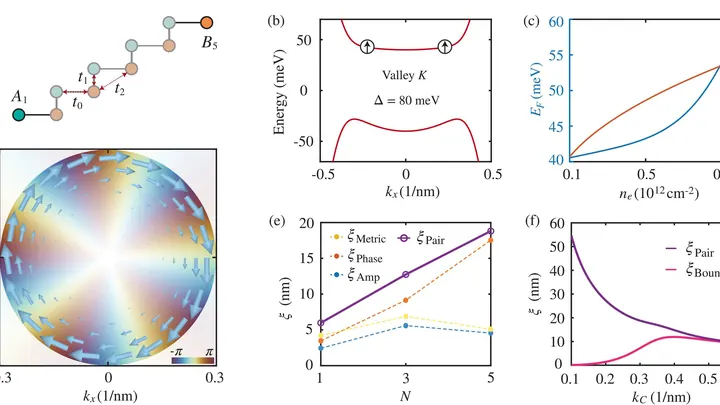
In a superconductor, electrons pair up like dancers holding hands. Usually, the distance between them, the pair size, depends on how fast they move and how strongly they are bound. But sometimes the dance floor almost disappears, and there's nowhere to move. This happens in materials with flat electronic bands: electrons nearly freeze, and the usual rules stop working.
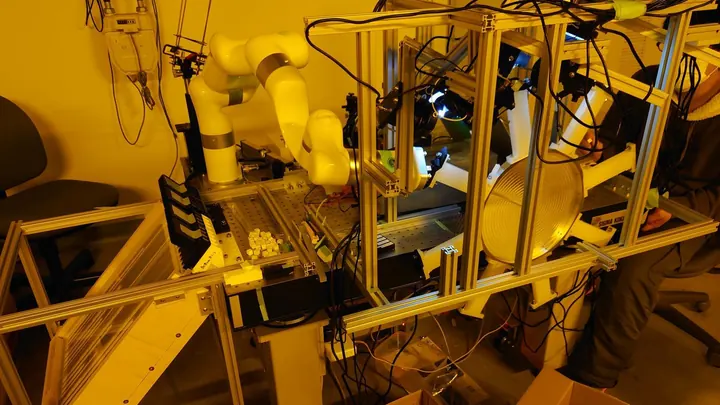
The future neutrino detector will contain millions of tiny plastic cubes: each the size of a die. They flash when a ghostly particle passes through, and that flash must be captured and measured. But if a cube is warped, has a burr, or a hole in the wrong place, the signal gets distorted, and the detector starts lying.
Checking each cube by hand is like sifting through sand on a beach.
A branching network, like a river delta or a tree crown, is built on the principle of economy. The classic law, derived back in 1926, stated that the cube of the parent vessel's diameter equals the sum of the cubes of the daughter diameters. This rule worked beautifully for ideal tubes, but real arteries stubbornly gave a different exponent — around 2.7 instead of 3.
The authors of the new study found the reason.
In a quiet lab, a device the size of a microwave oven sits on a table. Inside, a coil glides smoothly up and down while a computer reads electrical signals. This is the tabletop Kibble balance — a machine that links mass to quantum constants.
Previously, such balances occupied a whole room and required a team of engineers.