The reciprocal metre (symbol: m⁻¹) is the SI unit of wavenumber, spatial frequency, and other quantities that are defined as the inverse of a length. It represents one cycle or one wavelength per meter. In spectroscopy, the reciprocal centimeter (cm⁻¹) is more commonly used, but the reciprocal metre is the coherent SI unit. It also appears in the definition of optical power (diopters, which are m⁻¹) and in the curvature of surfaces.
History
The reciprocal metre was adopted as part of the SI system when it was established in 1960, though the concept of inverse length units has been used in optics and acoustics for much longer.
How it works
A quantity measured in reciprocal metres is obtained by dividing 1 by a length. For example, if a wave has a wavelength of 0.5 meters, its wavenumber is 1/0.5 = 2 m⁻¹. The unit is dimensionally the inverse of length, so it can be used to express any rate of change per unit distance, such as the attenuation coefficient of light in a medium (in m⁻¹) or the spatial frequency of a grating.
In practice
Reciprocal metres are used in optical design (lens power), in characterizing the decay of signals in fiber optics (attenuation in dB/km, but also in m⁻¹), and in defining the resolution of imaging systems.
Fun fact
The diopter, used to prescribe eyeglasses, is exactly a reciprocal metre: a lens with a power of 2 diopters has a focal length of 0.5 meters.
Systems:SIThe reciprocal metre is defined as the inverse of the metre, the SI base unit of length.
Two black holes, caught in a dance, spiral closer and closer until they merge into one. This dance is not silent: it shakes spacetime itself, sending gravitational waves rippling across the Universe. To understand what we hear in these waves, we need a precise mathematical model of the dance.
The orchestra plays, but the musicians can't hear each other. The conductor keeps stopping the music and walking over to each player to tune the instrument. That's roughly how space telescopes with segmented mirrors work.
When designing smartphone antennas, engineers need a reference — something like a tuning fork for adjusting musical instruments. As Maxwell showed, radio waves and light are of the same nature, and the new antenna module uses 5G millimeter waves traveling at the speed of light.
A stone falls into water, and ripples spread in all directions. Throw a handful of stones at once, and the ripples overlap: you can no longer tell which ripple came from which stone. A neutron beam hitting a detector looks much the same: a bright spot blurred by many causes.
Light usually behaves like a pedestrian on a two-way street: the path from a streetlamp to a camera matches the reverse path. But near a rotating black hole with broken spatial symmetry, this street becomes one-way. Swap the light source and observer, and the hole's shadow changes shape: from an oval resembling a rugby ball, it turns into a teardrop.
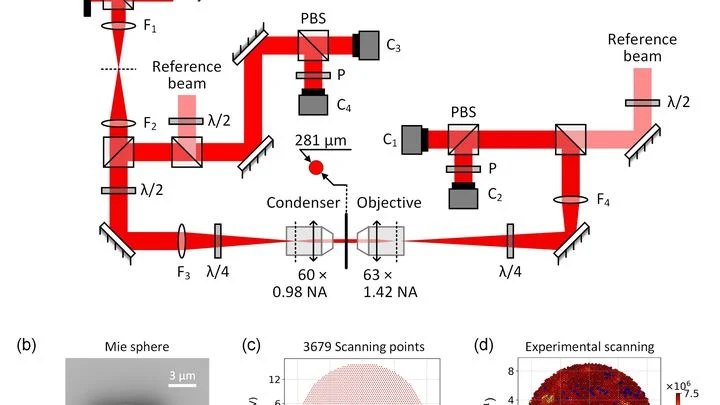
A flashlight beam in fog breaks into thousands of faint specks. Each speck is light that has bounced off countless water droplets before reaching your eye. To make sense of this mess, physicists construct a special table — the scattering matrix. It records how each incoming ray turns into a set of outgoing ones.
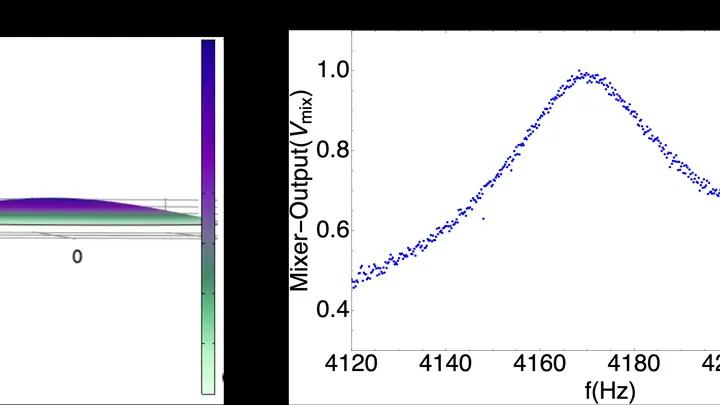
A thin film, clamped between two metal posts, trembles at the slightest nudge. Its movements are picked up by a microwave resonator — a cavity where radio waves bounce around like sound in an empty room. When the membrane shifts, the cavity's response changes.