The siemens per metre (S/m) is the SI unit of electrical conductivity, quantifying how easily an electric current flows through a material. It is the inverse of resistivity (measured in ohm-metres). A high value means the material is a good conductor, like copper (about 5.8×10⁷ S/m), while a low value indicates an insulator, like glass (around 10⁻¹² S/m).
History
The unit is named after Werner von Siemens, who contributed to electrical engineering in the 19th century; the siemens was adopted as an SI unit in 1971, replacing the older 'mho' (ohm spelled backwards).
How it works
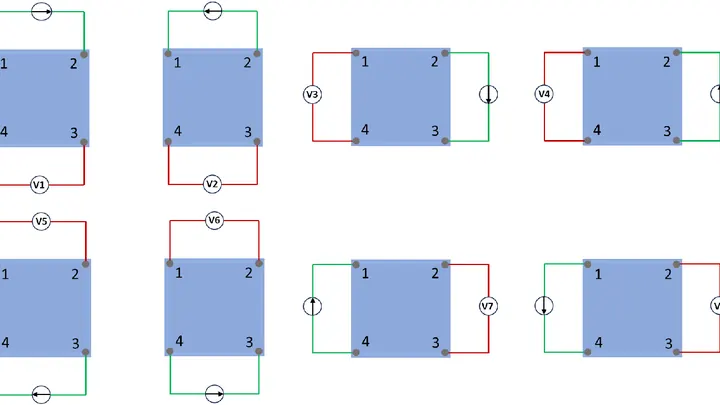
Conductivity σ relates the current density J to the applied electric field E via Ohm's law in local form: J = σE. The unit siemens per metre arises because conductivity is the ratio of current density (A/m²) to electric field (V/m), and 1 S = 1 A/V. In practice, conductivity is measured with four-point probes or eddy-current methods, and it depends on temperature, impurities, and frequency for alternating fields.
In practice
Conductivity measurements are used to assess water quality, to design electrical wiring and circuit boards, and to characterize materials for electromagnetic shielding.
Fun fact
Seawater has a conductivity of about 4 S/m, which is why submarines use extremely low-frequency radio waves — they penetrate conductive water better than higher frequencies.
Systems:SIThe electrical conductivity of a material that has a conductance of one siemens per meter of length and one square meter of cross-sectional area.
Inside an MRI magnet, current flows through a closed superconducting loop, like water circling in a bucket after you give it a spin, it just keeps going on its own. To change that current, you heat the loop with a small heater: it stops being superconducting, becomes an ordinary resistor, and then an external source can 'top up' or 'draw off' current.
The magnetic field in this setup must be as smooth as glass: the slightest ripple would blur the signal. The engineers built two coils that cancel each other's field externally and packed them in three layers of ferromagnetic plates.
A microchip the size of a fingernail gives off as much heat as a small light bulb. Getting rid of that heat is like trying to cool a cup of hot tea with a teaspoon: the insulating material around transistors is usually a poor heat conductor.
The orchestra plays, but the conductor hears only a general hum. Each instrument plays its own part, but you can't tell where the flute is and where the double bass is. You need a spectrum analyzer — a device that breaks down sound by frequency.
Heat is all around us: from a car's exhaust pipe to the casing of a running laptop. Thermoelectric materials could turn that waste heat into electricity.
A tiny ball weighing a fraction of a milligram, suspended in a magnetic field and cooled to near absolute zero, oscillates for 110 hours without stopping: this is record isolation. The energy loss is so small that the system's entropy barely increases, making any external influence noticeable.
A superconductor does not let a magnetic field penetrate its interior. But if the field is strong enough, it does get in — not as a continuous flux, but as individual vortex filaments, like tiny tornadoes. Inside each filament, superconductivity is destroyed, and around it flows a persistent current.
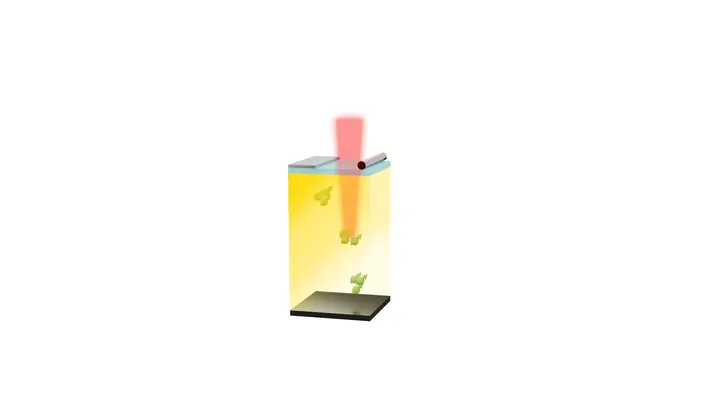
Light in a particle detector behaves like a voice in the mountains. One shout, and the echo repeats several times, growing fainter with each reflection. So it is in a silicon detector: a real flash from a particle gives rise to false ones that confuse measurements.
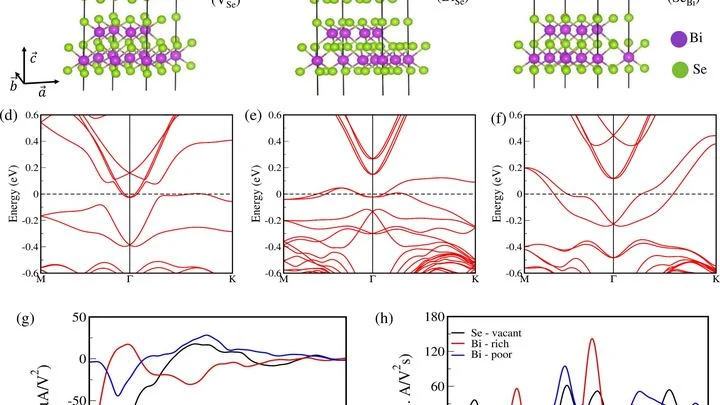
The crystal bismuth selenide (Bi₂Se₃) is symmetric by itself, like a neatly stacked sandwich: flip it over, and nothing changes. But twist one layer slightly relative to the other, and the symmetry breaks. The material begins to 'feel' which side the light comes from and responds with an electric current.
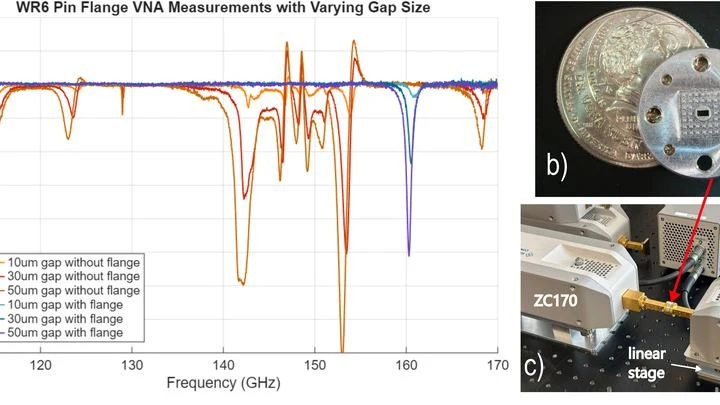
Tuning a radio to your favorite station is a search for the right frequency amid the noise. The new device does the same, but for waves about three millimeters long. Such waves come from distant galaxies and possibly from dark matter particles. The device is a pattern of superconducting niobium traces on a silicon wafer.
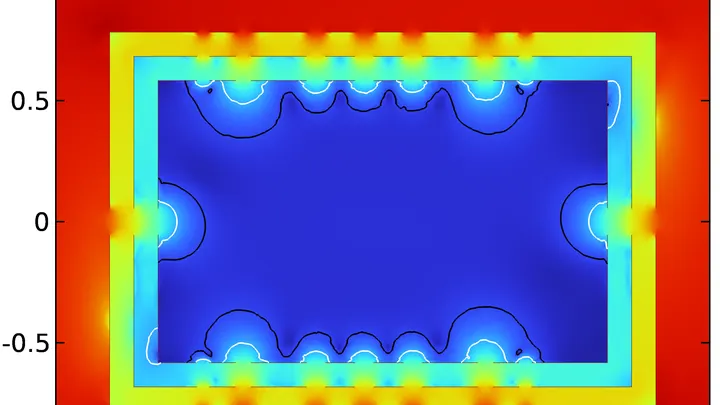
A power transistor made of silicon carbide operates under voltages thousands of times higher than what comes out of a wall outlet. If the field inside it becomes uneven, the device burns out. Previously, this field was invisible: it is too strong for ordinary sensors, and the device must remain under voltage.
The receiver doesn't catch radio waves but submillimeter light — the radiation emitted by cold clouds of gas and dust in distant galaxies. Inside, there's an array of tiny resonators, each tuned to its own frequency, like the strings of a grand piano tuned to notes.
The quantum world doesn't like being glanced at sideways. To extract all available information from an atom or photon, you need a whole fan of 'needles'—different ways to ask a question. Physicists call such a fan a complete set of measurements. But among complete sets, there are special ones: their needles are arranged so evenly that each responds with equal strength.
The night sky is not all that dark. Even far from cities, it glows faintly — which hampers astronomers trying to catch weak flashes from distant cosmic rays.
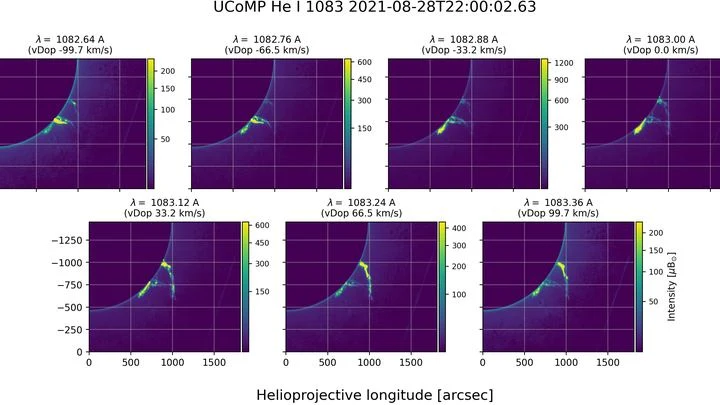
The Sun occasionally hurls enormous clouds of plasma into space — coronal mass ejections. Often tangled within these clouds are prominences: cooler, denser clumps of material. These contain plenty of neutral atoms that shine brightly in specific spectral lines.
Two light beams run side by side along silicon tracks narrower than a human hair. One oscillates up and down, the other left and right. The task is to separate them into different outputs without losing a drop of power. Engineers built a device just 20 micrometers long — roughly a quarter of the thickness of a sheet of paper.
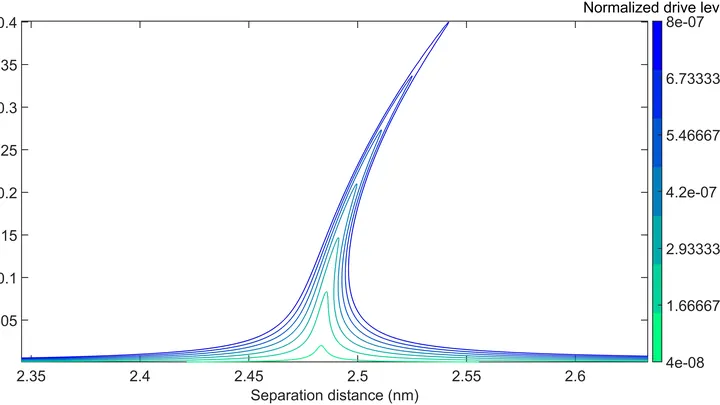
The tip of a tunneling microscope hovers above a surface at a distance smaller than the diameter of an atom. Usually, it feels out the topography like a finger reading a page of Braille. Now, that same tip has learned to listen to how a membrane the size of a fingernail trembles.