The Fermi surface is a key characteristic of a metal, determining its transport, thermal, and optical properties. It is an imaginary figure in the space of wave vectors where the electron energy equals the Fermi energy. In monovalent metals like sodium, it is almost a perfect sphere; in copper, “necks” appear connecting adjacent zones; in lead, it has a complex topology. Experimentally, it is mapped using angle-resolved photoemission spectroscopy (ARPES) or by measuring quantum oscillations of magnetization (the de Haas–van Alphen effect).
History
Fermi–Dirac statistics was proposed in 1926 by Enrico Fermi and Paul Dirac. The Pauli principle (1925) by Wolfgang Pauli became the foundation. The Sommerfeld free electron model (1928) introduced the concept of Fermi energy and a spherical Fermi surface. In 1930, the de Haas–van Alphen effect allowed experimental measurement of extremal cross-sections, confirming the non-sphericity of the Fermi surface in real metals. Further development of band theory by Bloch, Brillouin, and others led to detailed calculations. Modern ARPES methods (since the 1990s) provide direct images of the Fermi surface.
How it works
Within band theory, an electron in a crystal is described by a Bloch wave and a dispersion E_n(k). Level occupation follows Fermi–Dirac statistics: f(E) = 1/(e^{(E-μ)/k_B T} + 1), where μ is the chemical potential (at T=0, μ = E_F). The Fermi surface is the set of k for which E_n(k) = E_F. When an electric field E is applied, electrons accelerate: ħ dk/dt = -eE, and those near the Fermi surface can change their k, creating a current. The density of states at the Fermi level g(E_F) is proportional to the area of the Fermi surface and the inverse velocity; it determines many properties. Quantum oscillation experiments give the relation for frequency f = (ħ/2πe) S_extr, where S_extr is the area of an extremal cross-section of the Fermi surface. The Pauli principle and Fermi–Dirac statistics are fundamental here. The de Haas–van Alphen effect manifests as oscillations in magnetization in a varying magnetic field.
In practice
The shape of the Fermi surface predicts conductivity, magnetic properties, and even the suitability of a material for superconducting magnets.
Fun fact
Bismuth’s Fermi surface consists of tiny pockets containing just one electron per many thousands of atoms, which is why it is such a poor conductor.
In the quantum world, particles sometimes behave like acrobats on invisible tightropes. An instanton field is a brief vortex that appears and vanishes in an instant. When a fermion (a particle like an electron) enters such a vortex, its energy does not stay put. Instead, it smoothly slides from one level to another, like a ball rolling down a hill.
The wind carries pollen, and each grain moves as if on its own. But once the air swirls into a vortex, the pollen trajectories can no longer be separated: they are tangled. This is roughly how electrons behave in a strange metal: their motion is so strongly coupled to soft fluctuations of the medium that the usual particle carriers disappear.
A tiny sandwich of oxides, grown layer by layer, becomes perfectly conducting at about minus 200 degrees Celsius. This is not a magic trick but a new chapter in the search for high-temperature superconductors.
A cloud of cold atoms is trapped between two mirrors. Light is shone through it, and the atoms start to emit collectively: this effect is called superradiance. But the atoms don't just 'glow': their spins (internal magnetic arrows) interact with light in two distinct ways.
Graphene, a sheet of carbon one atom thick, behaves like a calm water surface, until superconductivity appears. Then, unusual waves ripple across it, like the circles from a thrown stone: pairs of electrons move without friction.
The furnace is white-hot, but the ceramic powder remains loose. Turn on the electric field, and within seconds the material settles, hardens, and turns into a solid monolith. This technique is called flash sintering (from the English "flash"), and it saves hours of firing and gigawatts of energy. But what exactly happens to the atoms at the moment of the flash remained a mystery.
For a long time, the event horizon behaved like a cosmic dictator: everything that crossed its boundary vanished irretrievably from our Universe. But quantum mechanics, like a dissident's voice, whispered: information cannot simply disappear.
In the grand symphony of magnetism, a duo long reigned: boisterous ferromagnetism and silent antiferromagnetism, where spin-soloists cancel each other out. But recently, a third voice joined the ensemble — altermagnetism.
Superconductivity and magnetic field are age-old foes: the field barges in like a whirlwind, tearing apart the delicate pairing of Cooper pairs, destroying order.
Nearly a decade and a half ago, the Fermi gamma-ray telescope spotted mysterious "bubbles" — giant plasma blobs, as if inflated by invisible lungs, towering tens of thousands of light-years from the Galactic center.
A pebble falls into a pond, and ripples spread across the water. In the quantum world, the pond is not made of water but of many identical particles, and the pebble is also a particle, just a foreign one. Such a foreign particle is called a Fermi polaron.
You're looking for a quiet room for an important conversation. You step into a space, and hear silence. But upon closer inspection, you find that in one corner the ventilation is simply broken, and in another there's a hole in the floor that absorbs sound.
A drop of water on a table lives a double life. Inside, molecules are surrounded by neighbors on all sides, but at the surface they have neighbors only below and to the sides — above is air. This difference creates the tension that holds the drop in shape.
Electrons in a conductor are like a chaotic crowd: colliding, they lose energy, and resistance arises. In a superconductor, however, they move in unison, like partners in a well-coordinated dance, without touching each other. This state has reduced энтропией — meaning disorder.
Such behavior is rare for gold and copper.
When an electric charge moves with acceleration, it emits electromagnetic radiation, i.e., light — a familiar phenomenon in physics. However, researchers have found that when moving along a specially chosen trajectory, the radiation acquires unusual properties.
A swarm of fireflies rarely collides, yet they synchronously change color by exchanging signals. This is how neutrinos behave in dense streams from collapsing stars: they collectively transform from one type to another, even though individually they interact extremely weakly.
In the mid-20th century, Roger Penrose described a black hole using the concept of a “trapped surface” – a region where even a light ray directed outward inevitably falls inward. A situation familiar to everyone: water in a sink’s vortex is irretrievably sucked down the drain.
Sunlight hits a silicon wafer, and a current flows in the circuit. That's the familiar work of a solar cell: light knocks out electrons, and a p–n junction (the boundary between two layers with different conductivities) forces them to move in one direction. But in some crystals, current arises differently — without any junctions, purely from the material's internal structure.
If you check where an electron is every second, its quantum properties change. It's like a child playing hide-and-seek but constantly being called by name: they freeze and stop running. In the particle world, such a "caller" is a measurement. It prevents particles from freely forming a shared quantum state, or entanglement.
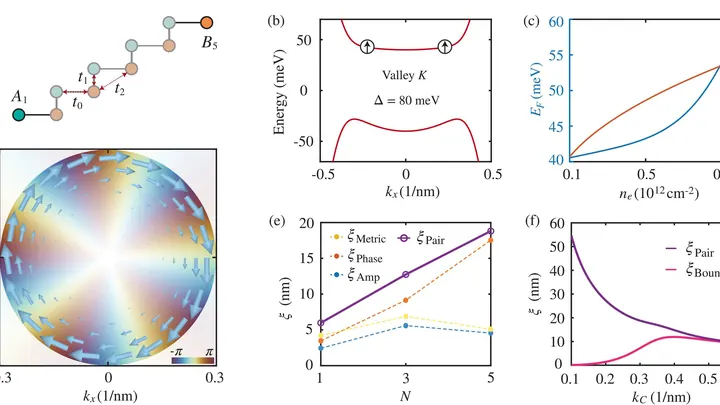
In a superconductor, electrons pair up like dancers holding hands. Usually, the distance between them, the pair size, depends on how fast they move and how strongly they are bound. But sometimes the dance floor almost disappears, and there's nowhere to move. This happens in materials with flat electronic bands: electrons nearly freeze, and the usual rules stop working.
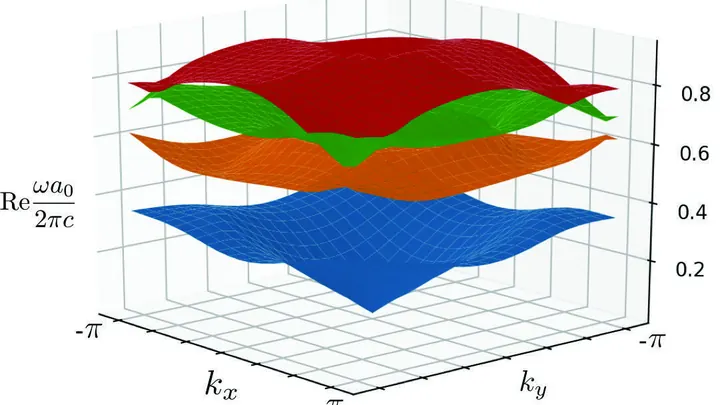
Light, discovered by Maxwell, behaves differently in different media. In a new study, researchers simulated a two-dimensional crystal that absorbs light and has magnetic properties. In it, light waves behave like passengers on a one-way escalator: they relentlessly move toward edges and corners, where they accumulate.
Ruthenium oxide has long been regarded as a textbook altermagnet — a material where magnetic moments of neighboring atoms point in opposite directions but do not fully cancel due to the crystal's special symmetry. New measurements show that inside the crystal, there is no magnetism at all. All the magnetic action is confined to the surface.
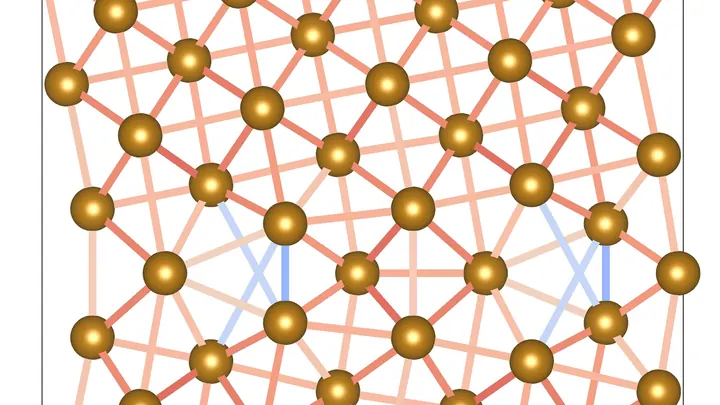
An iron crystal is like a mosaic of tightly packed grains. Where one grain meets another, a boundary forms — a narrow seam with disrupted order. It is in these seams that surprises for magnetism hide.
Scientists calculated how iron atoms interact with each other at three types of such boundaries.
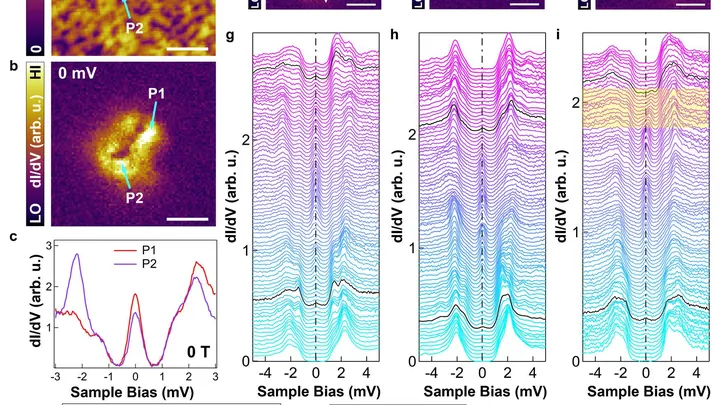
A tiny magnet, made from just two molecules, was placed on a metal surface, and it behaved like a temperamental conductor. Normally, electrons in a metal move in a coordinated way, like a crowd on an escalator. But when cooled significantly, this order breaks down, and the motion becomes unpredictable.
On the surface of a thin film of bismuth iron oxide, you can see neat stripes, like furrows in a plowed field. What lies beneath them has remained a mystery until now.
A swimmer cutting through water at the speed of the waves running on it finds themselves in a strange position: the waves they themselves generate can neither overtake them nor fall behind. They pile up at the swimmer's bow and freeze. A similar phenomenon occurs when a light source moves inside a medium at a speed matching the speed of energy transfer of the waves.
The crystal of the uranium compound UTe2 resembles a layered cake where electrons flow without resistance. But if you examine its surface under a microscope, you see ripples, like waves on water from a thrown stone.
Inside a piece of metal, electrons don't sit still: they move like water in a river. But you can't see this motion directly; it's too fast and too small. Scientists devised a workaround: they take 'frozen snapshots' of the electron liquid at different temperatures, then reconstruct how the electrons moved from those snapshots.
A sheet of graphene one atom thick is twisted at a small angle, and it starts behaving like a layered pie with layers slightly rotated relative to each other. At a certain twist angle, this material becomes a superconductor: electrons begin to move in pairs, like dancers in a waltz, without losing energy. But what exactly happens inside has remained a mystery.
When cooled strongly, a uranium-telluride crystal stops resisting current. Before that happens, at a slightly higher temperature, its resistance can still be measured — and it tells about the shape of the invisible paths along which electrons run.
A metal is a sea of electrons that move almost freely, colliding only occasionally. But in some materials, this sea suddenly becomes viscous and unpredictable: electrons stop behaving like independent particles. Physicists call this state 'non-Fermi liquid,' and it remains a puzzle.
Physicists trapped a cloud of lithium atoms between mirrors. Light bounces inside, like in an echo chamber, forcing the atoms to emit synchronously — resulting in superradiance, akin to a choir where voices merge into a single thunder. Like a stadium chanting in unison: each whisper turns into a deafening rhythm. The secret is density.
A sheet of paper hundreds of times thinner than a human hair: that's roughly the thickness of the vanadium oxide film scientists grew. Inside this film, electrons, the tiny carriers of electric current, move almost without collisions. Like cars on an empty night highway, they accelerate and don't lose speed.
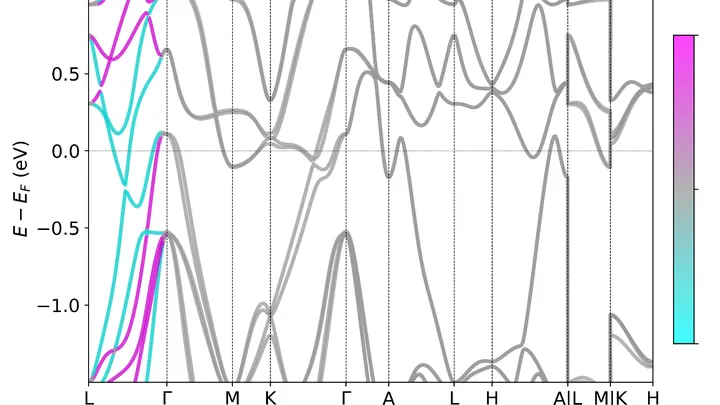
Electrons in a CrSb crystal behave like a school of fish: inside the material, they dart along their "corridors," and at the boundary with vacuum, they arrange themselves into intricate patterns. These patterns are the Fermi surface — a map of all allowed electron velocities. You can't reach out and touch it, but you can "feel" it with a magnetic field.
A chain of red phosphorus atoms is like a train where the cars are atoms and the couplers are chemical bonds. Sometimes the couplers are stronger, sometimes weaker, and that affects how electrons run through the train.
An electron inside a crystal is like a traveler walking through a city with winding streets. Its direction of motion constantly changes depending on where it is. Physicists call this feature the geometric Berry phase, and it determines how a material conducts electricity or responds to a magnetic field.
A sheet of carbon just one atom thick is placed in a strong magnetic field and cooled to thousandths of a degree above absolute zero. A microwave microscope slides along the sheet's edge, measuring how well that edge conducts electricity.
A thin film of ruthenium oxide Sr₃Ru₂O₇ grown on a foreign crystalline substrate behaves like a tightly stretched rubber sheet: the substrate either compresses it or stretches it.
A solar flare is like an explosion in the atmosphere: bright, fast, with different 'voices.' X-rays come from electrons that have been accelerated and then abruptly slowed down, losing energy. But in 2017, detectors on the Fermi satellite caught a different signal — gamma rays that didn't fit this picture.
The CrSb crystal behaves like an intersection where electrons with different spins choose different lanes. In a conventional magnet, all electrons align in one direction, but in an altermagnet, spins alternate like squares on a chessboard. This creates a complex map of velocities that is hard to see directly.