How a Flat Band Makes a Pair of Electrons Tiny express
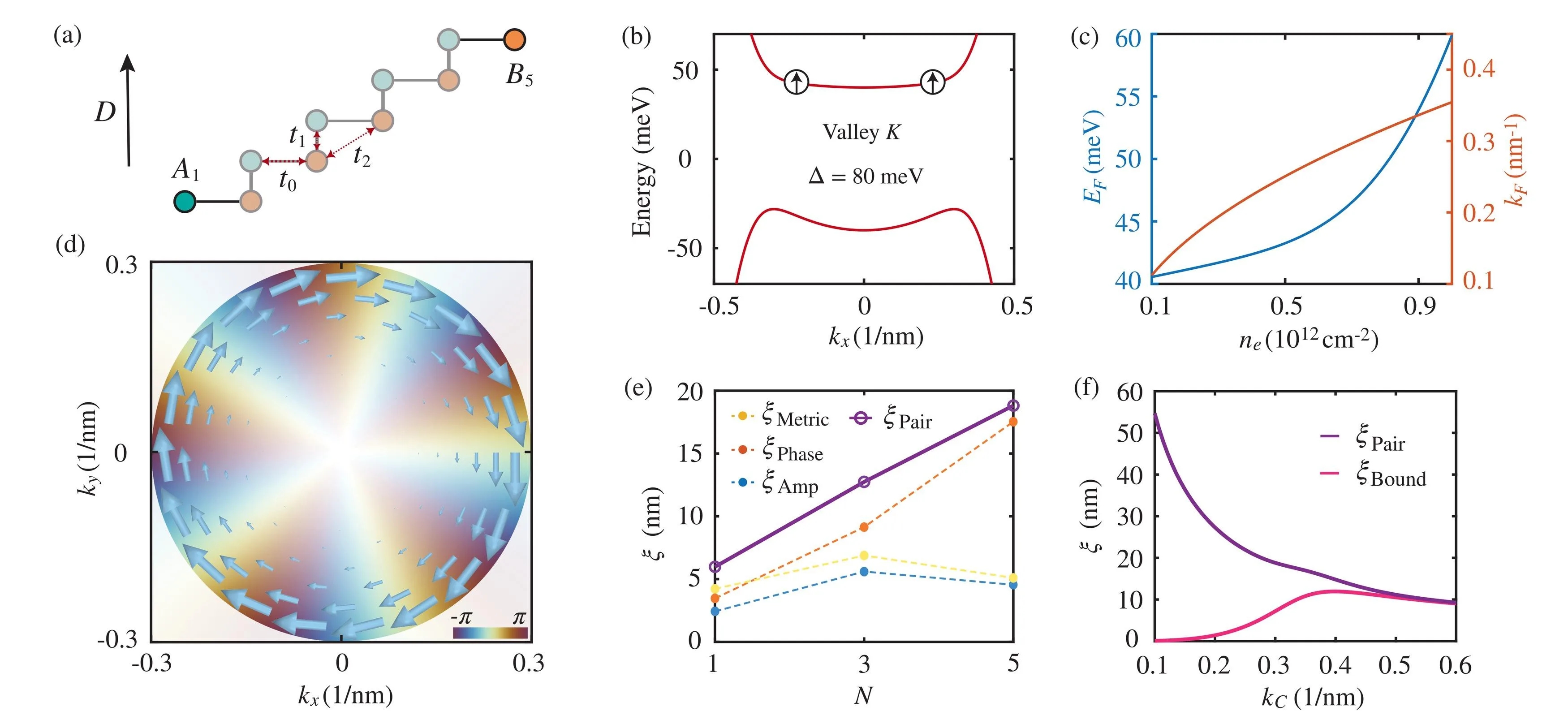
In a superconductor, electrons pair up like dancers holding hands. Usually, the distance between them, the pair size, depends on how fast they move and how strongly they are bound. But sometimes the dance floor almost disappears, and there's nowhere to move. This happens in materials with flat electronic bands: electrons nearly freeze, and the usual rules stop working.
Physicists have found a new way to measure the size of such pairs using the quadrupole moment — something like the charge distribution inside the pair. The big surprise: when time-reversal symmetry is broken (for example, by a magnetic field), the Berry curvature comes into play — a geometric property of the electron's wave, akin to the curvature of space for its internal state. It can squeeze the pair to the limit, setting the minimum possible size.
Applying the theory to rhombohedral graphene, a layered material made of carbon with flat bands, the scientists saw that it is precisely the Berry curvature that determines the pair size. The calculated values matched the coherence lengths known from experiments: about 30–50 nanometers. For comparison, that's hundreds of times smaller than the thickness of a human hair. Thus, the geometry of wave functions directly governs superconductivity at the microscopic level.
Original abstract
as written by the authors arXiv:2605.03133
The size of Cooper pairs defines a fundamental length scale of superconductivity, conventionally set by band dispersion and the superconducting gap. This picture breaks down in flat bands, where quenched dispersion makes quantum geometry essential. Here we develop a general framework based on the Cooper pair quadrupole moment, whose trace gives the pair size. The framework holds for both dispersive and flat-band cases, and provides a unified description of the geometric origin of this length scale. In particular, when time-reversal symmetry is broken, Berry curvature enters through the phase structure of the pair wavefunction and gives an essential contribution absent from previous quantum-metric theories. Together, Berry curvature and quantum metric impose a geometric lower bound on the pair size. Applying this framework to rhombohedral graphene, we find that the Berry-curvature-induced contribution can dominate and yields pair sizes comparable to experimentally inferred coherence lengths. These results identify Berry curvature as a central geometric ingredient controlling the microscopic length scale of superconductivity.
In rhombohedral graphene, the Berry curvature can make Cooper pairs so small that they would fit inside a virus.
In Peter Watts's novel Blindsight, superconducting carbon-based structures exist under extreme conditions — reminiscent of graphene systems where the geometry of electron waves plays a key role.