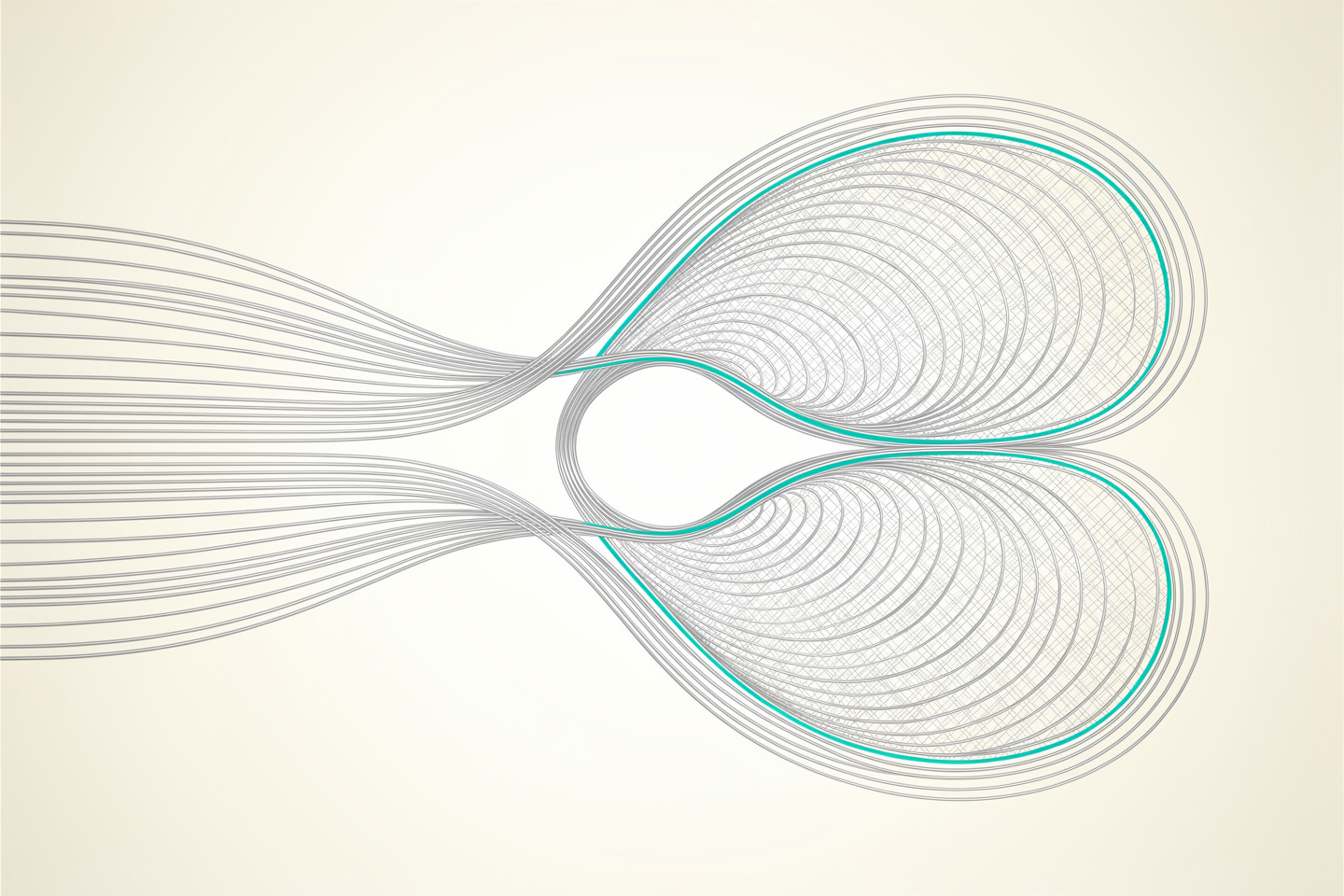
The movement of water in a cup after a sharp turn or wisps of smoke swirling in the air obey equations that calculate every whirl, but still haven't revealed all their secrets.
In practice: Weather forecasts, wing aerodynamics calculations, climate modeling, and ocean current simulations — all are built on these equations.
French engineer Claude-Louis Navier (1821) and British physicist George Stokes (1845) combined into a system equations expressing the conservation of mass and momentum in a viscous fluid. The momentum equation: ρ (∂v/∂t + v·∇v) = -∇p + μ ∇²v + f. The left side is mass times acceleration (including convective transport), the right side includes pressure forces, viscous friction, and external influences. The incompressibility condition ∇·v = 0 is added. Their genius was accounting for internal friction (the term with viscosity μ).
How it works
With them, engineers calculate how air flows around a car, and meteorologists predict cyclone movement. Viscosity (flow resistance) calms the flow, and if viscosity is low, turbulence arises — chaotic mixing.
💡 The Clay Mathematics Institute has announced a $$1 million prize for proving that solutions to the equations always exist and do not 'blow up' (remain smooth) in the three-dimensional case — it is one of the Millennium Prize problems.
The Navier-Stokes equations describe how fluids and gases move. They relate changes in flow velocity to pressure, viscosity (internal friction), and external forces (e.g., gravity). Simply put, it is a mathematical way of saying: 'what flows into a volume minus what flows out, plus everything that pushes or slows down.' The equations are complex because they contain nonlinear interaction: vortices create new vortices.
How it works
With them, engineers calculate how air flows around a car, and meteorologists predict cyclone movement. Viscosity (flow resistance) calms the flow, and if viscosity is low, turbulence arises — chaotic mixing.
💡 Even a small change in initial conditions can radically alter the flow — this is the famous 'butterfly effect,' popularized by Edward Lorenz, who, incidentally, discovered deterministic chaos while working with a simplified model of the Navier-Stokes equations.
The Navier-Stokes equations are a system of nonlinear partial differential equations describing the motion of a viscous Newtonian fluid (with a linear relationship between stress and strain rate). In vector form for an incompressible fluid: ρ (∂v/∂t + v·∇v) = -∇p + μ Δv + f, ∇·v = 0. Here v is velocity, ρ is density, p is pressure, μ is dynamic viscosity, f is external body forces. The equations express Newton's second law for a fluid element and the law of mass conservation.
Discovery
Claude-Louis Navier derived the equations in 1821, introducing a molecular hypothesis about forces between particles. In 1845, George Gabriel Stokes refined the derivation, abandoning molecular notions and formulating the commonly accepted form with a continuum approach. Later, Leonhard Euler derived equations for an ideal (inviscid) fluid, and Navier and Stokes added viscosity.
How it works
The equations are the foundation of hydro- and aerodynamics, meteorology, oceanography, astrophysics (accretion disks, interstellar medium). Depending on the Reynolds number, they describe laminar or turbulent flow. Numerical methods of computational fluid dynamics (CFD) allow modeling everything from blood flow to aircraft aerodynamics, but high turbulence requires supercomputers.
Caveats
The problem of existence and smoothness of solutions in 3D (one of the Millennium Prize problems); Turbulence remains analytically unsolved — semi-empirical models are used; For some initial data, solutions may break down singularly in finite time (neither proven nor disproven)
ρ is fluid density, ∂v/∂t is local acceleration, v·∇v is convective acceleration, ∇p is pressure gradient, μ is dynamic viscosity, ∇²v is the Laplacian of velocity (viscous dissipation), f is external body forces (e.g., gravity)
\nabla \cdot \mathbf{v} = 0
∇·v is the divergence of the velocity vector; for an incompressible fluid, it is zero, meaning no sources or sinks
Analog gravity doesn’t freeze in weak perturbations. When gas roars onto a black hole, it gives birth to a living acoustic spacetime—a horizon that oscillates and shifts. Using an equation of state for ultrahot plasma with a variable adiabatic index, the authors showed that the horizon radius dances
Numerical simulations revealed how plasma gets stuck in the throat of a rotating wormhole, painting a thin luminous rim on its shadow and making it flicker with a period set by mass and spin. These signatures, observable by the Event Horizon Telescope at 230 GHz, turn active galactic nuclei into nat
Simulating black hole images against different dark matter profiles revealed a frightening flexibility: a cored-NFW-type flattened halo noticeably inflates the bright ring, shifts its center, and amplifies asymmetry — almost exactly replicating real Event Horizon Telescope data. The Einasto profile,
Байесовский ансамбль уравнений состояния, построенный на гауссовских процессах, восстанавливает термодинамику холодной сверхплотной материи без предвзятых параметризаций. Ограничения от рентгеновских наблюдений NICER и гравитационно-волнового сигнала GW170817 заставляют скорость звука сначала взлете
At the heart of a dying star lies an algebraic cipher that translates the language of matter into the language of black hole geometry. Physicists have found a precise two-way map: given a density profile, you can recover the exterior metric—and vice versa—without solving complex differential equatio
By numerically investigating the scattering of scalar waves on a rotating traversable wormhole, scientists discovered Breit-Wigner resonances. They sharply intensify under fast rotation and for counter-rotating modes, creating a spectral fingerprint radically different from that of black holes—a sig
Astrons — hypothetical relics of the early Universe with a mass on the order of 10¹² solar masses and a gigantic electric charge — could explain dark energy. However, rigorous analysis crushes the simple hopes: ordinary accretion does not yield the required charge, and phenomenologically interesting
A covariant approach has been developed, showing that light in the gravitational "storm" of merging black holes alters its polarization, tracing the damped melody of the ringdown. Numerical simulations based on Kerr perturbation theory confirm: an achromatic rotation of ~10 degrees is a direct impri
All the headline discoveries — from mergers detected by LIGO to the image of M87*’s shadow — are interpreted as direct proof of black holes’ existence. But a careful analysis shows that the same signatures arise from any ultracompact horizonless object, if its radius differs from the gravitational r
Astrophysicists have proposed a new method for hunting dark matter — not searching for the black holes themselves, but listening to the quantum echo of gravity. In regions of ionized hydrogen, tidal forces from primordial black holes split the atomic level 2P₃/₂, turning a single 9.9 GHz absorption
New research shows: wormholes with a precisely tuned throat length can cast a shadow indistinguishable from that of a Schwarzschild black hole. But numerical simulations expose a critical flaw in the disguise—the wormhole's accretion disk emits far more energetic radiation thanks to Doppler boosting
The LHAASO observatory detected an extended gamma-ray source — the Cygnus Bubble — and new calculations show that it was spawned by the microquasar Cygnus X-3. Particles accelerated in the jets to tens of PeV diffuse into the surrounding medium and, upon colliding with gas, produce gamma-ray photons
Fast radio bursts—ultra-short but colossally powerful radio flashes from distant galaxies—leave an elegant curved trace on spectrograms, resembling a calligraphic flourish. For decades they were hunted with heavy algorithms and narrow neural networks, until the most unexpected tool was tried: a mult
A model based on exponential technological growth shows: the faster a civilization develops, the shorter the period during which it emits technosignatures we can detect. At rates comparable to Earth's after the emergence of AI, this window could be less than twenty years. Traditional narrowband sear