The Invisible Artist: How Dark Matter Distorts Portraits of Black Holes ✛ ✦
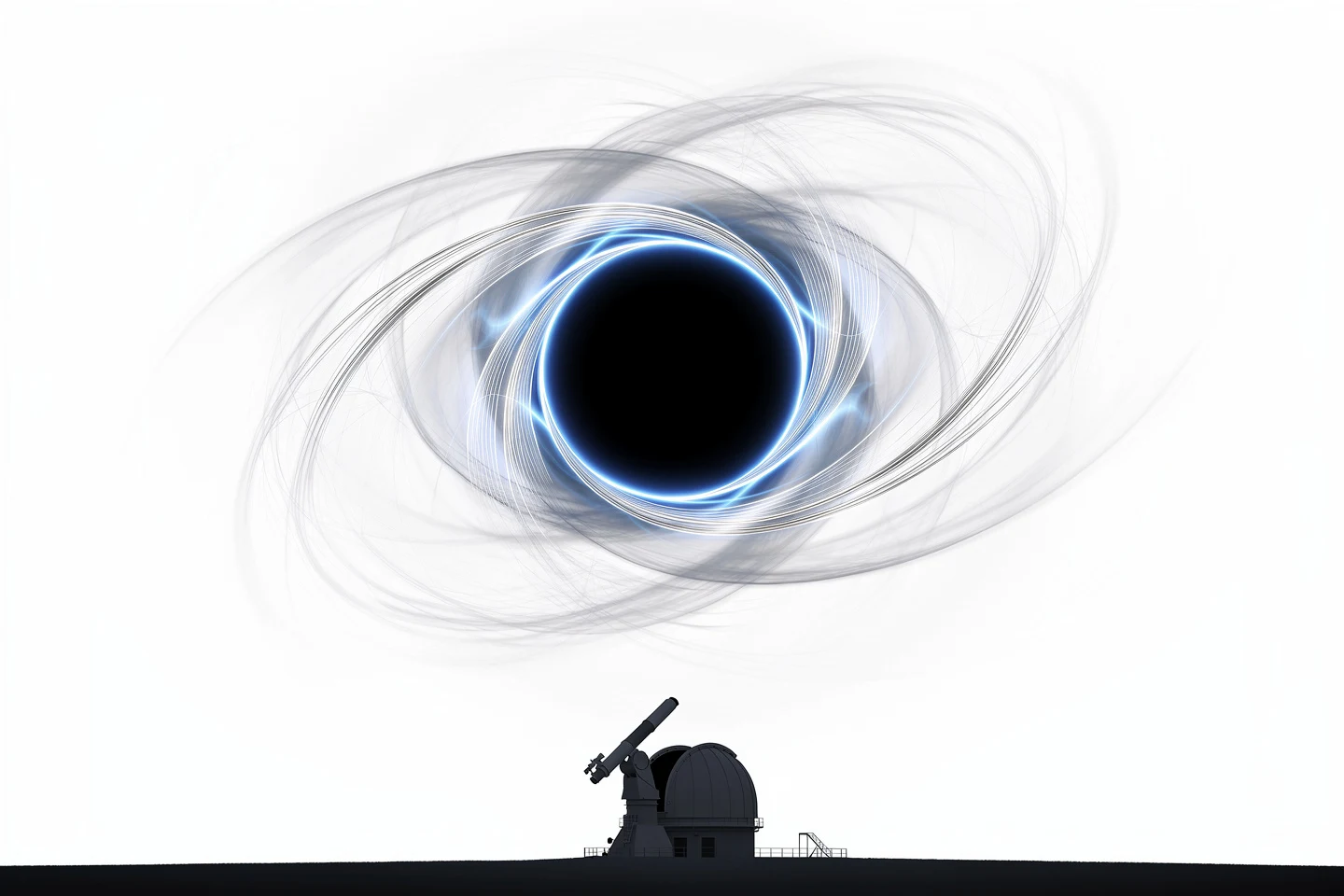
In 2019, the Event Horizon Telescope gave humanity the first image of a black hole shadow — a fiery ring around the abyss at the center of galaxy M87. This gravitational self-portrait, painted by the light of infalling plasma, instantly became an icon of modern astrophysics. But every portrait demands interpretation. What if an invisible artist intervenes in the play of strokes and shadows — dark matter, permeating galaxies and capable of distorting even the strongest gravitational lenses?
Imagine a canvas stretched on a frame of curved spacetime. The paints are photons, spurting from a scorching accretion disk. A Kerr black hole follows strict canon: a ring slightly offset due to rotation, with a predictable radius. But mix dark matter into the primer, and the watercolors run. New numerical simulations have compared how the "paints" behave in three field recipes: classic Kerr, with a soft Einasto profile, and with a sharp, flattened cored-NFW.
But a dark halo with a core (cored-NFW) is a resolute forger. It doesn't just add strokes: it repaints the canvas. The brightness center drifts from the geometric center by 5.13M versus 3.65M in the classic case, the radial profile peak creeps outward from 6.6M to 10.8M, and the asymmetry between the left and right sides almost doubles. Worse: plug in the masses and distances for M87* and Sgr A*—and the inflated ring suspiciously closely matches actual EHT measurements. Nature seems to wink: "Are you sure you're observing a pure black hole? Perhaps the spin you attribute to it is just a shadow of its dark halo?"
This masquerade exposes an uncomfortable degeneracy: changing the dark matter profile can mimic a larger spin, a different disk orientation, or even an alternative theory of gravity. Every event horizon snapshot is not just a monster's portrait, but a complex hologram where contributions from the central object and its invisible surroundings intertwine. The paradox in numbers: 85% of a galaxy's mass is nearly invisible, yet its gravitational brush can alter the apparent size of the photon ring by tens of percent — more than the difference between black holes with extreme and zero spin.
To untangle this knot, we'll need next-generation tools. Full radiative transfer calculations incorporating magnetic fields. Polarimetric observations capturing subtle details of redshift and Doppler boosting in active galactic nuclei. And multi-year data sets to separate the static ripples of dark matter from the dynamic breathing of the accretion flow. Only then will we learn who really holds the brush — Schwarzschild and Rubin, or someone even more elusive. Meanwhile, galactic centers remain an arena where every photon from the accretion disk can turn informant against a dark co-author.
Although dark matter makes up 85% of a galaxy's mass, its direct influence on horizon scales seems small. Yet simulations show it's enough to inflate the bright photon ring by tens of percent, making us question the accuracy of spin measurements.