Cosmic Calligraphy: A General-Purpose Neural Network Catches Fast Radio Bursts ✛
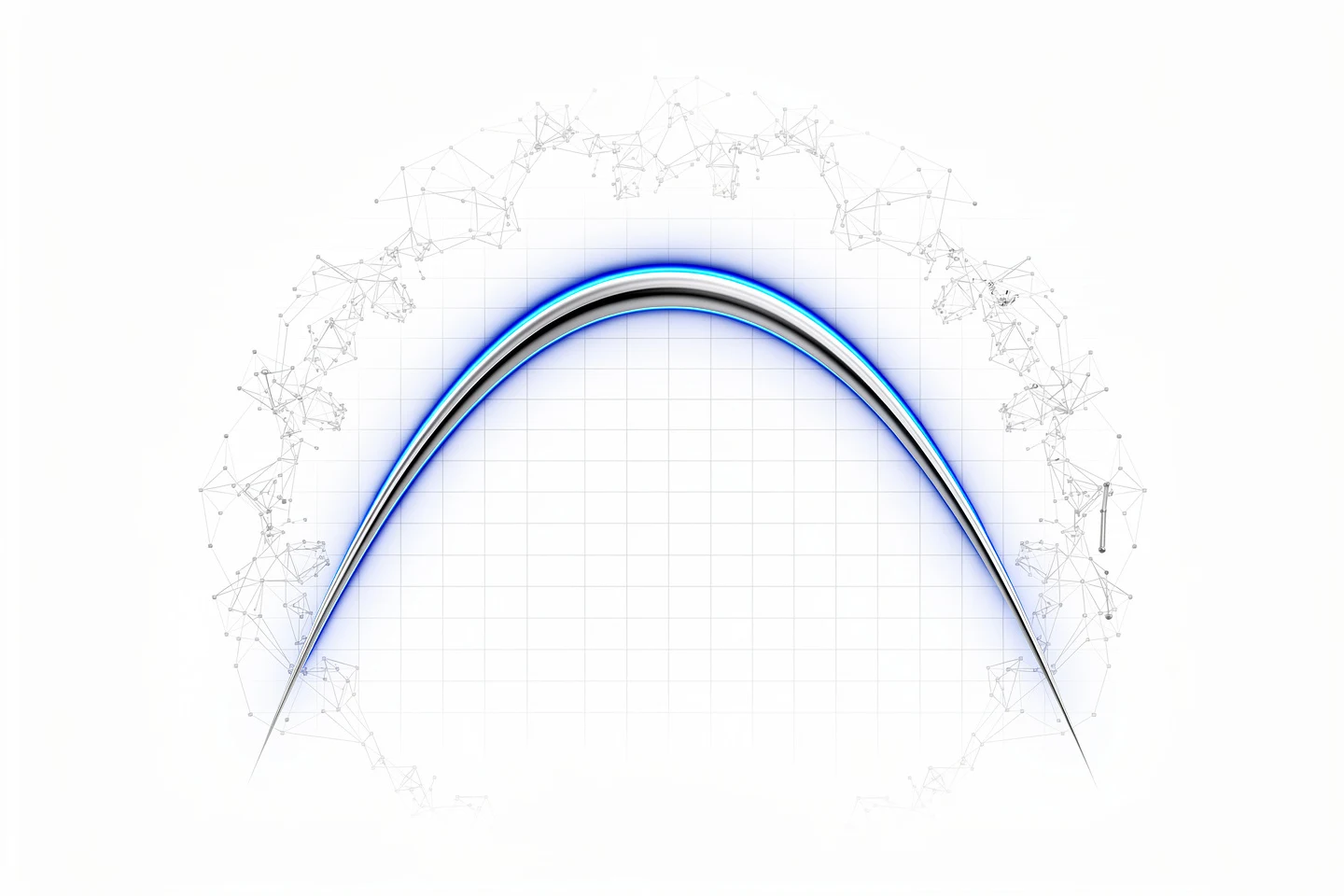
Back in 1967, Jocelyn Bell Burnell caught the first 'voice' of a neutron star — the strict pulse of a pulsar. Today, radio astronomers listen to far more fleeting signals — fast radio bursts (FRBs), lasting milliseconds and arriving from distant galaxies. On a dynamic spectrum, such a burst traces a characteristic curve: high frequencies arrive slightly earlier than low ones, like a flute sound gliding across a musical staff. This delay is the work of intergalactic plasma, which disperses radio waves, and it also turns each FRB into a miniature chart full of hidden information about the invisible matter of the Universe.
Researchers decided to conduct a thought experiment: what if you show a spectrogram image to a neural network that has never heard of FRBs but has seen billions of earthly images — cats, bridges, sunsets? Could it, like a calligrapher recognizing a master's hand in an unfamiliar alphabet, discern the characteristic curve of a cosmic flourish? For the test, they took the compact Gemma 4 model, 'fed' it 2000 simulated spectra from the L-band, and gave a brief text prompt: 'Is there a single broadband pulse with frequency-dependent delay in the image?' No examples, no coordinates, just the same visual input an astronomer sees.
The result turned out almost artistic. At a standard threshold, the Gemma 4 2B model showed 93.65% accuracy — statistically indistinguishable from the 92.90% of the professional SwinYNet detector. But the devil, as always, is in the details: the VLM missed only 6.4% of radio interference, while SwinYNet missed four times more. The model never mistook pure noise for a burst, as if its visual experience had taught it to distinguish a meaningful curve from white noise with the same ease as the eye distinguishes a signature from a blot. However, there was a price for elegance: the weakest FRBs, barely rising above the noise floor, were sometimes missed by the general-purpose network, which saw only random texture. The specialized SwinYNet, on the other hand, didn't miss a single flash but frequently misclassified structured interference like Wi-Fi-like signals as bursts.
This experiment breaks the stereotype that scientific tasks require narrow models trained on specific data. It turns out that a neural network, having absorbed a visual dictionary of everyday life, already possesses something like an intuition for form, and is ready to take the controls of any telescope. In the future, such models can be fine-tuned on real data, given memory of past decisions, and even embedded in pipelines that filter millions of candidates for a single precious burst. And if combined with a physics module, VLM could propose hypotheses about redshift via the dispersion measure, helping to answer questions about the nature of neutron stars and the missing baryons — because each FRB, piercing intergalactic plasma, carries a 'postmark' of the traversed matter, allowing us to weigh what does not shine in telescopes. Thus cosmic calligraphy gains its universal reader. And perhaps the main lesson here is not about astrophysics, but about artificial intelligence itself: truly intelligent systems should not cram specific rules but grasp the harmony of forms, and then even the handwriting of distant galaxies will open up to them.
Some FRBs are so powerful that they emit in a millisecond as much energy as the Sun does in several days. The first detected FRB (the Lorimer burst) was found in archival data years after the observations: it was almost discarded as interference.