Gravitational Radio Forest: How a Hydrogen Quantum Detector Reveals Dark Matter ✛ ✦
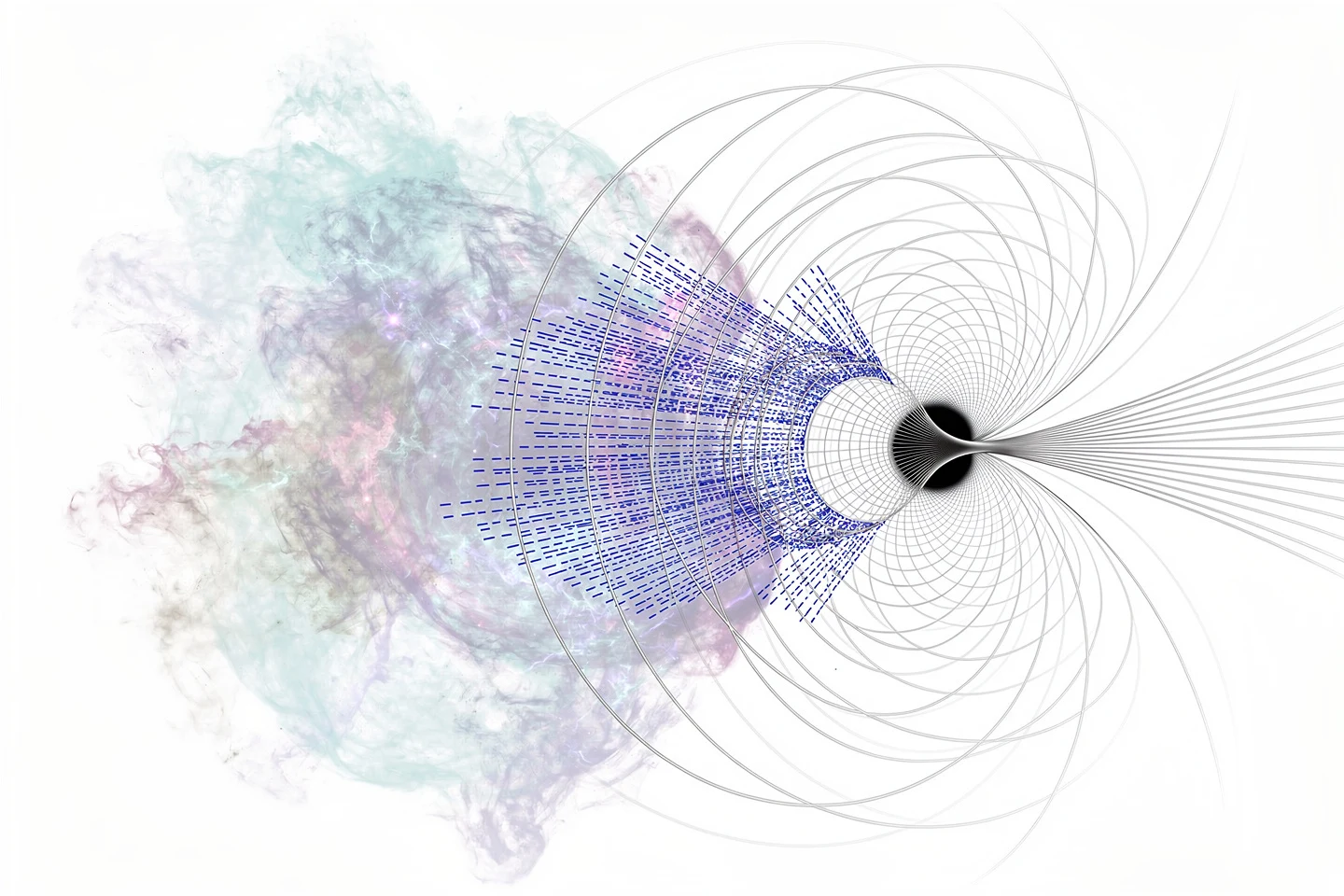
Dark matter is the great cosmic invisible. It neither emits, absorbs, nor reflects light, yet its gravitational grip is felt in every motion of galaxies. Seventy years ago Vera Rubin showed that the outskirts of galaxies rotate too fast — as if spurred on by an unseen shepherd. Since then, the hunt for this substance has become a central narrative in astrophysics. One of the prime suspects — primordial black holes (PBHs), born from superdense clumps in the universe's infancy, as predicted by Stephen Hawking. But how do you spot the invisible: objects with asteroid-like mass and a horizon smaller than an atomic nucleus, scattered throughout the vast interstellar medium?
Nature itself provides the answer, turning hydrogen into a quantum sensor of gravity. In HII regions — glowing nebulae around hot stars where star formation is bubbling — hydrogen atoms are excited by ultraviolet light. Among their energy levels is a special pair: the metastable 2S₁/₂ and the short-lived 2P₃/₂. The transition between them produces a radio line at 9.9 GHz — a pure, quiet note in the symphony of the universe. But when a PBH flies nearby, gravitational tides ruthlessly split the 2P₃/₂ level. The single line doubles, leaving two symmetric absorption shadows on the spectrum. And this is not a Doppler shift or line superposition. It's the vacuum itself, warped by the black hole, dictating new energy steps to the atom.
Billions of such black holes, each weighing as much as an asteroid but with a throat smaller than an atomic nucleus, roam through clouds of ionized gas. Each splits the line in its own way, depending on mass and distance. This army of gravitational conductors turns a narrow spectral line into a broad picket fence of absorption — a gravitational spectral radio forest. It spreads over a band of about 2 GHz, and its pattern is unique, like a fingerprint. No other astrophysical effect can mimic it. Moreover, the amplitude of the forest depends almost solely on the fraction of PBHs in dark matter and is hardly sensitive to their exact masses. That's the key: radio observations will measure the depth of the spectral dips and directly weigh the invisible fraction, bypassing cosmological uncertainties.
This method bridges the quantum mechanics of atoms in curved space with observational plasma astrophysics. If numerical simulations confirm the forest shape, and next-generation radio telescopes pick up the signal from directions toward the galactic center, it will be a discovery on par with the cosmic microwave background. The nature of dark matter will cease to be a guess and become a measurable gravitational landscape. Much like the Lyman-alpha forest that revealed the cosmic web, this radio forest will unveil the invisible harvest of primordial black holes. We will learn to read it: each trunk a black hole, each shadow a quantum whisper of tidal forces. And perhaps in this rustle we'll catch the echo of inflationary quantum fluctuations that once birthed the very fabric of the cosmos.
The 9.9 GHz frequency falls in the same band as household microwave radiation. Your lunch may be unaware, but at this frequency you could eavesdrop on the gravitational whisper of primordial black holes — and swap your usual reheating for a hunt for dark matter.