Astrons: Electric Leviathans That Defy Cosmology ✛ ✎ ✦
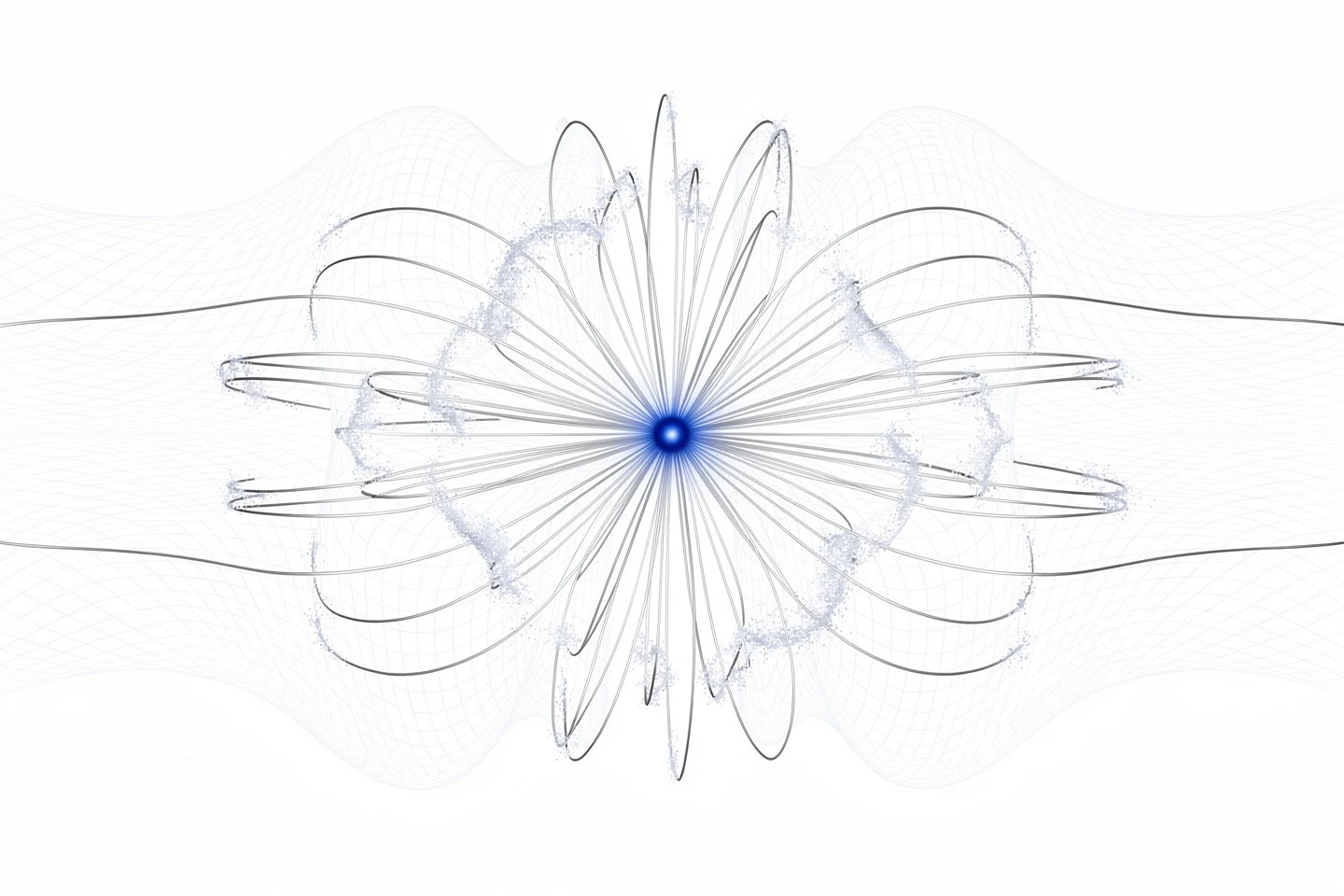
In the searing plasma of the newborn Universe, when space itself still rang with the echo of the Big Bang, objects may have emerged that challenge gravity itself. Not ordinary black holes — but electrically charged giants, astrons. Their mass is like that of a million billion suns, and their electric repulsion is five times stronger than gravitational attraction. Invisible yet all-pervading: according to a bold hypothesis, they, like an unseen hand, push galaxies apart, replacing dark energy in the accelerating expansion of the Universe.
Imagine a fleet of leviathans scattered across the cosmic void, like seeds of a giant crystal, separated by megaparsecs. Each carries a charge as if billions of ball lightnings were compressed inside it. In their heart lies a naked singularity: the parameter Ξ = $k_e$ Q²/(G M²) reaches 5.4 — not the paltry fractions of unity found in stars. Gravitational garments — the event horizon and photon sphere — have been torn from the titan’s shoulders, exposing the twisted guts of warped spacetime. The Reissner–Nordström solution, hybridizing the Schwarzschild metric with Maxwell's electrodynamics, delivers a harsh verdict: horizons survive only for Ξ ≤ 1, and the photon sphere only for Ξ ≤ 9/8.
But the cosmos does not forgive idealizations. Intergalactic plasma — a pervasive ocean of charged particles — muffles electric fields like a wet blanket smothering a ringing bell. On distances smaller than the typical inter-astron spacing, the field fades, and the leviathans stop 'hearing' each other, losing their collective strength. Worse still: ordinary charging via an accretion disk in the intergalactic medium yields only laughably small Ξ, so the birth of giants requires exotica — for instance, charge separation during a quantum-gravitational phase. And in the homogeneous Friedmann–Lemaître model, bequeathed by Lemaître, Coulomb energy masquerades as radiation with a density ∝ a⁻⁴ and gets diluted by expansion too quickly to compete with dark matter and dark energy.
The Einstein–Maxwell equations do not forgive hubris. If astrons are real, the acceleration of expansion is not a monotonous fluid pressure but a complex dance of gravitational inhomogeneities. Each naked singularity tugs spacetime toward itself, and the ensemble’s averaged rhythm gives rise to a cosmological crescendo. Verifying such a drama will require numerical simulation of nonlinear plasma processes near superextremal objects and an exact solution of the backreaction problem. Telescopes like JWST can search for faint lensing anomalies or redshift features betraying the presence of these ghostly titans. The astron scenario sharply raises questions about cosmic censorship, the nature of singularities, and quantum gravity. And if the horizon vanishes, Hawking evaporation loses its usual meaning — can a naked singularity decay? This puzzle reminds us: the darkest mystery may hide not in a new field, but in electrodynamics pushed to its absolute limit.
The astron paradox: electric repulsion, five times stronger than gravity, rips the event horizon off the singularity, exposing it for all to see. This is a direct violation of the cosmic censorship principle, challenging the very predictive power of physics.