Long-Throat Wormholes: How Doppler Notes Give Them Away ✛ ✦
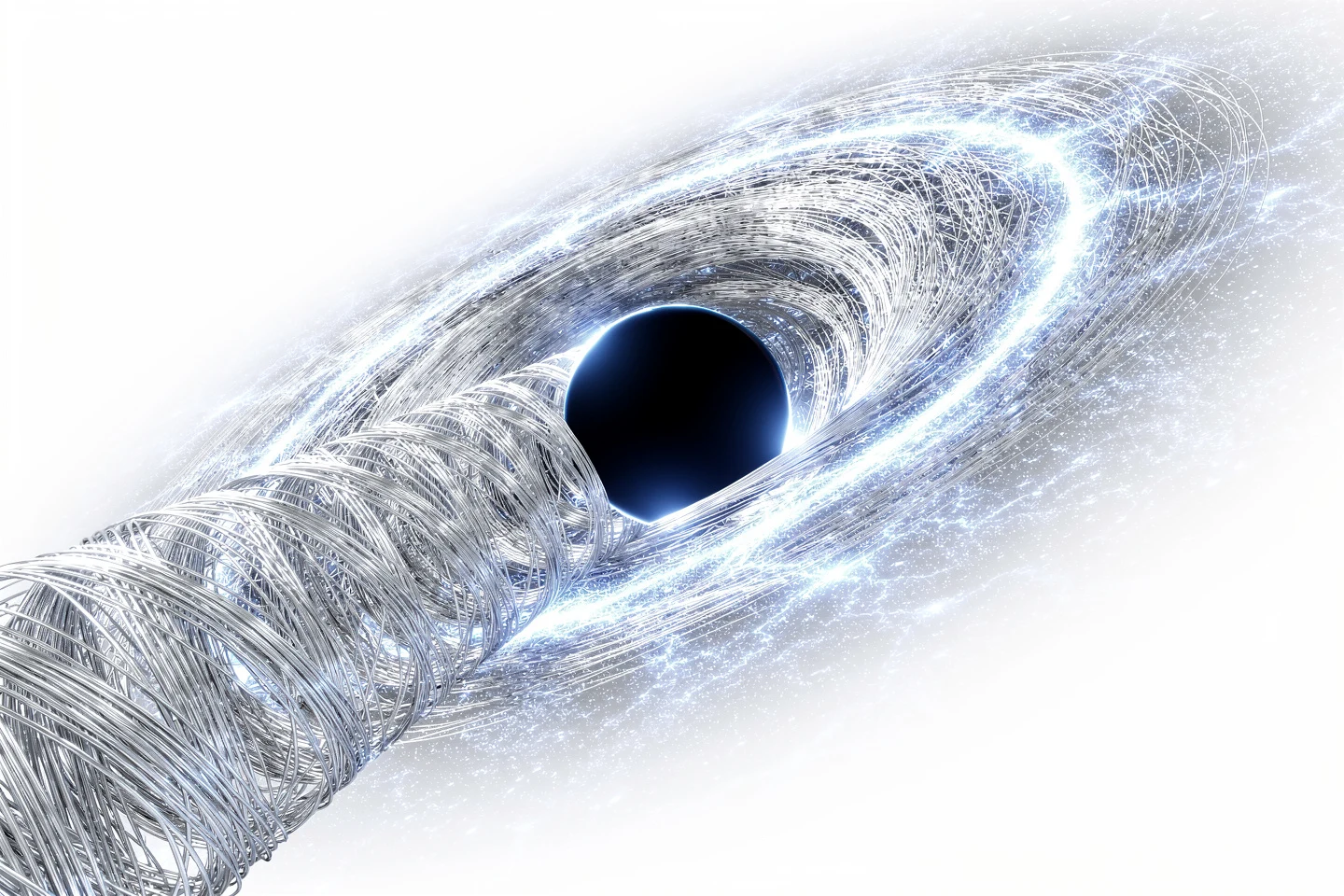
When a black hole steps into the lens, it leaves a perfect darkness in the image — a gravitational well where light falls forever. Images from the Event Horizon Telescope revealed shadows of supermassive objects, and they matched perfectly with the predictions of general relativity by Einstein. But silence doesn't guarantee the absence of a twin. A wormhole, a curved tunnel in the fabric of spacetime, can cast a shadow of the same size if you tweak its throat, like the length of a resonator in a musical instrument.
Imagine a flute: by changing the length of the vibrating air column, a musician plays notes of the same frequency in different octaves. Similarly, the parameters of a wormhole's throat, its radius and the smoothness of its profile, tune the silhouette so its angular size exactly matches the shadow of a black hole of equal mass.
Mathematically, this trick leans on an elegant formula for the shadow radius (see below) and an integral equation for the throat silhouette. Together they set all the conditions under which a wormhole skillfully masquerades as the classic monster.
But the orchestra can't help playing out of tune. Numerical simulations of the accretion disk reveal a spectral betrayal: matter swirling around the throat accelerates so fiercely that its radiation is ramped up by Doppler boosting. Around a black hole, gravitational redshift steals nearly a third of the photons' energy, dropping it to 0.74. For a long-throated wormhole, it's the opposite: the Doppler effect boosts the energy to values 1.45 times the original. The disk blazes with blinding light, and that signal can't be hidden.
Thus a method of cosmic 'decoding' is born. Joint measurement of the shadow and the disk's energy profile, especially including polarization of the radiation, will for the first time allow us to distinguish between a black hole and a wormhole in real objects — M87* and Sagittarius A*. Perhaps one of them will turn out to be not a bottomless dead end, but a tunnel to other worlds. Then the question 'where does this tunnel lead?' will cease to be science fiction. The hunt for wormholes is shifting from a mathematical amusement to a practical task of astrophysics — scientists are already adapting the models to rotating objects and preparing to analyze data from next-generation numerical simulations.
The name 'wormhole' came from John Wheeler's imagination, picturing a worm eating through an apple, bypassing the skin. And the idea of interstellar travel through such tunnels was seriously grounded by Kip Thorne and Michael Morris in the late 1980s.
In 'Interstellar,' a traversable wormhole, a portal to a distant galaxy, serves as a fictional embodiment of theoretical dreams of interstellar tunnels.