Phantom Note: Why Technological Progress Hides Extraterrestrial Civilizations ✛ ✦
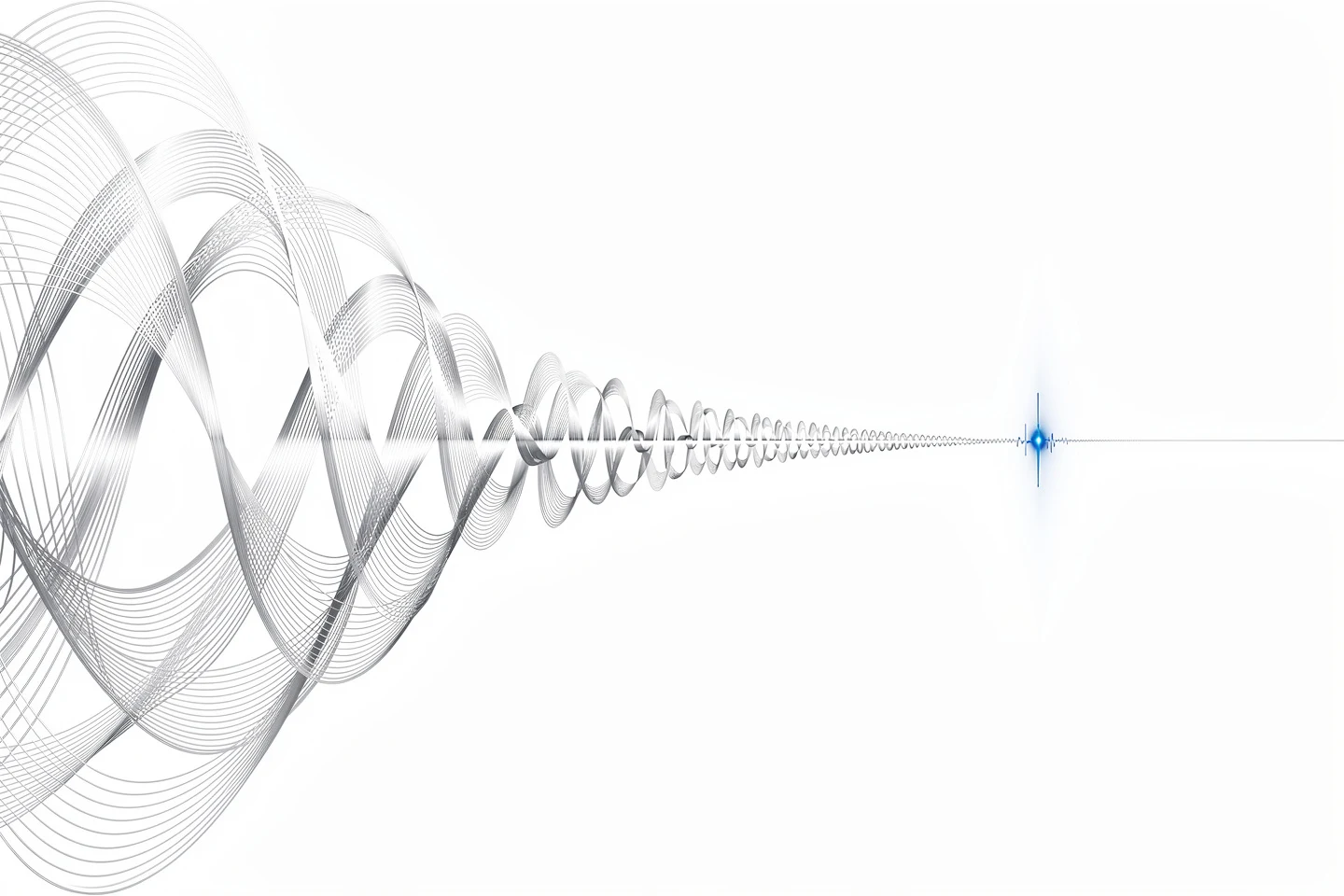
Decades of radio astronomy have listened to space, hoping to catch narrowband radio transmissions — the technogenic 'voice' of distant exoplanets. But our own technological evolution reveals a paradox: loud analog signals, like 1960s TV broadcasts, are just a brief squawk of a newborn civilization. It quickly switches to digital, broadband protocols, then to communication methods based on physics unknown to us. This transition resembles an orchestra that first tunes instruments chaotically and loudly, then plays a complex symphony in ultrasound, inaudible to us. The phantom tuning notes are all we can discern.
The duration of the phase when a civilization is accessible to our instruments is catastrophically short. The model of exponential technological growth K(t) = K₀ $e^{αt}$ (where α is the acceleration rate) shows: the detection window $τ_d$ = (1/α) ln($K_{max}$/$K_{min}$). The faster society develops, the shorter the period when its technosignatures lie within our sensitivity range. With slow progress spread over millennia (α ≈ 0.007 yr⁻¹), civilizations shine like eternal beacons: we could listen to the ancient 'music' of eras. But realistic scenarios, boosted by machine learning and AI, give α up to 0.14 yr⁻¹ — narrowing the window to a hundred years. For post-biological entities with α ≥ 1 yr⁻¹, it shrinks to just a couple of decades. It's like trying to record on a vinyl record a passage that lasts less than one rotation — the needle of our telescope only scratches a brief whisper.
These calculations redefine the search strategy. Narrowband radio signals are a museum exhibit of technological youth, and hoping to catch them is like trying to hear the echo of a silenced concert. SETI must become omnivorous: broadband radio surveys, analyzing light curves via photometry for astro-engineering megastructures, searching for anomalous thermal radiation through spectroscopy. We need not filter for familiar notes, but hunt for any perturbations of the cosmic background — rhythmic glitches in stellar twinkling, strange shadows against the interstellar medium.
This shift in perspective promises to solve the Great Silence. The model suggests we are not alone; rather, technological civilizations are rare, almost synchronous flares that we almost never catch due to developmental phase differences. Projects like the SKA and Vera C. Rubin Observatory are already implementing real-time all-sky scanning, and neural networks learn to distinguish technogenic anomalies from natural catastrophes. Perhaps the first artificial signal will be seen not as a meaningful message, but as a data artifact no astrophysicist could explain, and in that moment, our Galaxy will no longer seem silent.
If a hypothetical SETI project in the Alpha Centauri system had observed Earth in the 1950s, it would have detected strong analog TV signals; today, our planet would be practically radio-silent to it.
The concept of a fleeting window echoes Arthur C. Clarke's story 'The Sentinel,' where an alien beacon waits for millions of years but signals only a brief moment, and that moment must not be missed.