Polarization Echo: Light Catches the Gravitational Ringing of a Black Hole ✛ ✦
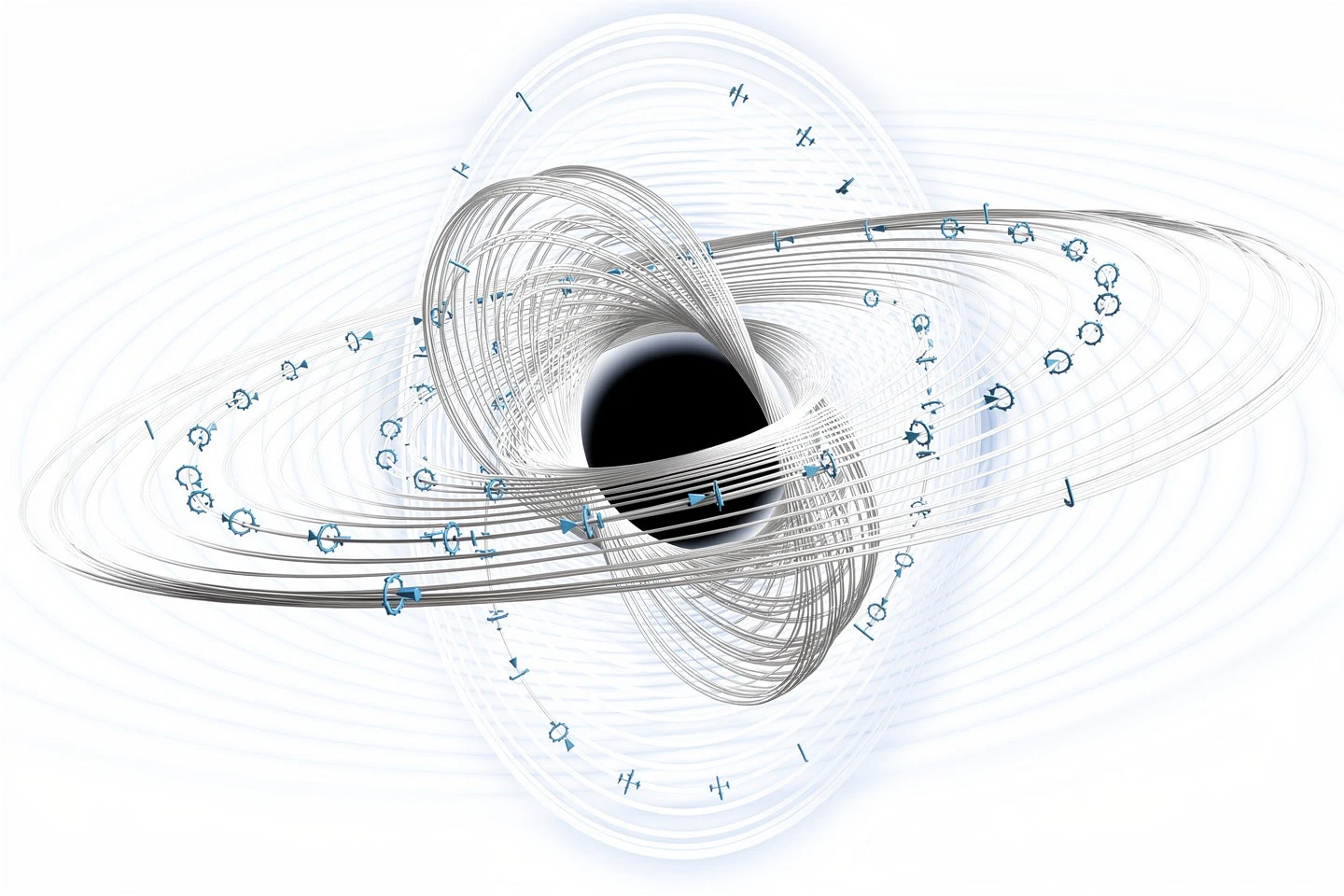
When two black holes merge, they shake the very fabric of spacetime. The newborn giant doesn't settle instantly (it rings like a cosmic bell, emitting a characteristic pattern of damped gravitational waves) the so-called ringdown. Encoded in these oscillations are the mass, spin, and other parameters of the hole, but capturing them directly is incredibly difficult. Now, an unexpected witness to this silent ringing has emerged: light itself.
The metaphor of a laser vibrometer works here with unnerving precision. By shining a beam on a vibrating tuning fork, we see the reflected light subtly tremble, revealing the oscillation frequency. Similarly, gravitational ringing, permeating a nearby accretion disk or a powerful jet from an active galactic nucleus, forces the polarization plane of photons to rotate — not chaotically, but in the strict rhythm of a damped harmonic, characteristic of the black hole's quasi-normal modes. Light becomes a sensitive membrane on which gravity leaves its sonic autograph.
The mathematics of this phenomenon is crystal clear: the polarization angle ϑ undergoes damped oscillations according to \( \vartheta(\tilde{t}_o) = |A| \cos(\omega_R \tilde{t}_o - \Phi) e^{-\omega_I \tilde{t}_o} \). Here, $ω_R$ and $ω_I$ are the frequency and damping decrement, uniquely dictated by the black hole's mass and spin. For a moderately rotating hole with a=0.7M, the rotation amplitude reaches ~10 degrees — a value well within reach of future polarimetric instruments. The phase Φ is directly tied to the source's azimuthal position: \( \Phi = m \varphi + \text{const} \), where m is the azimuthal quantum number. Thus, the geometry of the emitting region is imprinted in the rhythm of the polarization beats.
This discovery flings open a new polarimetric window into gravitational-wave astronomy. Unlike ground-based interferometers that listen to the low-frequency hum of space, polarization observations can visualize the ringdown in electromagnetic light, and the achromatic nature of the effect makes it easy to separate from plasma distortions. We gain an independent test of general relativity in the strongest gravitational fields, complementing Event Horizon Telescope snapshots and future space missions like LISA. The method's theoretical roots trace back to pioneers: John Wheeler pondered geometry's ability to rotate polarization, and Kip Thorne's work laid the foundation for modern gravitational-wave science. Now their speculative ideas gain observational flesh.
In the future, combined numerical simulations accounting for magnetic fields and turbulence in accretion flows, along with coordinated observations with next-generation polarimeters, will not only capture the polarization echo of black hole mergers but also compare it with direct signals from gravitational antennas. Perhaps soon we will learn to read the birth story of a black hole not through the trembling of space, but through the quiver of light.
Unlike Faraday rotation in plasma, which strongly depends on wavelength, gravity-induced polarization rotation is the same for all frequencies — an achromatic "gravitational Faraday effect," predicted back in the 1950s but now, for the first time, quantitatively estimated for realistic merger scenarios.