Cosmic Hourglass: The Flickering Shadow of a Wormhole ✛ ✎ ✦
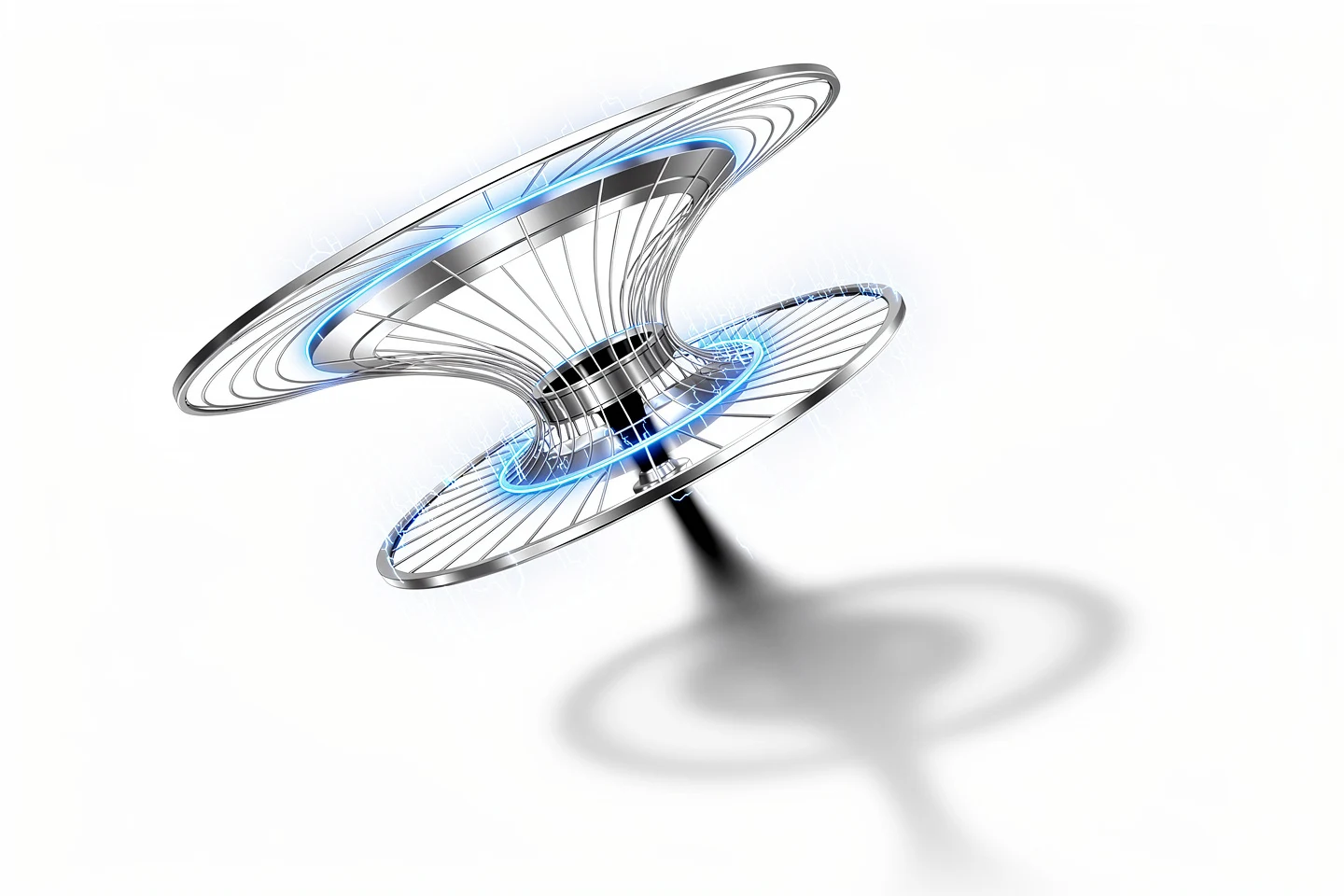
The shadows of supermassive objects at the centers of galaxies, M87 and the Milky Way, have become icons of modern astrophysics. But what if these shadows are not from absorption, but passage? The equations of Einstein allow for traversable wormholes — tunnels in the fabric of spacetime. Their greatest mystery lies not in where the throat leads, but in how it looks when flooded with scorching plasma from an accreting cloud.
In a three-dimensional simulation that merged general relativity with magnetohydrodynamics, scientists traced the fate of such plasma around a rotating wormhole with a throat parameter of ℓ = 2.5 M. As a magnetized torus approached one of the mouths, gravity began to conduct its motion. The wormhole works like a giant hourglass, flipped between universes. But instead of a trickle of sand, a fiery vortex gets stuck, accumulates, and glows white-hot in the throat — a plasma plug caught in a gravitational saddle.
When the spin is high, frame-dragging, an effect predicted by Einstein and his colleagues, comes into play. It twists magnetic fields into tight spirals, and the shadow ceases to be a simple circle. In images reproducing what the Event Horizon Telescope would see at 230 GHz, an additional 'throat' branch of the photon ring appears — a faint, hair-thin luminous rim distorting the left edge. This is the throat's mark on the celestial sphere, a geometric autograph left by no Kerr black hole.
But the most profound signal isn't a static snapshot: it's a pulse. The light curve shows quasi-periodic oscillations with a period determined by mass and spin (for objects like Sagittarius A*, this means tens of minutes). Plasma trapped near the throat oscillates vertically, like a bobber on waves of curved spacetime. This rhythm is a direct echo of gravity from an exotic geometry, impossible to confuse with the chaotic variability of an ordinary accretion disk. If such ticks can be recorded, their stability would turn the wormhole into the most precise clock in the universe, and prove that spacetime has a throat.
The dual signature, a shadow with a throat rim and periodic flickering, becomes a lie detector for active galactic nuclei. By comparing simulations with real data and future polarization observations, astronomers may finally answer: does a black hole lurk in the heart of the Milky Way, or a passage to another universe? The leap from mathematical exoticism to observable reality has already begun.
The idea of a wormhole as a bridge between universes was born with Ludwig Flamm in 1916—just a year after general relativity was published. Back then it seemed a mathematical curiosity, and now we hunt for its shadow.
In the film Interstellar, a wormhole appears as a sphere granting instant travel to another galaxy. Its consultants relied on actual equations, but today's simulations add a new twist: the throat of such a wormhole would collect searing plasma, and its shadow would itself become a storyteller of spacetime's hidden geometry.