The Quark Symphony of a Neutron Star ✛ ✦
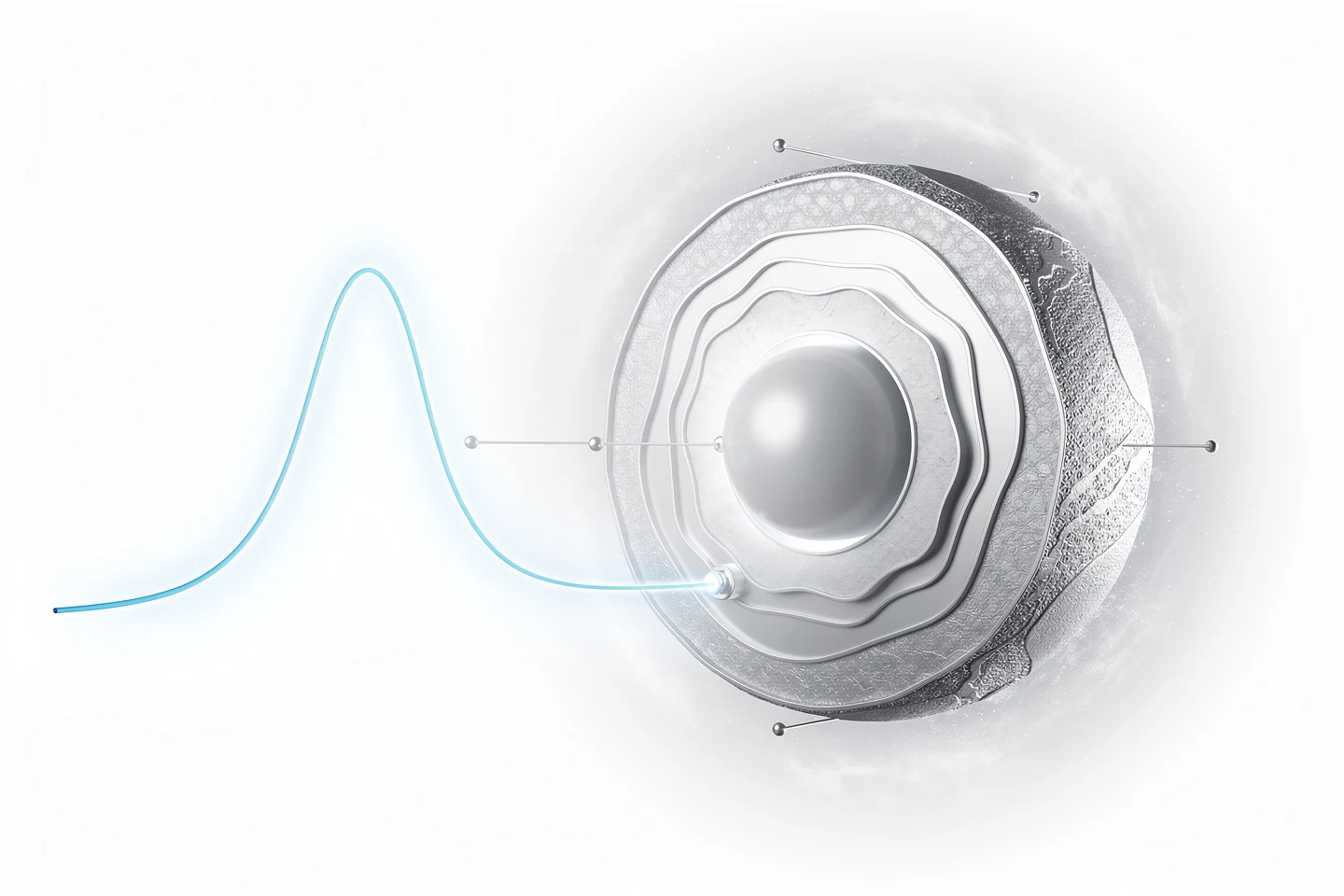
The core of a neutron star can be likened to a taut string of super-nuclear density. Sound traveling along it is the oscillation of pressure, whose speed $c_s$ betrays the stiffness of matter. New research shows that this cosmic string does not hum monotonically. First, it tightens with a mighty crescendo, reaching nearly 70% of the speed of light, then it lets go, softening to a pianissimo of the universal conformal limit. This profile is dictated not by a model's whim, but by the harsh thermodynamics of polarized vacuum QCD and data from pulsars and gravitational waves.
The key to this portrait is a non-parametric approach. Instead of fitting the equation of state to rigid formulas, the researchers represented the square of the speed of sound through an auxiliary field φ and endowed it with a prior distribution generated by Gaussian processes. The ensemble is stitched from three parts: a low-density segment of nuclear crust, a high-density anchor from perturbative QCD at μB = 2.6 GeV (where asymptotic freedom, discovered by Frank Wilczek, already operates), and an intermediate bridge optimized by the principle of least action. Iterative projection through covariance keeps the solution within strict bounds, and the metric of curved spacetime connects pressure to observed masses via the Tolman–Oppenheimer–Volkoff equations.
Multi-messenger data (rhythmic signals from millisecond pulsars like PSR J0030+0451 and J0740+6620, as well as the gravitational-wave burst from the merger GW170817) revealed non-monotonicity. The speed of sound peaks at 0.68 (+0.14, –0.13), significantly exceeding the conformal limit of 1/3, then returns to it at densities around 30 $n_{sat}$. The trace anomaly Δ ≡ 1/3 − p/ε becomes positive inside the star, signaling massive, "dressed" degrees of freedom. Quantitatively, the transition is captured by the cumulative softening index ς: its posterior value exceeds by orders of magnitude anything that purely hadronic models can produce. In other words, in the heart of massive neutron stars with a maximum mass of about 2.11 M☉, a quark-hadron crossover unfolds.
Future observations with next-generation gravitational-wave detectors, Einstein Telescope and Cosmic Explorer, and X-ray missions like STROBE-X will allow us to hear the overtones of this symphony. Numerical simulations of mergers, accounting for the crossover and the birth of quark-gluon plasma, may reveal unique multi-messenger signatures: from modulation of the gravitational-wave signal to anomalies in kilonovae afterglows. Thus, the picture of stellar evolution gains a new chapter, and the question of where hadrons end and quark freedom begins ceases to be purely theoretical.
The speed of sound reaching two-thirds the speed of light does not violate causality: information from the core to the surface of a neutron star takes a fraction of a millisecond. For comparison, light covers the same distance in about the same time, but here, sound almost keeps up.
In Robert Forward's novel 'Dragon's Egg,' intelligent life on the surface of a neutron star, based on nuclear interactions, is described — an artistic foreshadowing of the very exotic matter we now study in the cores of these stars.