Agujero negro sin singularidad: una nueva geometría del espacio exprés
En el centro de un agujero negro clásico se esconde una singularidad: un punto donde la densidad y la curvatura del espacio-tiempo se vuelven infinitas. La física se queda muda allí. Karl Schwarzschild fue el primero en resolver las ecuaciones de Einstein para un objeto así, pero la singularidad siguió siendo un misterio.
La métrica con rebote negro reemplaza la singularidad por una transición suave: el espacio no se comprime hasta un punto, sino que se da la vuelta. Todo depende de un único parámetro $a$. Si es menor que cierto umbral, tenemos un agujero negro regular sin singularidad. Si es mayor, surge un túnel hacia otra región del universo: un agujero de gusano transitable.
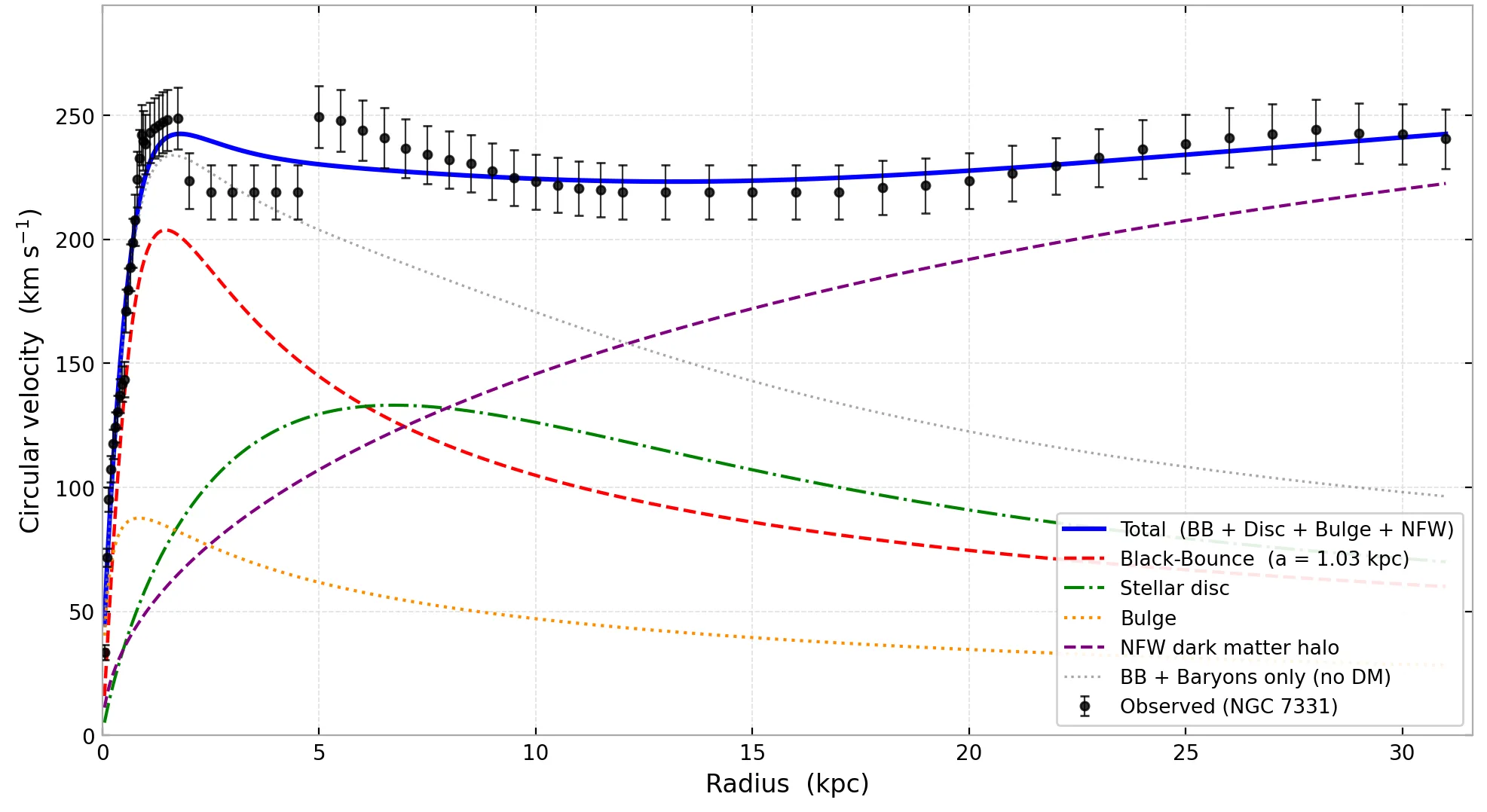
Esta es la primera vez que el parámetro de rebote se mide no en un experimento mental, sino en una galaxia real. El modelo no solo elimina la singularidad en el núcleo, sino que también encaja perfectamente con el halo de materia oscura estándar a grandes distancias. El sistema solar también siente este parámetro: en el trabajo se calculan pequeñas correcciones al avance del perihelio de Mercurio, a la desviación de la luz y al retardo de las señales de radio. Son pequeñas, pero en el futuro podrían ser comprobables.
Resumen original
tal como lo escribieron los autores, en inglés arXiv:2607.09840
The black-bounce spacetime provides a regularized modification of the Schwarzschild metric by introducing a free parameter $$a$$ that eliminates the central singularity while preserving the exterior geometry of a classical black hole. This work investigates the physical implications of this metric across three complementary observational windows. First, we examine the horizon structure and the transition between a regular black hole ($$a < 2M$$) and a traversable wormhole ($$a > 2M$$), offering a viable singularity-free alternative to classical black hole solutions. Second, we perform Solar System precision tests perihelion precession of Mercury, gravitational lensing, and the Shapiro time delay of radar signals demonstrating that the bounce parameter $$a$$ introduces small but measurable corrections relative to general relativity. Third, and for the first time, we apply the black-bounce metric to galactic dynamics by deriving the circular velocity field and fitting it to the observed rotation curve of NGC~7331. A four-component mass decomposition black-bounce central potential, Freeman exponential disc, Hernquist bulge, and a Navarro--Frenk--White dark matter halo yields $$a = 1.035 \pm 0.119$$~kpc , providing the first observational constraint on the bounce parameter from galaxy kinematics. Our results confirm that the black-bounce metric regularises the inner galactic core while remaining fully consistent with a standard dark matter halo at large radii, establishing this spacetime as a compelling testbed for singularity-free alternatives to classical black holes.
El parámetro de rebote para NGC 7331 resultó ser del orden de tres mil años luz, comparable a la distancia desde nosotros hasta el centro de nuestra propia Galaxia.
La idea de un agujero de gusano transitable como puente entre regiones distantes del espacio se explora en la película 'Interstellar', donde los protagonistas viajan a través de un agujero de gusano cerca de Saturno.