X-rays are a form of high-energy electromagnetic radiation with wavelengths shorter than ultraviolet light, typically ranging from about 0.01 to 10 nanometers. They are produced when high-speed electrons collide with matter or when electrons transition between inner atomic shells. X-rays are famous for their ability to penetrate soft tissue but are absorbed by dense materials like bone, making them invaluable in medical imaging and materials science.
Historia
X-rays were discovered by Wilhelm Röntgen in 1895, who observed them as an unknown type of radiation that could expose photographic plates. He named them 'X-rays' to signify their mysterious nature, and he received the first Nobel Prize in Physics in 1901 for this discovery.
Cómo funciona
X-rays are generated when charged particles, usually electrons, are accelerated and then decelerated rapidly, or when they knock inner-shell electrons out of atoms, causing higher-energy electrons to fill the vacancy and emit photons. Because of their short wavelength, X-rays can pass through many materials, but their absorption depends on the atomic number and density of the material. In detectors, X-rays are captured by converting their energy into electrical signals, often using scintillators or semiconductor sensors.
En la práctica
X-rays are used in medical radiography, computed tomography (CT) scans, airport security scanners, and in astronomy to observe high-energy phenomena like black holes and supernovae, as mentioned in the article about invisible light from young galaxies.
Dato curioso
X-rays were first used for medical imaging within months of their discovery, and the first X-ray image ever taken was of Röntgen's wife's hand, showing her bones and wedding ring.
Afinar la cuerda hasta la nota deseada: el pulso láser se ajusta para que las armónicas suenen al unísono en frecuencias de kiloelectronvoltios.
La luz que vemos oscila a una frecuencia de cientos de billones de veces por segundo.
En una galaxia lejana, a unos 290 millones de años luz de nosotros, se esconde el objeto HLX-1. En el pasado brilló más que cientos de miles de millones de soles, pero ahora se ha calmado. De 2018 a 2022, los telescopios espaciales Hubble, Chandra y Swift siguieron su declive.
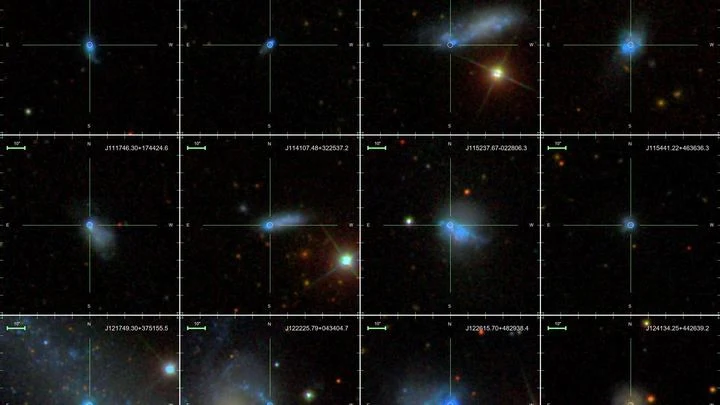
Una bombilla tenue de repente comienza a iluminar patrones invisibles en la pared. Así es como los astrónomos observan las lejanas galaxias enanas: diminutas islas estelares, pobres en elementos pesados. En algunas de ellas se ha detectado un débil resplandor violeta de helio ionizado (la línea espectral especial He II 4686 Å).
En el centro de muchas galaxias se esconden agujeros negros supermasivos. De vez en cuando 'gritan' — emiten poderosas erupciones de rayos X. Los científicos llevan tiempo devanándose los sesos con la naturaleza de estas 'erupciones cuasiperiódicas'.