La bulle sombre et le micromonde : la gravité à des millionièmes de mètre express
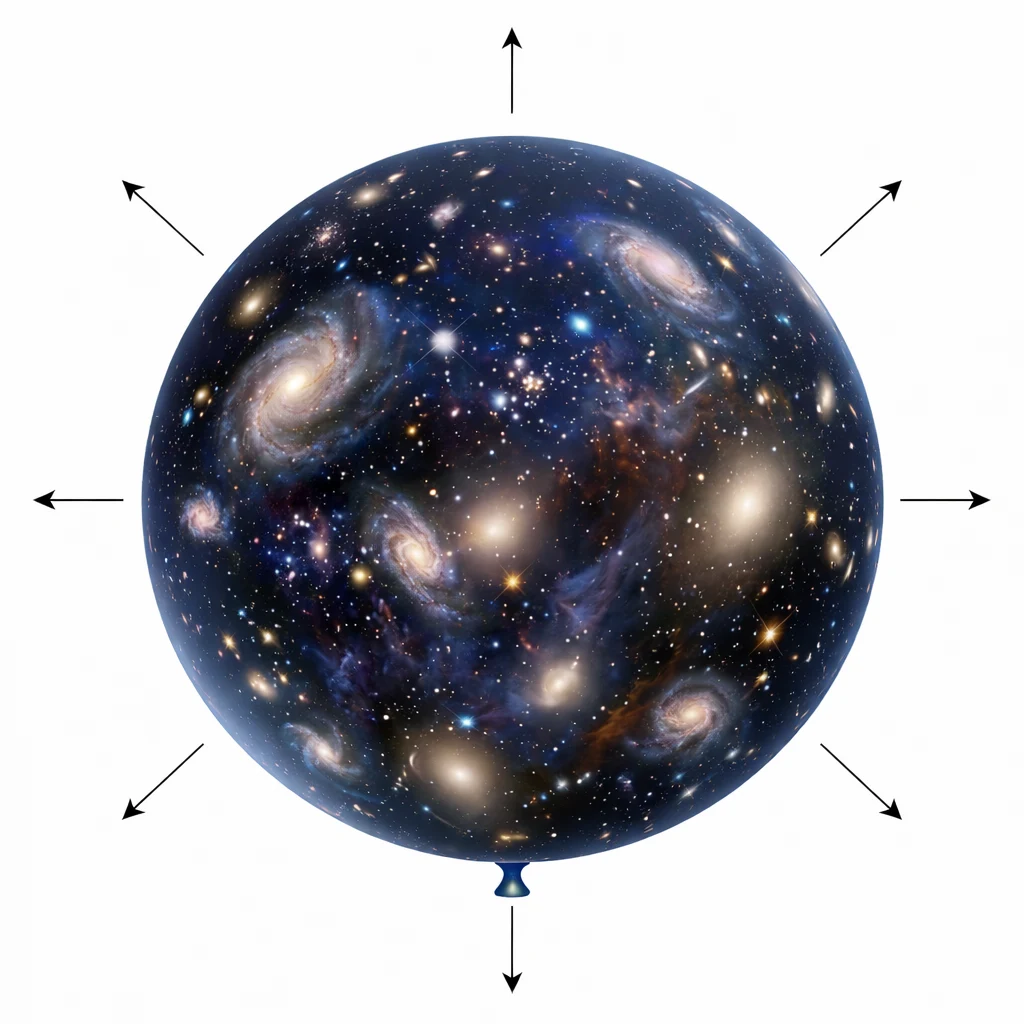
L'Univers se comporte comme une bulle de savon qui gonfle dans une mousse multidimensionnelle. Le modèle de la bulle sombre explique pourquoi elle s'étend de plus en plus vite : la bulle d'espace-temps grandit, et sa membrane acquiert une épaisseur minuscule — environ un micron, comme une bactérie. À de telles distances, la gravité « s'étale » dans cette épaisseur et s'affaiblit.
On peut le vérifier en mesurant l'attraction de particules microscopiques. À une distance d'un micron, la force sera de quelques pour cent plus faible que ce que prédit la loi de Newton des manuels. Cet affaiblissement est intimement lié à l'expansion accélérée du cosmos — les deux sont des manifestations d'un même phénomène. Le modèle indique aussi une légère courbure de l'espace, que les astronomes espèrent détecter.
Résumé original
tel que rédigé par les auteurs, en anglais arXiv:2606.20942
The dark bubble model explains the existence of a positive cosmological constant by making explicit use of the instabilities underlying the de Sitter swampland conjectures to make the accelerated expansion of the universe inevitable. A distinctive consequence of the construction is a unique hierarchy connecting cosmological, gravitational, string, and higher-dimensional scales. In particular, the model naturally predicts the existence of a dark dimension of micron size, an idea that has been argued for on independent grounds in the literature. The same framework also predicts a weakening of gravity at distances of order the dark-dimension scale, leading to a fading of the gravitational force at micron distances. We argue that the dark bubble therefore provides a concrete realization of both the dark dimension proposal and Sundrum's fat graviton scenario, in which gravity effectively ceases to probe shorter distances. Additional predictions include a string scale of order tens of TeV and a measurable positive spatial curvature of the universe. We review these key aspects of the model, discuss their implications for gravity and cosmology, and highlight its key predictions.
Le micron (un millionième de mètre) est la taille typique d'une bactérie. Si une telle dimension existait, elle serait littéralement sous notre microscope.