Телескоп Уэбб нашёл космическую мельницу пыли экспресс
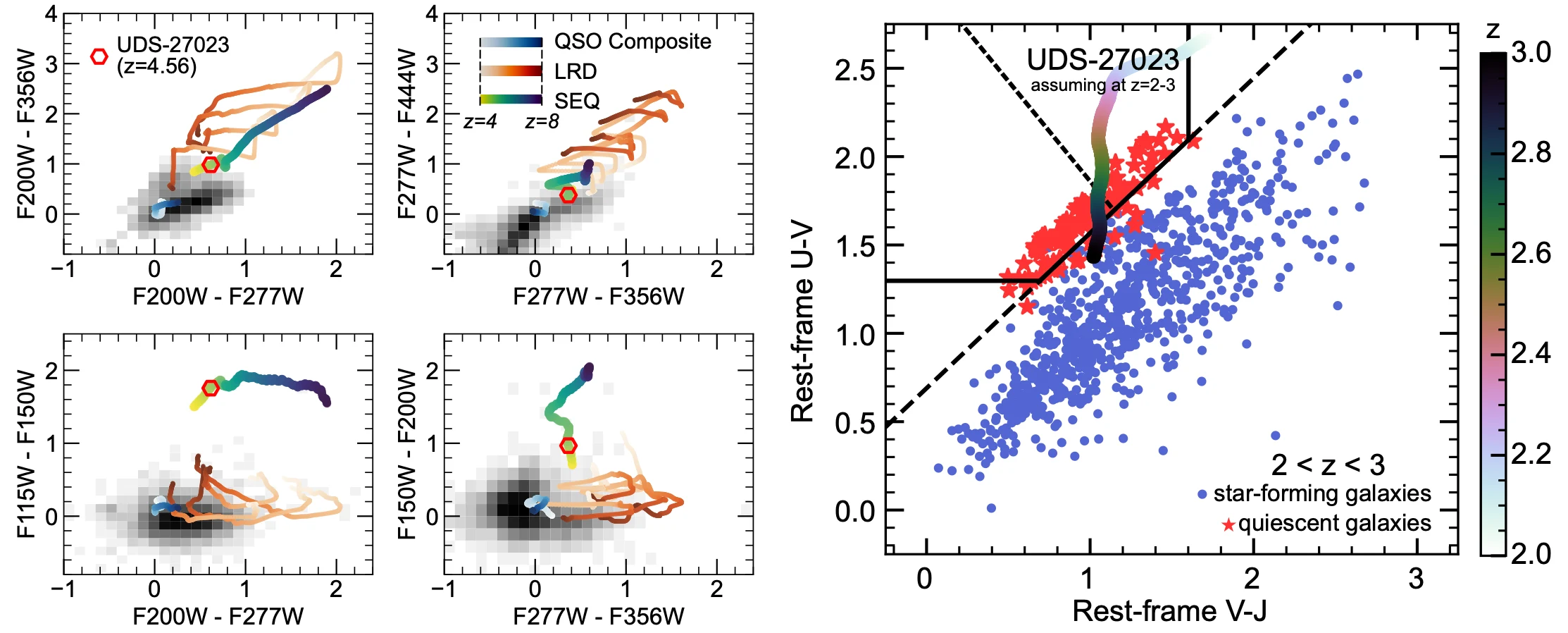
С помощью телескопа Джеймс Уэбб астрономы заглянули в древний квазар — ослепительное сердце галактики, где гигантская чёрная дыра засасывает вещество. Оказалось, что она не просто разрушает, но и созидает: её мощные выбросы и ударные волны действуют как настоящая космическая мельница. Они перемалывают частицы космической пыли в тончайший порошок — тот же, что и обычный песок, только растёртый до микроскопических размеров.
И вот неожиданный поворот: телескоп не заметил характерной спектральной детали, которая выдаёт углеродную пыль — а она почти вездесуща. Похоже, эта мельница настроена избирательно: перерабатывает только силикаты, игнорируя углерод.
Оригинальная аннотация
как её написали авторы, на английском arXiv:2606.02685
The rapid accumulation of massive dust reservoirs in the early Universe remains a major challenge in astrophysics. While core-collapse supernovae can inject large dust grains ($$a \gtrsim 0.1\,\mu{\rm m}$$) on short timescales, explaining the total dust budgets in the early Universe likely requires efficient grain growth in the interstellar medium (ISM). Such growth depends critically on an abundant population of small grains, which maximize the surface area available for accretion and may be generated by rapid dust-processing or dust-formation channels. Here, we report the discovery of a QSO UDS-27023 at $$z=4.556\pm0.003$$, identified using JWST/NIRSpec spectroscopy. By quantitatively comparing the spectra to QSO composite templates, we find that UDS-27023 displays an exceptionally steep far-UV extinction curve ($$A_{1500}/A_V \approx 8$$) but notably lacks the 2175 Angstrom bump, indicating a dominance of small silicate dust grains. We interpret this phenomenology as evidence for active small-grain production and processing in the QSO environment. Mechanical shattering of pre-existing large grains by QSO-driven shocks and outflows provides one natural pathway, while in-situ condensation of silicate grains inside dense QSO-driven winds may offer an additional route. Such a population of steep-extinction QSOs (SEQs) may therefore reveal a short-lived phase in which luminous AGN generate, process, and redistribute small grains, potentially facilitating rapid ISM grain growth and enriching the circumgalactic medium.
Свет от этого квазара путешествовал 12,5 миллиардов лет, прежде чем достиг телескопа. Мы видим его таким, каким он был всего через 1,3 миллиарда лет после Большого взрыва.