Торий-229: атомная квантовая батарея экспресс
Два маятника на общей нити обмениваются движением: толкнёте один — закачается второй, а через мгновение первый получит толчок обратно. В атоме тория-229 так же энергия почти без потерь перетекает между электронной оболочкой и ядром.
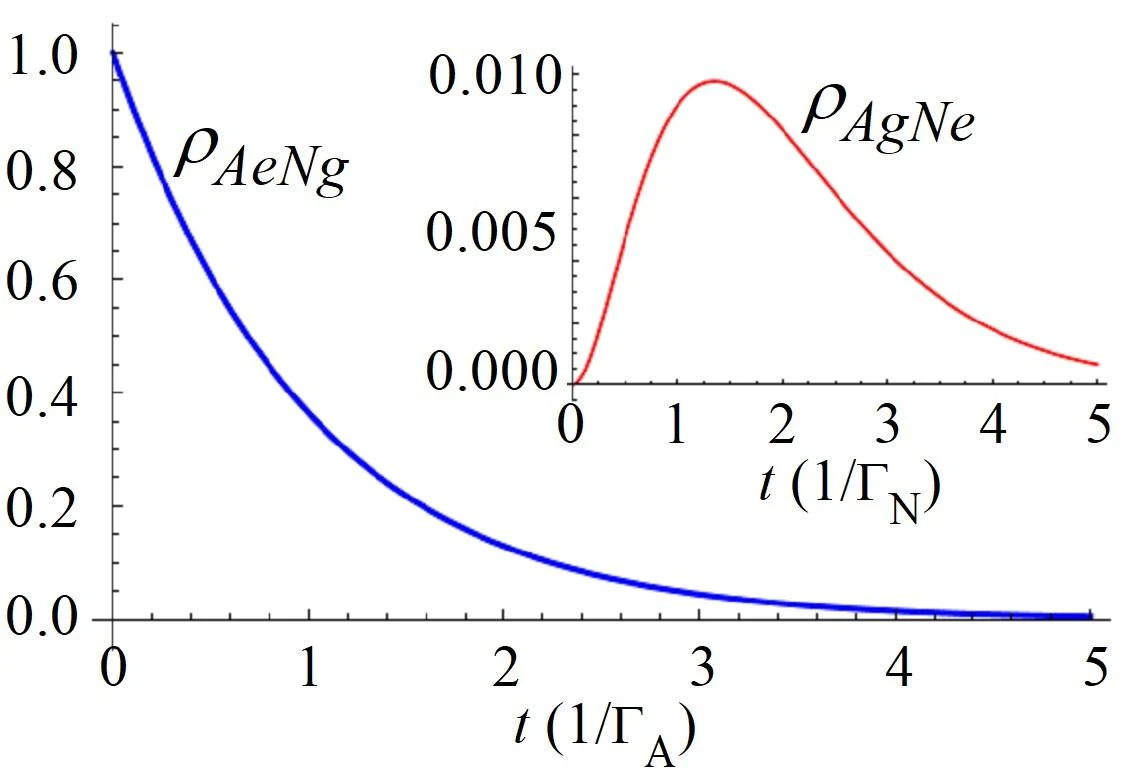
Этот ритм виден в ловушке для атомов: анализ света (спектроскопия) и измерение яркости (фотометрия) показывают колебания оболочки. Лазер заряжает её, и энергия ныряет в ядро — получается ядерная батарейка без проводов, на световой подзарядке. В основе — законы Стандартной модели, описывающей вещество. Нильс Бор разгадал слоистую структуру атома, а Эрнест Резерфорд нашёл массивное ядро.
Ядра обычно требуют жёсткого гамма-излучения. Но торий-229 уникален: его ядро возбуждается от мягкого ультрафиолета с энергией всего 8,4 электронвольт — это уровень электронов, а не ядер. Энергия в миллион раз меньше типичной ядерной, и поэтому батарейку можно создать уже сейчас.
Оригинальная аннотация
как её написали авторы, на английском arXiv:2607.00607
The electron shell of the Thorium ion with the $$M$$1(8.4~eV) transition between levels and the doublet of the $$^{229}$$Th nucleus ground state with the similar transition represent two qubits spatially inserted one within the other. In the case of relative proximity of the energies of these transitions, weakly damped energy oscillations can be excited between qubits, namely, multiple coherent energy transfer from the electron shell to the nucleus and vice versa. This process in the $$^{229}$$Th ions does not require resonant (within the width of the levels) coincidence of the transition energies due to the relatively high interaction energy of the electron and nuclear currents. The electron shell ``breathes'', periodically decreasing and increasing in size. The effect can be observed in an ion trap by the intensity of light scattered by thorium-229 ions. This extends the energy range for the $$^{229m}$$Th$$(3/2^+,8.4$$~eV) isomer excitation via an electron bridge. Furthermore, the system under consideration is transformed into a nuclear quantum battery when exposed to coherent laser radiation. To ``charge'' the battery, i.e. to excite $$^{229m}$$Th, one can use developed methods for charging quantum batteries, in particular, coherent excitation of the electron shell followed by coherent transfer of excitation energy to the nucleus (the coherent electron bridge). This opens the way for the design of the $$^{229}$$Th nuclear quantum battery at the current level of technological development.
Ядро тория-229 можно 'зарядить' не гамма-лучом, а обычным ультрафиолетовым светом — его энергия возбуждения всего 8,4 электронвольт, как у прыжка электрона в атоме, а не у ядерной реакции.