Why Warming Speeds Up and Then Stalls: The Climate's Layered Cake
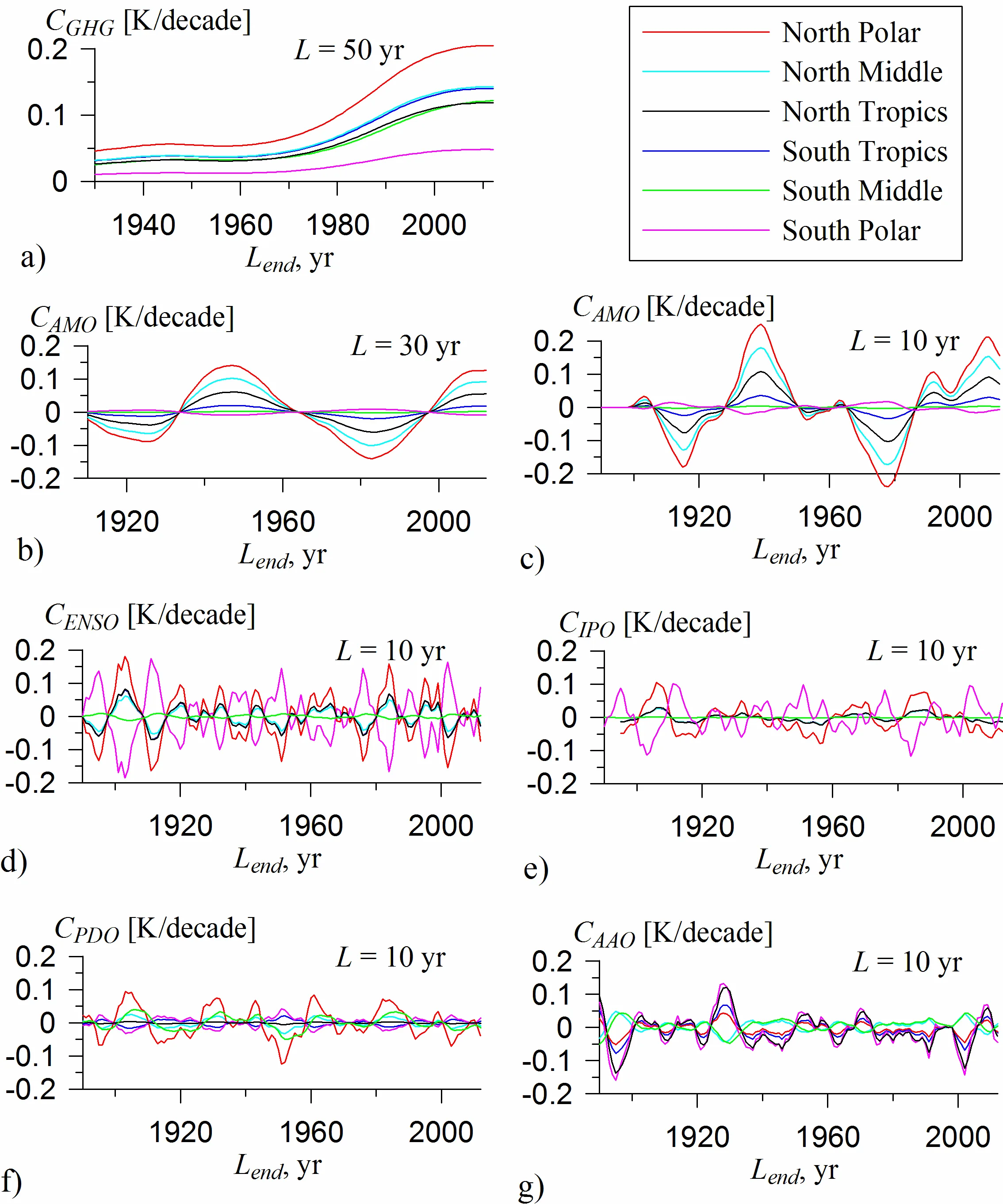
Warm air from a radiator rises to the ceiling, but near the window, the wall is cooler than by the door. Earth's climate works the same way: greenhouse warming isn't spread in an even layer; it's more like a layered cake. The top layer is the ocean's natural seesaw, which can temporarily hide the greenhouse filling.
Natural seesaw refers to slow shifts between warm and cool water in the ocean. These don't add heat from outside; they just shuffle it around different parts of the planet. But over short stretches of 20–30 years, they can act like a strong wind that alternately fans the flames or dampens them. Scientists built a simple model linking the temperature in a given year to the previous year's temperature, the amount of greenhouse gases, and the phase of the ocean seesaw. Then they "switched off" each factor one by one: they replaced the observed greenhouse gas series with a synthetic one frozen at 1880 levels and watched how the slope of the temperature curve changed. It's like tasting a cake layer by layer to figure out which one gives the main flavor.
The result was clear. Over short stretches, natural swings can outweigh the greenhouse gas contribution, especially in the Arctic. But stretch the window to half a century or more, and the greenhouse gas contribution starts to dominate at all latitudes. Over the last two decades, it has reached 0.2 K per decade. These numbers help explain why Antarctic sea ice area grew in recent decades while Arctic ice shrank rapidly. They also remind us that natural swings can substantially mask or amplify warming on short horizons, and this must be taken into account when interpreting short-term climate trends.
Let's return to the room with the radiator. If you watch the thermometer for just a few minutes, you might conclude the heating isn't working: the draft from the window cools the wall. But wait an hour, and the room warms up. It's the same with climate: short-term ocean swings can be confusing, but over the long haul, the greenhouse filling determines the flavor of the whole cake.
The largest contribution of natural fluctuations to temperature trends is found in the Arctic, up to 0.2 K per decade, which is comparable to the greenhouse gas contribution on short intervals. Meanwhile, in Antarctica, the temperature relationship with El Niño has the opposite sign compared to other latitudes: when the tropical Pacific warms, Antarctica cools.