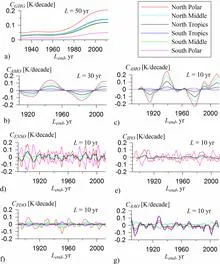
Radiative forcing is a measure of how much an external factor—such as increased carbon dioxide, changes in solar output, or volcanic aerosols—disturbs the Earth's energy balance. It is defined as the change in net irradiance (incoming sunlight minus outgoing heat radiation) at the top of the atmosphere, measured in watts per square meter. A positive forcing warms the planet, while a negative forcing cools it. This concept is central to climate science because it provides a common yardstick for comparing the warming or cooling influence of different natural and human-made agents.
History
The term was formalized in the 1970s and 1980s, with key contributions from scientists like Syukuro Manabe and James Hansen, who used it to quantify the climate impact of greenhouse gases in early climate models.
How it works
When a factor like CO2 increases, it absorbs more outgoing infrared radiation that would otherwise escape to space. This reduces the net outgoing energy at the top of the atmosphere, creating an energy surplus—a positive radiative forcing. The climate system then responds by warming until a new equilibrium is reached, with the surface and atmosphere radiating enough extra heat to balance the books again. The forcing value is typically calculated for a specific change (e.g., doubling CO2) using radiative transfer models, isolating the immediate effect before any climate feedbacks like ice-albedo or water vapor changes kick in.
In practice
Radiative forcing is the standard metric in IPCC reports for comparing the climate impact of different greenhouse gases, aerosols, and land-use changes, informing policy targets like the Paris Agreement.
Fun fact
The radiative forcing from all human-added greenhouse gases since pre-industrial times is about 3 watts per square meter—roughly the energy of one small LED bulb per square meter of Earth's surface.
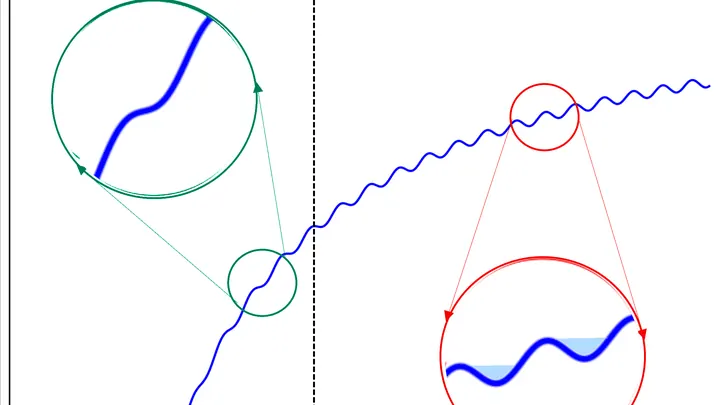
A spotlight with an adjustable beam width sweeps along the shore. Its light is the long ocean waves that are born in the surf zone and spread in both directions: toward the beach and out to the open sea. Previously, this spotlight was considered a point source, but the actual breaking zone, where short waves break, has a finite width, and it changes as the wave front advances and retreats.
A camera flash that fires in a thousandth of a second doesn't heat the subject — unlike a regular flash that lasts a full second. A similar trick has been found in radiotherapy: when a radiation dose is delivered in milliseconds instead of minutes, healthy tissues suffer less. This is called the FLASH effect.
A stone falls into a pond — near the shore, the ripples are barely visible, while the water churns at the point of impact. The electric field around a charge behaves similarly: close in, it's sharp and tangled, but at a distance it stretches into a smooth wave that carries energy away. Physicists call this distant region the radiation zone.
Today's Martian surface is a cold, nearly airless home. Many dream of a full renovation: warming the planet, filling it with air from carbon dioxide and nitrogen.
The Sun constantly emits a stream of charged particles — the solar wind. Among them are many electrons, some of which fly back toward the Sun. But observations show that fewer electrons return than expected.
Warm air rises from a radiator, and the room seems to heat evenly. But if you put your hand against the wall by the window, it feels cooler than by the door.
A swing builds up when you push it in time. But sometimes the person on the swing responds not to every push but to every third one, and the amplitude grows slowly yet inexorably.