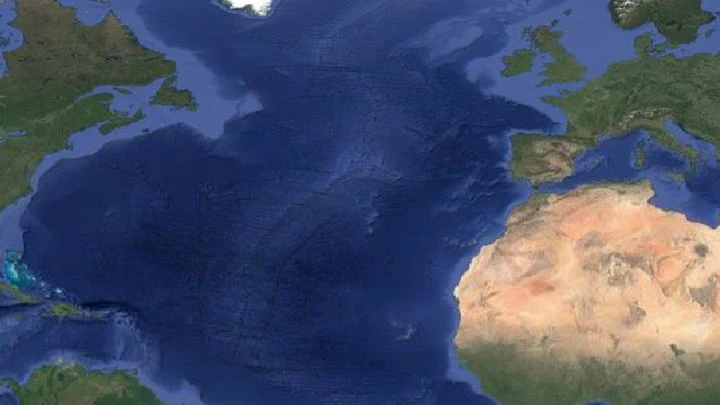
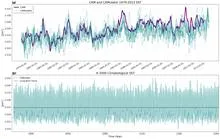
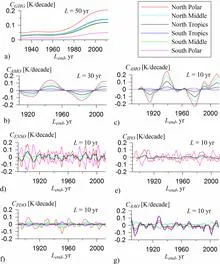
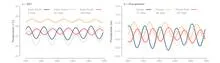
The Atlantic Multidecadal Oscillation (AMO) is a long-term, natural fluctuation in the surface temperature of the North Atlantic Ocean. It operates on a timescale of roughly 50 to 70 years, meaning that the ocean basin as a whole can be in a warmer or cooler phase for decades at a time. This oscillation is not a single event but a recurring pattern, and it has significant influence on climate far beyond the ocean itself, affecting rainfall, hurricane activity, and temperatures across North America, Europe, and Africa.
History
The concept of a multidecadal Atlantic temperature cycle was recognized in the late 20th century, with the term 'Atlantic Multidecadal Oscillation' popularized by researchers such as Michael Mann and colleagues in the late 1990s, though earlier studies in the 1980s and 1990s had noted similar patterns.
How it works
The AMO is driven by a combination of ocean circulation and atmospheric interactions. The key mechanism involves the Atlantic Meridional Overturning Circulation (AMOC), a large-scale system of ocean currents that transports warm water northward near the surface and cold water southward at depth. When the AMOC is strong, more warm water is pulled into the North Atlantic, leading to a warm phase of the AMO; when it weakens, the region cools. This process is not purely periodic but emerges from the chaotic interplay of ocean dynamics, heat exchange with the atmosphere, and variations in salinity. The oscillation's long timescale arises because the ocean's deep layers respond slowly to changes, acting as a thermal memory that integrates short-term atmospheric noise into decades-long swings.
In practice
Understanding the AMO is crucial for decadal climate prediction, helping to anticipate shifts in hurricane frequency, Sahel rainfall, and regional drought patterns, which informs water resource management and disaster preparedness.
Fun fact
The AMO's warm phase in the mid-20th century coincided with a period of increased hurricane landfalls in the United States, while its cool phase in the 1970s and 1980s saw reduced hurricane activity.
A drying puddle of mud becomes covered with cracks, like an old painting with craquelure. At first the cracks meet at nearly right angles, forming a rough grid. But if the mud is wetted again and allowed to dry, the pattern changes: cracks begin to meet in threes, at an angle of 120 degrees, like a honeycomb.
Why this happens remained a mystery for a long time.
Picture a guitar string stretched between two frets. When you pluck it, a standing wave forms: some points on the string oscillate strongly, while others, the nodes, remain almost still. The chromosphere, a layer of the solar atmosphere sandwiched between the photosphere and the corona, behaves in much the same way.
In a pot of boiling soup, light fat droplets rise to the top, while heavy vegetable chunks sink to the bottom. Particles in the tenuous hot gas around the Sun and other stars behave much the same way — except instead of broth, there's a mixture of charged particles: electrons, protons, and alpha particles.
The giant cloud of icy chunks on the outskirts of the Solar System, the Oort cloud, resembles a transparent bubble stretched to a light-year across. Usually, these chunks hang quietly in their distant corners, but sometimes something disturbs them.
Most often, it's the tidal influence of our Galaxy.
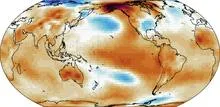
In 1991, Mount Pinatubo erupted with such force that it blanketed the planet in a thin veil of ash and gases for years. That veil, like a blanket on a hot night, trapped heat and cooled the ocean surface, causing tropical sea surface temperatures to dip. This event marks the start of a detective story about why some oceans are spawning ever more ferocious hurricanes while others remain calm.
In the deep oceans of icy moons, water is not still. Warm plumes rise from the rocky seafloor, but the planet's rotation twists them into long, slanted rolls stretched along the rotation axis. Previously, this process could not be included in global models: it was too complex.
A tuning fork produces a pure tone, but if you strike it too hard, it starts to rattle, and a musician might mistake that rattle for complexity in the sound.
In the Atlantic, a giant invisible conveyor operates: warm surface waters flow north, cool, sink, and return south. This circulation, AMOC, carries heat, making Europe noticeably milder than Canada at the same latitudes. But the conveyor isn't eternal: if diluted by fresh water from melting Greenland ice, the engine stalls.
For 800,000 years, ice ages have occurred every 100,000 years. The rhythm matches the elongation of Earth's orbit. But the orbit changes the flow of solar heat so subtly — as if the conductor barely moved the baton, yet the orchestra thundered. It remained a mystery how this weak signal controls the ice sheets.
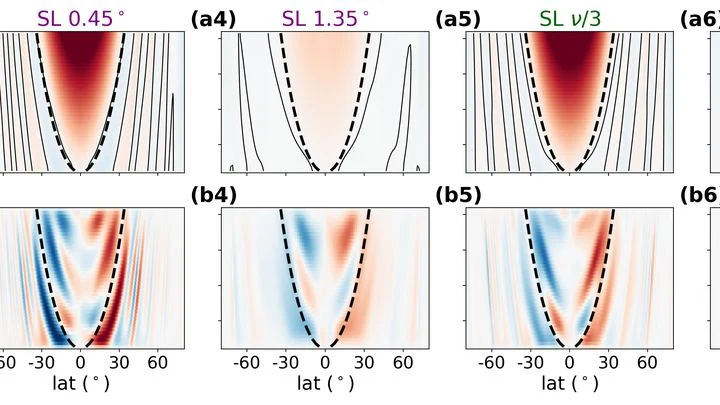
Deep inside Earth lies a solid iron core about the size of the Moon. It floats in liquid metal and sways slightly, like a pit in a peach when you shake the fruit. Such oscillations are called Slichter modes: the core shifts both along the planet's axis and perpendicular to it.
Three forces act together to damp this motion.
The Sun pulses in a slow rhythm, and that rhythm can be heard in the rains over Brazil. Sunspots on the solar disk thicken and thin roughly every eleven years, and along with them, pressure in the Pacific Ocean shifts, sea surface temperatures change, and then rainfall amounts in the northeast of the country follow suit.
Thousands of kilometers of fiber-optic cables lie on the ocean floor. They carry internet traffic, but the cables themselves sense the slightest vibrations in the water and the seabed. If you listen closely to such a cable, you can hear a blue whale singing or the ground trembling thousands of kilometers away.
Ring-shaped reefs, atolls, are usually explained like this: corals grow along the edge of a volcanic island while the island slowly sinks. What's left is a hollow ring that can stretch for kilometers. But satellite images show similar rings around very small reefs where there are no volcanoes and no subsidence.
Imagine a radiator in a room: it heats up, but if its surface is clogged with dust, heat escapes less efficiently. Something similar is happening to our planet. Earth receives energy from the Sun and must radiate the excess back into space, otherwise temperatures rise. Scientists call this ability to shed excess heat radiative feedback.
Ahead of the bow shock that Earth creates in the solar wind, giant bubbles of rarefied gas sometimes appear. Inside them, particle density drops by factors, and electric fields start to tremble like a plucked string.
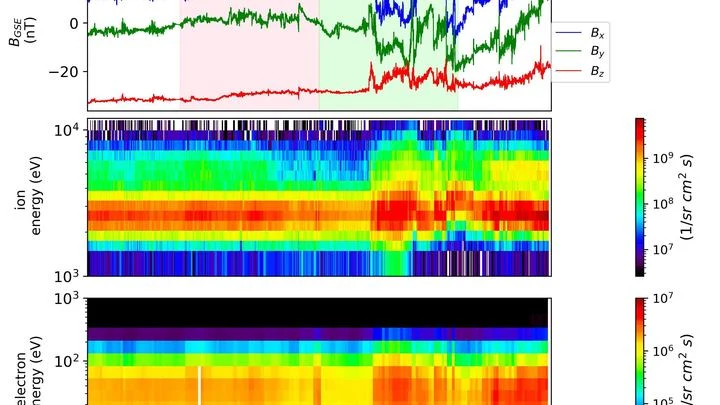
October 10, 2024. The Sun hurled a cloud of magnetized plasma toward Earth, and four spacecraft, stationed at a single point between the Sun and Earth, simultaneously recorded how that cloud churned. The distance between the outermost probes was just 80 Earth radii, about half a million kilometers.
For a long time, the climate of ancient Mars remained a mystery: the beds of dried-up rivers spoke of water, but models couldn't explain how it got there — after all, 4 billion years ago the Sun shone 30% dimmer. New research shows that the planet swayed, as if on a swing, between long glaciations and short wet epochs.
An ice core from Antarctica is a time machine that recorded the climate for 130,000 years straight, year after year, with no gaps. Air bubbles trapped in the ice preserve the carbon dioxide of those ancient eras.
The orchestra assembled, the instruments were tuned, but there was barely any music: that's what the 2025 Atlantic hurricane season looked like. The ocean was the fifth warmest on record, and a weak La Niña usually adds strength to storms. But instead of a continuous concert, we got isolated thunderous chords: three Category 5 hurricanes, with silence in between.
Why was the orchestra silent?
Lunar rocks brought a puzzle: their age is 4.35 billion years, but the Moon itself should have appeared 150 million years earlier. The missing time is hidden in tidal heating. When the Moon hung closer to Earth, Earth's gravity acted like tireless hands: it constantly kneaded and bent the satellite.
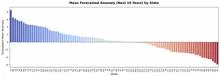
The climate of the United States is not a straight line creeping upward. It is an orchestra without a conductor, where every violin and every drum plays its own part, and together they create an intricate pattern of warm and cold, wet and dry years.
After the Moon's birth, Earth resembled a sizzling lump of dough: a continuous liquid magma and a dense shroud of gases. The Moon acted like a giant spoon, constantly kneading this lump with its gravity. Friction generated heat, delaying cooling.
A translator at a high-stakes negotiation doesn't just render words quickly; they make sure the meaning doesn't get lost. CAMulator does the same: it takes the complex climate model CAM6 and translates it into the language of a neural network that runs hundreds of times faster, without losing the physical essence.
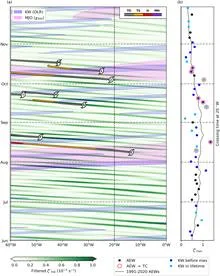
The ocean breathes, and hurricanes swing on its breath like on a seesaw. Over the past seventy years, hundreds of tropical cyclones have crossed the North Atlantic, and not all of them behaved alike. Some decades brought a barrage of destructive storms to coastlines; others brought calm.
Water remembers. Every current, every eddy, every degree of temperature in the ocean's depths does not vanish without a trace; it leaves a mark that can be read. But until recently, that mark was read only by bulky physical models that spent weeks on supercomputers and still got the details wrong.
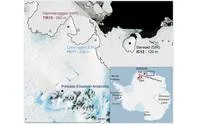
On the coast of Dronning Maud Land, two ice cores stand like two seismographs on one shore. One, FK17, was drilled on the crest of the Lokenryggen ice rise; the other, TIR18, on the crest of Hammaryggen. A hundred kilometers apart, they catch different tremors of the climate. One hears the Pacific, the other the Atlantic and Indian Oceans.
Every year, the same drama unfolds over West Africa: from June to September, the sky fills with moisture and releases rains that determine the harvests of millet, sorghum, and maize. This rainy season is driven by the West African monsoon, a giant atmospheric pump that pulls moist air from the ocean deep into the continent.
Warm air rises from a radiator, and the room seems to heat evenly. But if you put your hand against the wall by the window, it feels cooler than by the door.
Every year in Costa Rica, dengue fever arrives like the rainy season: people expect it, they prepare for it, but the exact rhythm of outbreaks has remained a mystery. In some cantons, the disease flares up every year; in others, every two or three years.
In 1960, a meteorologist at a station in Peru records water temperature, while a farmer in India watches the sky waiting for the monsoon. There is no direct link between these two events, but months later one will echo in the other.
Imagine a house of cards where each card supports the others. One wobbles, and the neighbors start to lean. Earth's climate system works similarly: ice sheets, ocean currents, tropical forests, all are connected. If one element crosses a threshold, it can drag the rest down with it.
The ocean remembers its past. Heat given to the water off the coast of Norway does not vanish without a trace: it embarks on a long journey across the Atlantic, only to return decades later and alter the temperature at those same shores once again.
The thermometer at a weather station in Delhi doesn't know it's part of a giant ear. Every day it records the temperature, and after forty years of such records, you can hear the breathing of an entire subcontinent. The India Meteorological Department divided the country's land into one-degree squares and took readings from 1970 to 2009.
It takes eight years for a wave to circle Antarctica. It carries warmth and cold in turn, and sea ice advances and retreats with its crests. Previously, researchers caught this wave using different methods and saw either a propagating signal or a frozen dipole. Now it's clear: the dipole is just a snapshot of the wave when it stretches between two oceans.
The planet's winds are not free-flowing currents but rather obedient jets that can be nudged from an unexpected direction. The ocean surface, covered with waves, acts like a tuning knob: change its roughness, and giant air rivers shift by hundreds of kilometers.
Twice a day, at eleven in the morning and eleven at night, a white balloon with an instrument rises into the sky from a tiny station in San Pietro Capofiume, just eleven meters above sea level. Over twenty-two years, more than sixteen thousand such launches have recorded how air temperature changes with altitude: from the warm ground to the thin cold at twenty kilometers.
A rock chronicle where each layer is a page, and spectral analysis reads the rhythm of the lines. In the Realmonte salt mine in Sicily, geologists measured the thickness of 120 three-part cycles: a millimeter-scale clay parting, a thin anhydrite or polyhalite layer, and then a decimeter-scale halite bed.