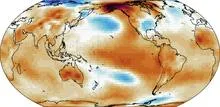
Decadal variability refers to climatefluctuations that unfold over periods of roughly ten to thirty years — longer than individual weather events but shorter than full ice-age cycles. These swings are not random noise; they often show coherent patterns across entire ocean basins, such as the Pacific Decadal Oscillation or the Atlantic Multidecadal Oscillation. Decadal variability matters because it can mask or amplify the slower trend of human-caused global warming, making it harder to detect climate change in any given decade.
History
The concept emerged in the late 20th century as long instrumental records and paleoclimate proxies revealed multi-decadal swings. The Pacific Decadal Oscillation was formally identified in 1996 by Steven Hare, while the Atlantic Multidecadal Oscillation was described by Michael Schlesinger and Navin Ramankutty in 1994.
How it works
The ocean's enormous heat capacity acts as a flywheel: slow currents and deep-water circulation can store and release heat over decades. For example, in the Pacific, a pattern of warm and cool sea-surface temperature anomalies can persist for 20–30 years, shifting storm tracks and rainfall over North America and Asia. These oscillations arise from coupled interactions between ocean currents, wind patterns, and heat exchange, but they are not periodic like a clock — they are irregular, with varying duration and intensity.
In practice
Water resource managers and fisheries scientists use decadal climate indices to plan infrastructure investments and set fishing quotas, since these oscillations can shift rainfall patterns and ocean productivity for years at a time.
Fun fact
The Atlantic Multidecadal Oscillation is thought to influence the frequency of severe hurricanes along the U.S. East Coast, with active eras lasting 20–40 years followed by quieter ones.
The world's most precise stopwatch still runs with one eye on an old pendulum. Hydrogen masers — the best radio-frequency flywheels (devices that keep the rhythm between comparisons with a reference)—accumulate error because noise between ticks leaks into the final signal.
A choir where every singer hits the notes precisely sounds louder than you'd expect from a simple sum of voices. A hundred singers aren't just a hundred times louder than one: they're ten thousand times louder. In the world of atoms, something similar happens. In collective behavior discovered by Robert H.
At the dawn of time, the universe experienced a brief moment of frantic expansion — inflation. Tiny quantum jitters of spacetime stretched to cosmic scales. These jitters, primordial fluctuations, became the seeds from which galaxies and stars later grew.
A translator in a conference hall tries to convey the speaker's words, but the hall is noisy: someone coughs, chairs creak, and the street outside is loud. If the speaker lowers their voice, the translator still keeps translating, but their voice drowns in the noise.
In 1991, Mount Pinatubo erupted with such force that it blanketed the planet in a thin veil of ash and gases for years. That veil, like a blanket on a hot night, trapped heat and cooled the ocean surface, causing tropical sea surface temperatures to dip. This event marks the start of a detective story about why some oceans are spawning ever more ferocious hurricanes while others remain calm.
A tuning fork produces a pure tone, but if you strike it too hard, it starts to rattle, and a musician might mistake that rattle for complexity in the sound.
Drylands are like skin cracking from dehydration. When rainfall decreases, plants don't vanish overnight: they rearrange, leaving bare patches of soil between them. These patterns are visible even from space.
Scientists compared satellite images of eight arid regions, from the Sahel in Africa to Australian deserts.
For 800,000 years, ice ages have occurred every 100,000 years. The rhythm matches the elongation of Earth's orbit. But the orbit changes the flow of solar heat so subtly — as if the conductor barely moved the baton, yet the orchestra thundered. It remained a mystery how this weak signal controls the ice sheets.
The Sun pulses in a slow rhythm, and that rhythm can be heard in the rains over Brazil. Sunspots on the solar disk thicken and thin roughly every eleven years, and along with them, pressure in the Pacific Ocean shifts, sea surface temperatures change, and then rainfall amounts in the northeast of the country follow suit.
Ring-shaped reefs, atolls, are usually explained like this: corals grow along the edge of a volcanic island while the island slowly sinks. What's left is a hollow ring that can stretch for kilometers. But satellite images show similar rings around very small reefs where there are no volcanoes and no subsidence.
Imagine a radiator in a room: it heats up, but if its surface is clogged with dust, heat escapes less efficiently. Something similar is happening to our planet. Earth receives energy from the Sun and must radiate the excess back into space, otherwise temperatures rise. Scientists call this ability to shed excess heat radiative feedback.
Ahead of the bow shock that Earth creates in the solar wind, giant bubbles of rarefied gas sometimes appear. Inside them, particle density drops by factors, and electric fields start to tremble like a plucked string.
The Sun is not a calm sphere but a boiling cauldron that follows its own rhythms. Roughly every 11 years, its activity peaks: more dark spots appear on its surface, and streams of charged particles fly into space. But hidden within this grand cycle is a shorter one — about 1.7 years.
For a long time, the climate of ancient Mars remained a mystery: the beds of dried-up rivers spoke of water, but models couldn't explain how it got there — after all, 4 billion years ago the Sun shone 30% dimmer. New research shows that the planet swayed, as if on a swing, between long glaciations and short wet epochs.
The Sun is slowly brightening, and in hundreds of millions of years its heat would become lethal for Earth. Fortunately, the built-in planetary thermostat — the carbon cycle — when overheating triggers rocks to absorb carbon dioxide faster, cooling the climate.
In 1992, Hurricane Andrew tore through Florida, leaving insurers with $$15.5 billion in losses. Many companies went bankrupt, and the market devised a way to shift disaster risk onto investors: catastrophe bonds. These securities pay generous coupons as long as a specified disaster does not occur, such as a hurricane of a certain strength or an earthquake in a particular region.
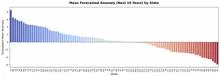
The climate of the United States is not a straight line creeping upward. It is an orchestra without a conductor, where every violin and every drum plays its own part, and together they create an intricate pattern of warm and cold, wet and dry years.
A quantum system, once born, does not forget it. Even after dozens of lifetimes, a trace of the initial state remains in its decay: a slowly decreasing power-law tail. For two fluorescent dyes, erythrosine B and eosin Y, this tail has been observed for the first time in two spectral channels simultaneously.
The ocean hums like a crowded hall: in one corner, voices argue about decades; in another, about years; in a third, about the changing seasons. To pick apart these voices, climatologists used to rely on filters they tuned themselves, letting through only slow waves or only fast ones. But the Pacific plays by its own rules: a warm patch off the coast of Peru can be a brief spike or part of a long-term rearrangement.
Water remembers. Every current, every eddy, every degree of temperature in the ocean's depths does not vanish without a trace; it leaves a mark that can be read. But until recently, that mark was read only by bulky physical models that spent weeks on supercomputers and still got the details wrong.
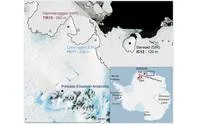
On the coast of Dronning Maud Land, two ice cores stand like two seismographs on one shore. One, FK17, was drilled on the crest of the Lokenryggen ice rise; the other, TIR18, on the crest of Hammaryggen. A hundred kilometers apart, they catch different tremors of the climate. One hears the Pacific, the other the Atlantic and Indian Oceans.
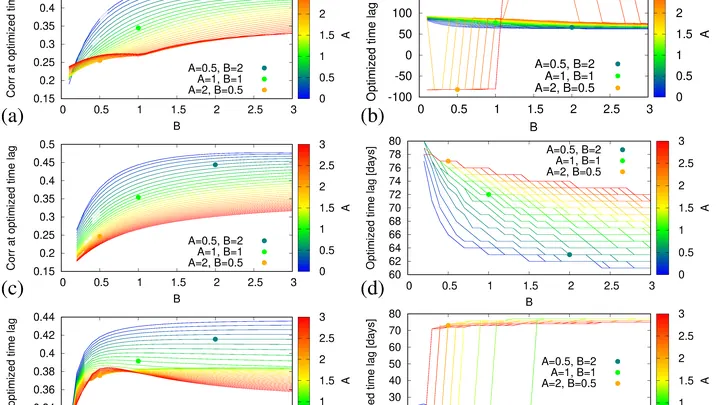
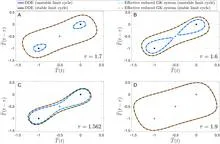
The Pacific Ocean remembers. Water warmed off the coast of Peru drifts slowly westward, and six months later its heat returns to South America. Scientists call this six-month journey the delay. It turns a simple climate model into a maze where the route depends not only on your current position but also on where you were half a year ago.
Warm air rises from a radiator, and the room seems to heat evenly. But if you put your hand against the wall by the window, it feels cooler than by the door.
Every year in Costa Rica, dengue fever arrives like the rainy season: people expect it, they prepare for it, but the exact rhythm of outbreaks has remained a mystery. In some cantons, the disease flares up every year; in others, every two or three years.
In 1960, a meteorologist at a station in Peru records water temperature, while a farmer in India watches the sky waiting for the monsoon. There is no direct link between these two events, but months later one will echo in the other.
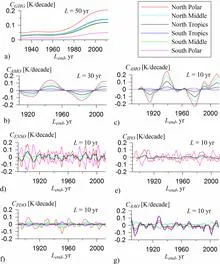
A baker puts a layered cake in the oven: the dough is the same, the heat is the same, but each layer bakes differently. The thin crust on top is already browning, while the middle is still underdone. Earth's climate is similar: the planet is warming, but different parts of it are warming at different rates and at different times.
The ocean remembers its past. Heat given to the water off the coast of Norway does not vanish without a trace: it embarks on a long journey across the Atlantic, only to return decades later and alter the temperature at those same shores once again.
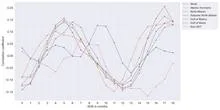
The thermometer at a weather station in Delhi doesn't know it's part of a giant ear. Every day it records the temperature, and after forty years of such records, you can hear the breathing of an entire subcontinent. The India Meteorological Department divided the country's land into one-degree squares and took readings from 1970 to 2009.
Over the tropical Pacific, air pressure breathes with periods from two to fourteen years. The barometer on Tahiti rises while it falls in Darwin, Australia, and the entire planet's climate shudders: El Niño arrives. Meteorologists call this the Southern Oscillation and have tracked it for 138 years, but until now they couldn't answer a simple question: where do such periods come from?
In 1972, anchovies vanished off the coast of Peru. Fishermen were left empty-handed, and the world learned the word El Niño. Since then, scientists have been searching for ways to predict when that warm current will once again upend the planet's weather.
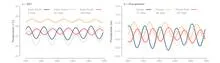
An orchestra without a conductor: the instruments set their own rhythm. That is how one might describe the climate system of the Indo-Pacific region, where sea surface temperatures oscillate across many time scales, from seasonal to multi-decadal. Previously, to hear a single instrument, you had to pre-tune filters, cutting off everything else.
Twice a day, at eleven in the morning and eleven at night, a white balloon with an instrument rises into the sky from a tiny station in San Pietro Capofiume, just eleven meters above sea level. Over twenty-two years, more than sixteen thousand such launches have recorded how air temperature changes with altitude: from the warm ground to the thin cold at twenty kilometers.
A kitchen thermometer doesn't creep upward gradually when you turn on the stove: first it stays put for a while, then suddenly jumps a few degrees. According to researchers' calculations, global temperature behaved much the same way from 1950 to 2013.
Ocean temperatures did not rise like water filling a bathtub; they rose like a person climbing stairs: two broad steps upward, with waves of natural variability lapping around them, advancing and retreating. The first step occurred in 1925/26, the second in 1987/88.
A rock chronicle where each layer is a page, and spectral analysis reads the rhythm of the lines. In the Realmonte salt mine in Sicily, geologists measured the thickness of 120 three-part cycles: a millimeter-scale clay parting, a thin anhydrite or polyhalite layer, and then a decimeter-scale halite bed.
A forest fire has no "typical" size: a small grass burn and a firestorm covering thousands of hectares are part of the same phenomenon. The same goes for tropical cyclones: the energy they release over their lifetime does not cluster around some average value. Instead, it follows a power law, and this rule holds across all of Earth's oceans.