quantity

humidity

The amount of moisture in the air, an environmental factor in experiments.
12 related articles

Description

Humidity, the concentration of water vapor in air, is a fundamental environmental parameter that influences everything from weather patterns to the performance of scientific instruments. In experimental physics, humidity can affect measurements by altering air density, causing condensation on optical surfaces, or introducing spurious electrical signals. It is also a critical variable in atmospheric physics, where it drives cloud formation and precipitation.

History

The concept of humidity has been understood qualitatively for centuries, but quantitative measurement began with the invention of the hygrometer by Horace Bénédict de Saussure in 1783, using a hair that lengthens with moisture.

How it works

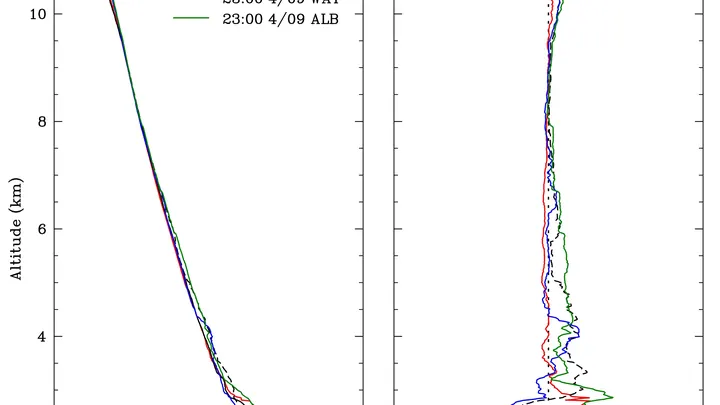
Humidity is typically measured as relative humidity, the ratio of the current water vapor pressure to the saturation vapor pressure at a given temperature. In experiments, it is controlled using desiccants, humidifiers, or climate-controlled enclosures. In atmospheric studies, humidity profiles are obtained from radiosondes, satellites, or ground-based remote sensing, and they feed into models of weather and climate.

In practice

Humidity control is essential in semiconductor fabrication, precision optics, and museum conservation, while humidity data are crucial for weather forecasting and climate modeling.

Fun fact

A cubic meter of air at 30°C can hold up to 30 grams of water vapor, but at 0°C it can hold less than 5 grams, which is why cold air feels so dry.

Related articles · 12

Light Flows Without Friction: Three Ways to Measure the Limit
In a Paris laboratory, light was made to flow around an obstacle the way water flows around a rock in a stream. But this water is special: it feels no friction.
Aircraft Reveal Atmospheric Humidity
Every second, thousands of passenger aircraft in the sky transmit radio signals: that's how air traffic controllers track where each flight is. These signals don't travel in a straight line: air of varying humidity bends them like a lens. If you can measure that bending, you can work out where the air is drier and where it's more humid.
HEP Theory2026-07-241 minarXiv:2607.22914express
The Whisper of Gravity: Why the Quantum World Doesn't Fade Away
At the dawn of time, the universe experienced a brief moment of frantic expansion — inflation. Tiny quantum jitters of spacetime stretched to cosmic scales. These jitters, primordial fluctuations, became the seeds from which galaxies and stars later grew.
Mesoscale2026-04-091 minarXiv:2604.07946express
Water in Nanopores: Layer by Layer or All at Once
In a narrow gap between two plates, water from humid air collects on its own: this is capillary condensation. If the gap is only a few nanometers wide, water no longer behaves like a continuous liquid: every molecule counts.
Chemical Physics2026-04-031 minarXiv:2604.03464express
How Water Dances with Carbon Rings
A water molecule, finding itself near a carbon ring, starts to vibrate, and immediately falls under the sway of an invisible conductor. The ring's electron cloud, like a maestro, dampens some vibrations while amplifying others.
Chemical Physics2026-03-291 minarXiv:2603.27767express
Why Water Gets Heavier at 4 Degrees
Water is the only common liquid that doesn't immediately contract when cooled. Ice melts, and water becomes denser, but only up to 4 degrees Celsius. Beyond that, with further cooling, it expands again. This quirk explains why fish survive in freezing ponds: the densest water sinks to the bottom, while a lighter cold layer stays on top and turns into ice.
HEP Phenomenology2026-03-212 minarXiv:2603.20770express
How Spin in Fluids Rewrites the Rules of Motion
A drop of ink falls into a glass of water, and ripples spread out from it. Water seems simple, but if you look inside, each molecule isn't just moving forward: it's also spinning like a tiny top. Physicists call this intrinsic rotation spin. Usually, it goes unnoticed: in calm water, the tops spin every which way, and their rotation doesn't affect the fluid's overall motion.
Machine Learning2026-02-261 minarXiv:2602.23146express
Weather in Every Backyard
The weather on the next street can differ from yours: cooler by the river, hotter over asphalt, windier between buildings. A regular forecast misses this: its grid cell is the size of a city, not a backyard.
Turbulence doesn't always grow raindrops
In a cloud, billions of droplets swirl around, collide, and merge: that's how rain is born. But exactly how turbulence, those invisible air swirls, helps or hinders droplet growth has been unclear. In the lab, researchers recreated a slice of a cloud and tracked every droplet.
Muons as a Thermometer for Cyclones
For 36 days, tropical cyclone Freddy raged over the Indian Ocean, the longest-lived cyclone on record. Meteorologists tracked it from satellites, aircraft, and ground stations. But one detail eluded all instruments: the precise air density deep within the vortex. And that density determines where the cyclone will turn tomorrow.
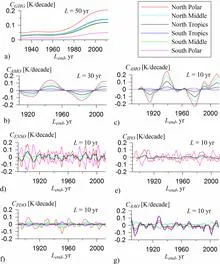
Climate as a Layered Cake: How Much Heat Comes from Humans and How Much from the Ocean
Warm air rises from a radiator, and the room seems to heat evenly. But if you put your hand against the wall by the window, it feels cooler than by the door.
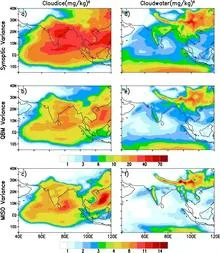
The Monsoon's Icy Pulse: How Cloud Ice Predicts Rain
Every summer, a giant atmospheric engine unfolds over India: moist ocean winds bring the rains that sustain crops and the lives of two billion people. But this engine sputters, and forecasting it a season ahead remains elusive. Models give only rough answers, and a monsoon forecast error can cost millions of tons of food.