How to Weaken El Niño with Clouds ✛
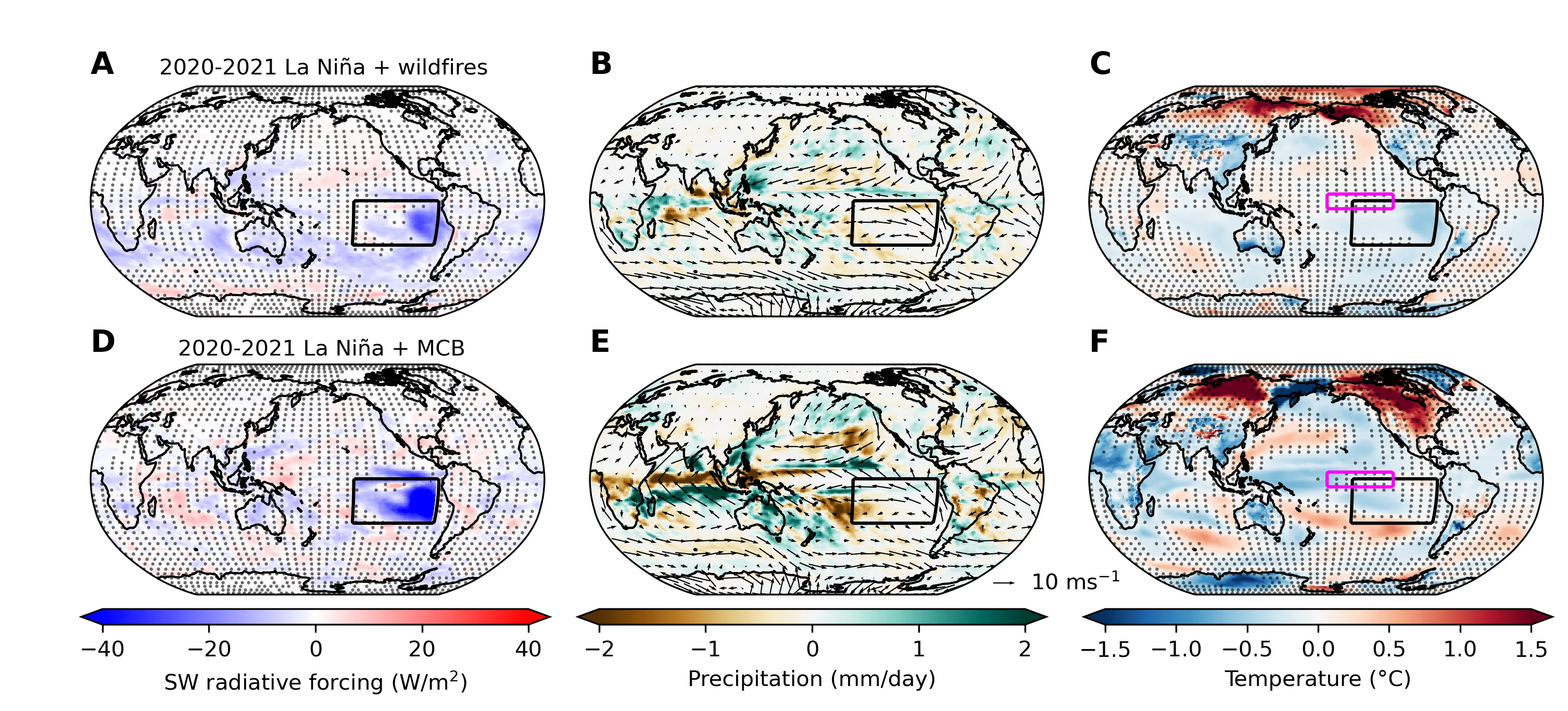
The Pacific Ocean off the coast of South America sometimes heats up dramatically, and then some countries get droughts while others get floods. This phenomenon is called El Niño. Scientists have come up with a way to weaken it: spray tiny droplets of saltwater over the ocean. This makes clouds thicker and more reflective, like a white sheet thrown over something hot. In a computer model, such cooling lowered the water temperature in the right spot by 1.5 degrees, and the weather almost returned to normal.
But there is an important condition: you need to start early, as soon as the first signs of El Niño appear, and keep going for several months. If you wait too long and only start spraying at the end, the effect is five times weaker. The reason is that warm water heats itself: it weakens the wind, and weak wind doesn't mix the ocean, so the water gets even warmer. Early cooling prevents this cycle from closing.
For now, this is only computer modeling. To actually spray salt, you would need thousands of ships, and we need to check that it wouldn't harm other parts of the planet. But at least we now know that the ocean's fever can be fought not just with forecasts but with action.
Achieving the target droplet concentration would require about 2000 cargo ships spraying sea salt, roughly 2% of the world's merchant fleet.
The idea of managing climate in a targeted way evokes Kim Stanley Robinson's novel 'The Ministry for the Future', where geoengineering is used to mitigate climate disasters, though there the focus is on cooling the planet rather than weakening a single El Niño.