Cloud Brightening Against El Niño ✛
When the Pacific off the coast of Peru heats up, the planet's familiar weather map goes haywire: droughts in some places, floods in others. That's El Niño, and it costs the global economy trillions of dollars. Scientists have long been able to predict it, but now, for the first time, they are testing whether it can be weakened while it's still developing. The idea is like putting a cold compress on a feverish forehead: not treating the whole planet, but applying coolness to the hottest spot.
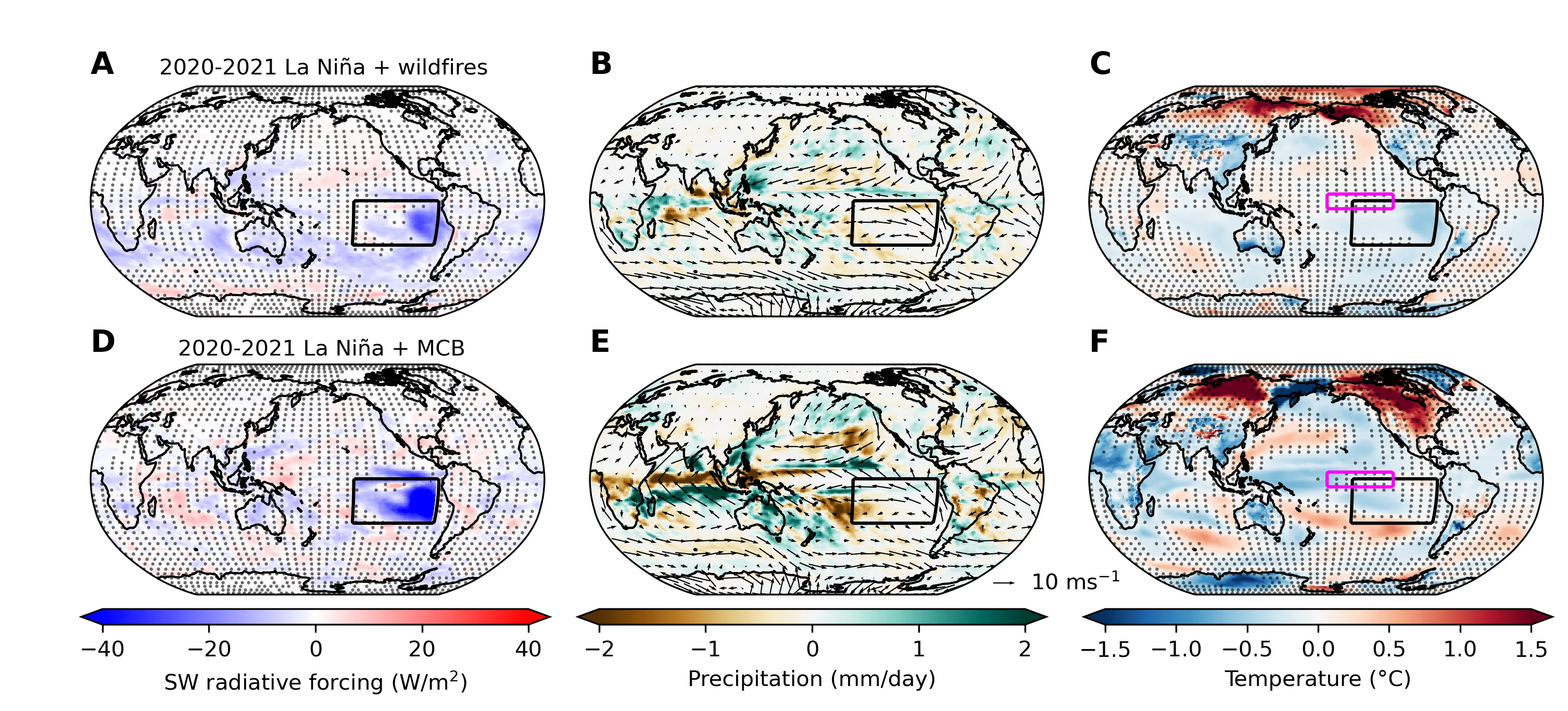
The compress in this case is marine cloud brightening. Over the southeastern tropical Pacific, tiny droplets of sea salt are sprayed to make clouds denser and reflect more sunlight back into space. In the model, this technique lowered surface temperatures in the intervention zone by 1.18 °C, and in the key El Niño region Niño3.4 by 1.48 °C. That was enough to return nearly to neutral conditions by the peak of the event. But not just any cooling worked; it had to start early and continue until the end. If spraying began only in December, the effect dropped to 0.31 °C.
A natural experiment provided a reality check. In late 2019 and early 2020, smoke from the Australian wildfires lofted huge amounts of particles into the atmosphere, which similarly reflected sunlight over the southeastern tropical Pacific. The model reproduced a cooling similar to what was observed then. So the mechanism is not made up; it has already occurred in reality.
The work shifts the perspective on solar geoengineering. Previously, it was discussed as a way to slow global warming over decades. Now it turns out the same tool could be aimed at a seasonal phenomenon and possibly mitigate the damage from a specific El Niño. However, practical application is far off: the results need to be tested with other models, the impact on subsequent La Niña events assessed, and the potential side effects in regions untouched by the compress understood. But the first step is taken: it seems the ocean's fever can be brought down in a targeted way.
Achieving the target droplet concentration would require about 2000 cargo ships spraying sea salt, roughly 2% of the world's merchant fleet.
The idea of managing climate in a targeted way evokes Kim Stanley Robinson's novel 'The Ministry for the Future', where geoengineering is used to mitigate climate disasters, though there the focus is on cooling the planet rather than weakening a single El Niño.