Cloud Brightening Against El Niño ✛
Context
This work stands apart from its neighbors: around it in the archive lie studies on El Niño prediction, space weather, climate modeling, and solar flares, but none consider actively intervening in the El Niño mechanism itself. The closest thematic group relates to large-scale atmospheric structure and machine learning, yet the approach here is different: not prediction but targeted modification. El Niño is the main source of interannual climate variability, amplifies the effects of global warming, and causes economic damage on the order of trillions of dollars. Solar geoengineering was originally conceived to combat long-term warming, but it can be redirected toward seasonal phenomena.
Methods
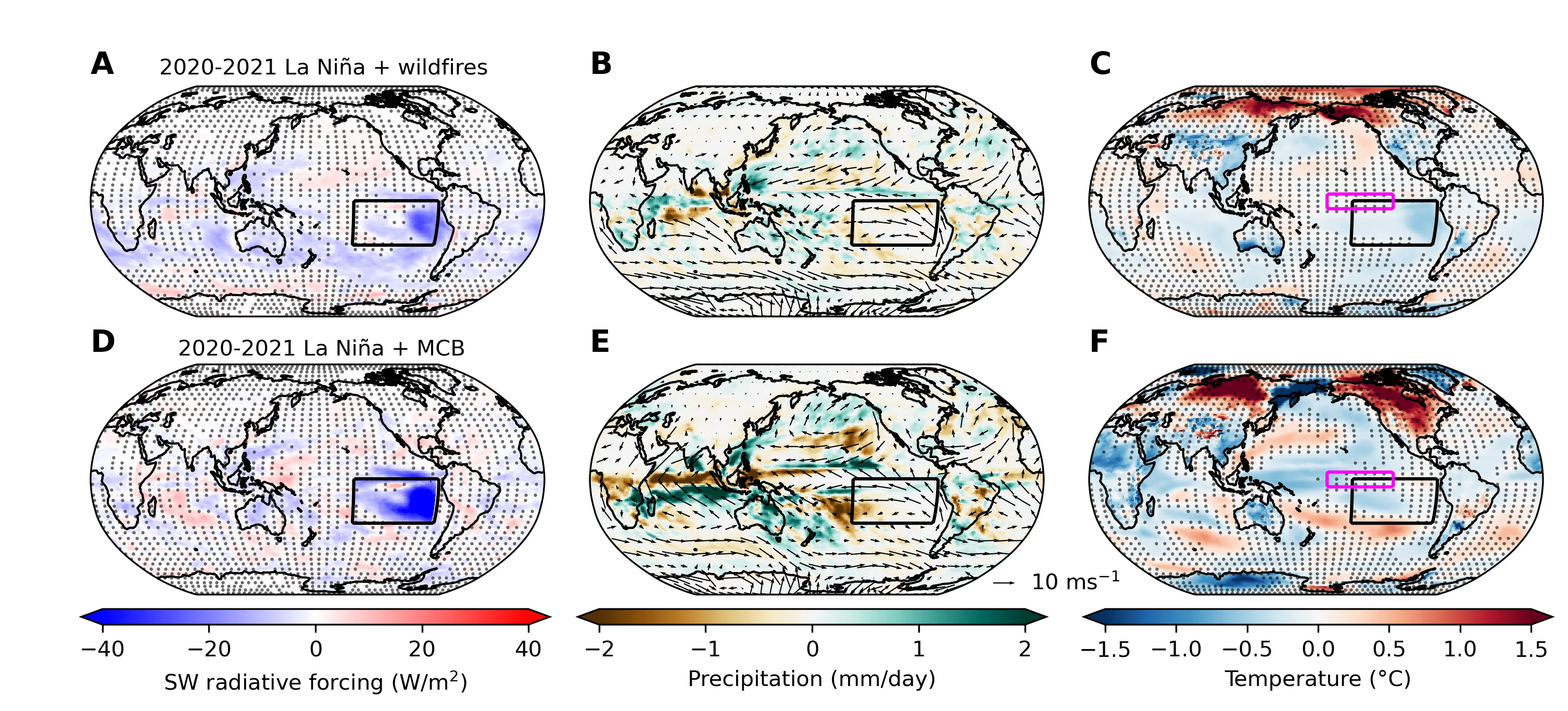
The authors used the Seasonal-to-Multiyear Large Ensemble (SMYLE) based on the CESM2 model, a seasonal forecasting system with a ten-member ensemble. Marine cloud brightening was simulated by increasing cloud droplet concentrations to 500 particles per cubic centimeter over the southeastern tropical Pacific (30°S to the equator, 150°W to 85°W), an area covering about 5% of Earth's surface. Six strategies were modeled with different start times and durations, from June to February. To validate the natural analog, the response to brightening was compared with the response to aerosols from the 2019–2020 Australian wildfires.
Results
The earliest and longest strategy (June–February) reduced surface temperature by 1.18 °C in the intervention region and by 1.48 °C in the Niño3.4 region, nearly returning to neutral conditions by the peak of El Niño. Later and shorter intervention (December–February) yielded only a 0.31 °C reduction. The effect is not simply radiative cooling: early intervention disrupts the Bjerknes feedback loops, strengthening the Walker circulation and increasing the thermocline tilt. The model reproduced cooling similar to that observed after the Australian wildfires, confirming the mechanism's realism. Regional responses generally weaken with early intervention, although statistical significance is limited due to internal variability.
Implications
Unlike neighboring studies that predict El Niño or examine its link to warming, this work shows for the first time the possibility of deliberately weakening an ongoing event through regional intervention. The study shifts the focus of solar geoengineering from long-term warming to managing variability, which could be cheaper and faster. Using a seasonally initialized model enhances credibility compared with previous marine cloud brightening studies.
Future development
This line of research could expand to testing on a broader set of El Niño events, including future climate change scenarios. It is important to examine the long-term consequences of short-term interventions: whether the frequency and amplitude of subsequent La Niña events will change, or whether multi-year La Niñas might emerge. Also needed is an assessment of the impact on the background climate state and possible side effects for regions not directly affected.
Impact
The results could influence research on solar geoengineering, seasonal forecasting, and the economics of climate risk. They also touch on discussions about the governance of deliberate climate interventions.
Next steps
Conduct ensemble experiments with other Earth system models to test robustness. Assess the costs and technical feasibility of deploying a fleet of sprayers in the target region.
Key open problems
The work directly addresses the unresolved problem of El Niño predictability: the spring predictability barrier limits the time available for intervention, and the authors propose acting soon after it is crossed. Questions remain about side effects and ethical aspects of deliberately altering climate variability.
The knowledge machine's view
This section is addressed to the author of the paper and their colleagues. Neighbouring works were found by meaning-based search across our archive, not by word overlap. We do not review: we show the field around the work.
What the work does
The authors explored the possibility of weakening El Niño through marine cloud brightening, using the SMYLE/CESM2 ensemble seasonal model. They simulated aerosol spraying in the southeastern tropical Pacific with various start dates and durations, showing that early and prolonged intervention (June through February) substantially reduces temperatures in the Niño3.4 region and restores neutral conditions. The cooling observed after the 2019–2020 Australian wildfires served as a natural analog.
Where its strength is
A key strength of the work is demonstrating that regional forcing can disrupt the Bjerknes feedback loops, rather than merely causing local cooling. The use of an initialized seasonal model lends more credibility to the results compared with previous studies.
Where it could go next
- It might be interesting to compare your results with long-lead El Niño forecasting methods: if an event is predicted a year and a half in advance, a window opens for planning intervention with an optimal start time.based on: El Niño Can Be Predicted a Year and a Half in Advance arXiv:2601.12251
- A related study on seasonal variations in space weather lies nearby; perhaps the analogy with seasonal variability could suggest how to account for natural fluctuations when assessing the statistical significance of the response.based on: Space Weather by the Seasons arXiv:2605.27057
Worth trying
- Test whether the effect holds in other Earth system models, such as E3SM.
- Assess sensitivity to spraying parameters: droplet size, intensity, and area of application.
- Investigate combined strategies: marine cloud brightening together with other geoengineering methods to reduce side effects.
Why this may matter
If targeted weakening of El Niño proves feasible, it could reduce the damage from extreme weather events, which is estimated in the trillions of dollars, and open the door to managing climate variability in addition to mitigating long-term warming.
Nearby works in our archive
- Enceladus's Ocean — A Perfect Heat Pumpsimilarity 0.50
- Solar Cycles: How Magnetic Swings Sway the Futuresimilarity 0.49
- Space Weather by the Seasonssimilarity 0.47
- Dark Matter Ignites a Gamma Glow Around the Sunsimilarity 0.47
- Solar flare lights up heliumsimilarity 0.47
- Saturn's Thunderstorms Reveal Invisible Particlessimilarity 0.46
- El Niño Can Be Predicted a Year and a Half in Advancesimilarity 0.46
The archive is sparse around this work: the closest review is only 0.50, against a usual 0.64. It looks like few have drilled nearby.
Achieving the target droplet concentration would require about 2000 cargo ships spraying sea salt, roughly 2% of the world's merchant fleet.
The idea of managing climate in a targeted way evokes Kim Stanley Robinson's novel 'The Ministry for the Future', where geoengineering is used to mitigate climate disasters, though there the focus is on cooling the planet rather than weakening a single El Niño.
Key numbers
- temperature reduction in the intervention region: 1.18 °C
- temperature reduction in the Niño3.4 region: 1.48 °C
- droplet concentration: 500 cm⁻³
- intervention area: 5% of Earth's surface
- cost estimate: billions of dollars versus trillions in damages