The Bjerknes feedback is a self-reinforcing loop in the equatorial Pacific Ocean that amplifies temperature changes, playing a central role in El Niño and La Niña events. It works like this: if the ocean surface warms slightly, the air above it heats up, causing the trade winds — which normally blow from east to west — to weaken. Weaker winds reduce the upwelling of cold water from the deep ocean in the eastern Pacific, so the surface warms even more. That further weakens the winds, and the cycle continues. The loop also operates in reverse: a cooling triggers stronger winds, more upwelling, and further cooling.
History
Named after Norwegian meteorologist Jacob Bjerknes, who proposed the feedback in 1969 to explain the coupling between ocean and atmosphere that drives El Niño.
How it works
The mechanism hinges on the coupling between ocean temperature and atmospheric pressure. Warm water in the western Pacific creates rising air and low pressure, while cooler water in the east creates sinking air and high pressure. This pressure difference drives the trade winds. When the eastern ocean warms, the pressure gradient weakens, winds slacken, and the thermocline — the boundary between warm surface water and cold deep water — flattens. With less tilt, upwelling of cold water diminishes, reinforcing the initial warming. The loop is positive because each step amplifies the previous one, but it is eventually checked by other processes, such as ocean wave dynamics, which lead to the natural oscillation between El Niño and La Niña.
In practice
Understanding this feedback is essential for seasonal climate prediction, as it governs the onset and intensity of El Niño events that affect weather worldwide.
Fun fact
The Bjerknes feedback is so strong that a small temperature anomaly of less than a degree can trigger a global climate shift, altering rainfall patterns from Australia to the Americas.
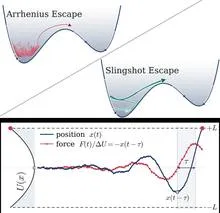
A particle sits in an energy pit like a pea in a dimple. To get out, it needs to go over the barrier, and usually this is rare: the higher the barrier, the longer the wait. The Arrhenius law says the waiting time grows exponentially, meaning doubling the barrier height increases the time by hundreds of times.
Every year, as December approaches, the water off the coast of Peru becomes anomalously warm or anomalously cold. This is El Niño and La Niña, two phases of the same climate pendulum that swings in the equatorial Pacific. The pendulum is not a simple one: it remembers what happened to it several months earlier, and this memory determines which way it will swing next.
For 800,000 years, ice ages have occurred every 100,000 years. The rhythm matches the elongation of Earth's orbit. But the orbit changes the flow of solar heat so subtly — as if the conductor barely moved the baton, yet the orchestra thundered. It remained a mystery how this weak signal controls the ice sheets.
Imagine a radiator in a room: it heats up, but if its surface is clogged with dust, heat escapes less efficiently. Something similar is happening to our planet. Earth receives energy from the Sun and must radiate the excess back into space, otherwise temperatures rise. Scientists call this ability to shed excess heat radiative feedback.
An ice core from Antarctica is a time machine that recorded the climate for 130,000 years straight, year after year, with no gaps. Air bubbles trapped in the ice preserve the carbon dioxide of those ancient eras.
In a blacksmith's forge, a blast of air fans the glowing coals, and shock waves blow bubbles of hot gas. In galaxy centers, a supermassive black hole drives the same process. Its narrow plasma jets, like bellows, punch through the surrounding space and create bubbles visible in X-rays.
The tropical Pacific Ocean heats and cools like a giant battery, and its rhythm affects weather from India to Canada. This rhythm is called El Niño–Southern Oscillation, or ENSO for short. Forecasting it months ahead is like predicting when a pot will boil without knowing the strength of the flame.
The Pacific Ocean is like a giant swing: warm water piles up in the west, then slides toward the east, and the temperature off the coast of South America jumps. Such warm years are called El Niño, and cold ones La Niña. But the swing doesn't move on its own: it's pushed by the wind.
The orchestra assembled, the instruments were tuned, but there was barely any music: that's what the 2025 Atlantic hurricane season looked like. The ocean was the fifth warmest on record, and a weak La Niña usually adds strength to storms. But instead of a continuous concert, we got isolated thunderous chords: three Category 5 hurricanes, with silence in between.
Why was the orchestra silent?
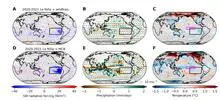
When the Pacific off the coast of Peru heats up, the planet's familiar weather map goes haywire: droughts in some places, floods in others. That's El Niño, and it costs the global economy trillions of dollars. Scientists have long been able to predict it, but now, for the first time, they are testing whether it can be weakened while it's still developing.
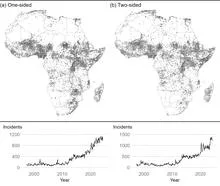
On an African field, maize has just been harvested. The grain sits in sacks, and for armed groups it's a lure: something to take from farmers. But if the harvest fails, the lure disappears, and attacks become fewer. That's exactly what happens when El Niño (the warm current in the Pacific Ocean that alters weather worldwide) brings drought to Africa's farming regions.
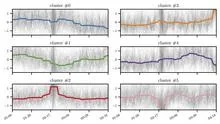
Two orchestras play from the same score, but in different keys. The score is the warm El Niño current, which every few years heats the tropical Pacific. The key is the regime in which the midlatitude atmosphere responds to that heating. One orchestra plays steadily and predictably; the other keeps stumbling, yet its playing carries deep bass notes that the first lacks.
In February 2017, Lima, a city of over ten million people, was hit by El Niño: the warm current off Peru's coast brought torrential rains, floods, and landslides. More than a hundred people died, thousands of homes were destroyed, and roads turned into rivers. The city's economy, like a living organism, fell out of rhythm: shoppers visited stores less often, and their spending patterns shifted almost overnight.
Over the Pacific Ocean, giant seesaws swing back and forth. Warm water pushes against the coasts of South America, and El Niño begins; a few years later, the ocean surface cools, and the seesaw tips the other way, into La Niña. These oscillations last for years and reshape cloud cover, rainfall, and wind across an entire continent.
In the tropical Pacific, the ocean sometimes warms more than usual, sometimes cools. Fishermen off the coast of Peru noticed this centuries ago and named the warm phase El Niño, which means 'little boy,' because it arrived around Christmas. Today, these temperature swings affect weather across the planet: from droughts in Australia to downpours in California.
Every morning in six American cities, from Chicago to Minneapolis, faucets open at the same time coffee makers switch on. Water and electricity flow through pipes and wires like two connected vessels in the city's body. In the past, utilities monitored these flows separately, as if the organism had no common circulatory system.
From 1955 to 1979, the extent of Antarctic sea ice shrank by 23% in winter and 67% in summer, then partially recovered. This is like a spring that was slowly compressed and then released: the climate of the Southern Hemisphere responded with a delay of several decades.
The conductor of an orchestra gradually loses control of the tempo. First, the second violins fall slightly behind, then the cellos speed up, and soon every musician is playing in their own rhythm, even though a minute ago they all followed the same melody.
Two pendulums hang side by side, connected by a spring. Give one a push, and through the spring the other starts to swing. That's how the two regions of the equatorial Pacific are arranged, where sea-surface temperature rises and falls in the rhythm of El Niño.
A warm tongue of water stretches along the equatorial Pacific, and within weeks, Peru sees torrential rains while Australia's pastures dry out. That is how El Niño begins: a natural conductor that, at critical moments, makes only a few orchestra members play, but much louder.
The planet's winds are not free-flowing currents but rather obedient jets that can be nudged from an unexpected direction. The ocean surface, covered with waves, acts like a tuning knob: change its roughness, and giant air rivers shift by hundreds of kilometers.
A translator sits in a hall where people speak an unfamiliar language. They don't understand the words, but they hear how the tone shifts: sometimes calm and steady, sometimes excited and sharp. From intonation alone, they guess what is being discussed.
A swing pushed once per second usually oscillates once per second. But if you push it harder and at the right rhythm, it can swing three times slower: one full swing for every three pushes. Physicists call this subharmonic resonance, and it seems to govern the most prominent climate and solar oscillations.
The Pacific Ocean does not breathe evenly but in bursts. Every few years, its warm waters stir, and then Australia suffocates from drought while Peru is flooded with rain. This phenomenon is called El Niño, and it resembles a traveler wandering along an invisible road map.
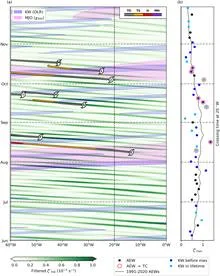
The ocean is like a pendulum with a memory. A push from seasonal winds returns not immediately but months later, when a wave crosses the Pacific. This delay, the authors argue, is what makes El Niño and La Niña repeatedly peak at the same time of year.
A swing builds up when you push it in time. But sometimes the person on the swing responds not to every push but to every third one, and the amplitude grows slowly yet inexorably.
A forest fire has no "typical" size: a small grass burn and a firestorm covering thousands of hectares are part of the same phenomenon. The same goes for tropical cyclones: the energy they release over their lifetime does not cluster around some average value. Instead, it follows a power law, and this rule holds across all of Earth's oceans.
The Paraná River behaves like a seismograph that records not the shaking of the ground but the pulse of the Sun. A century of daily water-level measurements at the gauging station in the city of Corrientes, 900 kilometers from the river's mouth, shows that when the Sun has many sunspots, the river floods more. This connection is neither accidental nor weak.
A hammock woven from thousands of cords is stretched between continents. Each cord is a link between two points on the planet: when it warms in one place, it cools in another, day after day. As long as the hammock holds, it keeps the climate in its familiar rhythm. But every few years El Niño arrives, a warm current off the coast of Peru, and the cords begin to snap.