The dispersion relation is a mathematical relationship that connects a wave's frequency (or energy) to its wavelength (or momentum). It is a fundamental property of any medium, describing how waves of different wavelengths travel at different speeds. This relation determines whether a wave is dispersive (spreading out over time) or non-dispersive (maintaining its shape), and it is crucial for understanding phenomena from ocean waves to quantum particles.
History
The concept emerged in the 19th century with the study of light and water waves. William Rowan Hamilton and others developed the mathematical framework, but it was Lord Rayleigh who systematically applied it to wave propagation in the 1870s. In quantum mechanics, Louis de Broglie and Erwin Schrödinger later used dispersion relations to describe matter waves.
How it works
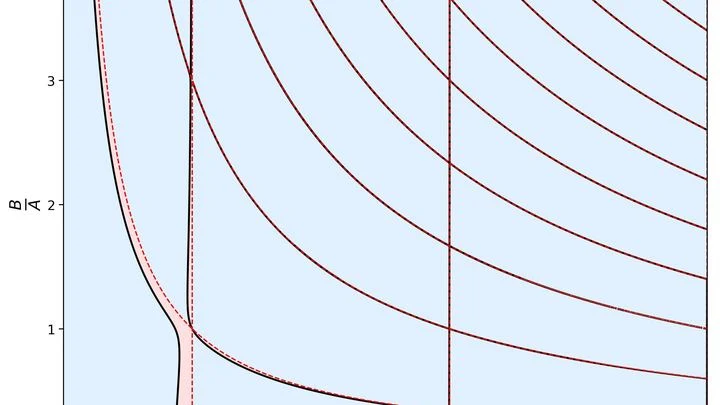
For a wave with angular frequency ω and wave number k, the dispersion relation is often written as ω(k). The phasevelocity (v_p = ω/k) tells how fast a single crest moves, while the group velocity (v_g = dω/dk) tells how fast the overall energy of a wave packet travels. When v_p depends on k, the medium is dispersive, causing different frequency components to separate, as seen when white light passes through a prism.
In practice
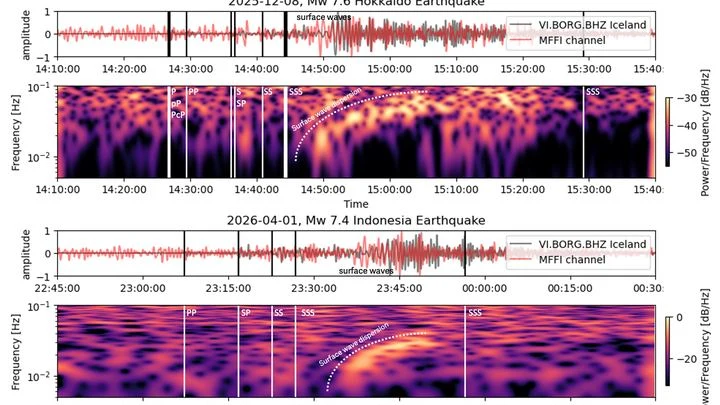
Dispersion relations are used in fiber optics to manage pulse spreading, in seismology to infer Earth's interior structure, and in condensed matter physics to calculate the electronic band structure of materials.
Fun fact
In a vacuum, light has a perfectly linear dispersion relation (ω = ck), meaning all frequencies travel at the same speed, which is why a pulse of light does not spread out in empty space.
A wave packet is like a traveler who either loses steam and spreads out along the way, holds a steady pace, or gathers into a fist. In a 50-meter flume with water 5 meters deep, scientists tracked how a bell-shaped group of waves behaves when its height is changed but not its width.
In 1054, a star flared up in the constellation Taurus. The light of its death was so bright that it was visible in daylight for nearly a month, and Chinese astronomers recorded it in their chronicles. Today, the Crab Nebula is spreading over that spot, and its claws are clouds of gas still being whipped up by the dead star at its center.
If you push water in a narrow channel too fast, a steep wave forms and breaks into foam. In the world of ultracold atoms, cooled to near absolute zero, quantum laws prevent such a wave from breaking. Physicists took a cloud of rubidium atoms stretched into a thin thread and sharply compressed it from one end with a movable wall of light.
A camera looks at two distant sparks. They're so close together that they merge into a single fuzzy blob. It seems impossible to tell them apart — the classic limit of optical microscopy has been reached.
But quantum mechanics hints that the light field still holds a secret about where each spark sits.
In a crystal, heat travels on waves. Atoms vibrate, and these vibrations, called phonons, carry energy from the hot edge to the cold one. For a long time, it was believed that if phonons hit resonance (their frequencies exactly match) and can exchange energy, heat would flow like an avalanche. It turns out that's not the case.
In 2017, detectors picked up a gravitational wave from the collision of two neutron stars. Just 1.7 seconds later, telescopes saw a flash of gamma-ray burst from the same spot. That tiny delay became a treasure for physicists.
The planet-spanning web of undersea internet cables acts like a giant ear. The glass thread inside responds to water movements: currents, tides, and distant earthquakes bend the cable. Light traveling along the thread takes slightly longer: this delay is measured on shore against a reference. That’s how the speed of light reveals itself.
A stone falls into a pond, and ripples spread evenly in all directions. But some media behave as if the wave knows which way to turn, like water that only swirls clockwise. This asymmetry comes from odd viscosity and odd elasticity — properties of media with broken mirror symmetry.
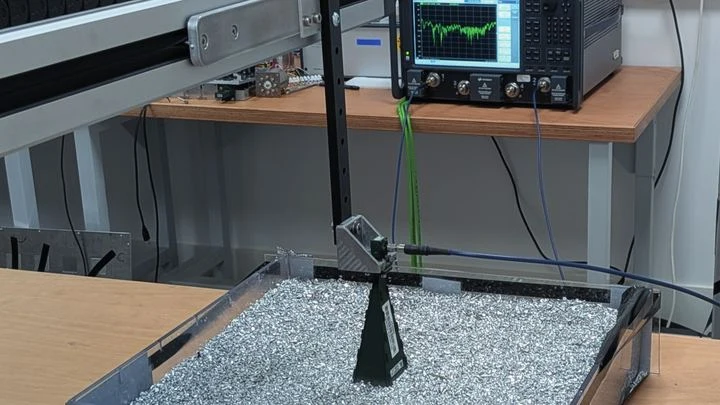
Physicists have achieved three-dimensional Anderson localization of electromagnetic waves — a phenomenon where waves become permanently entangled in a random labyrinth of metal particles and cease to propagate.
Gravitational waves are not vibrations of matter, but tremors of spacetime itself, predicted by Albert Einstein. They travel at the speed of light and pass through objects, stretching and squeezing them.
Water flowing through a pipe can become a trap for sound. If the flow speed exceeds the speed of sound in water, then sound waves trying to go against the current can no longer escape: they are swept away, like light beyond a black hole's horizon.
In ordinary water, ripples from a thrown stone spread in even concentric circles. But imagine a liquid whose molecules are like tiny screws with a right-handed thread. In such a medium, the surface acts like a one-way street: waves can only travel in a certain direction.
A cell is a city with gates. Each gate is a protein channel in the membrane: through it, ions, sugars, and signaling molecules pass in and out. Some gates are almost always open, while others open and close randomly, like subway doors that let a passenger through one moment and slam shut in their face the next.
The diffusion equation, a mathematical tool describing how particles spread out in space, has long painted a paradoxical picture: a disturbance, like ripples on Water, instantly engulfs the entire universe. This challenged the theory of relativity, which holds that nothing can move faster than light.
When water churns behind a boat, the energy of motion is converted into heat through a cascade of vortices. Measuring how quickly this happens directly is difficult: you'd need to track all the vortices at once. So scientists use a simplification: they look at only one velocity component at a single point.
A stone drops into a pond — ripples spread across the water. Do short waves outrun long ones? No, in deep water it's the opposite: long waves overtake short ones. In metal, sound of one pitch travels at one speed, another pitch at another.